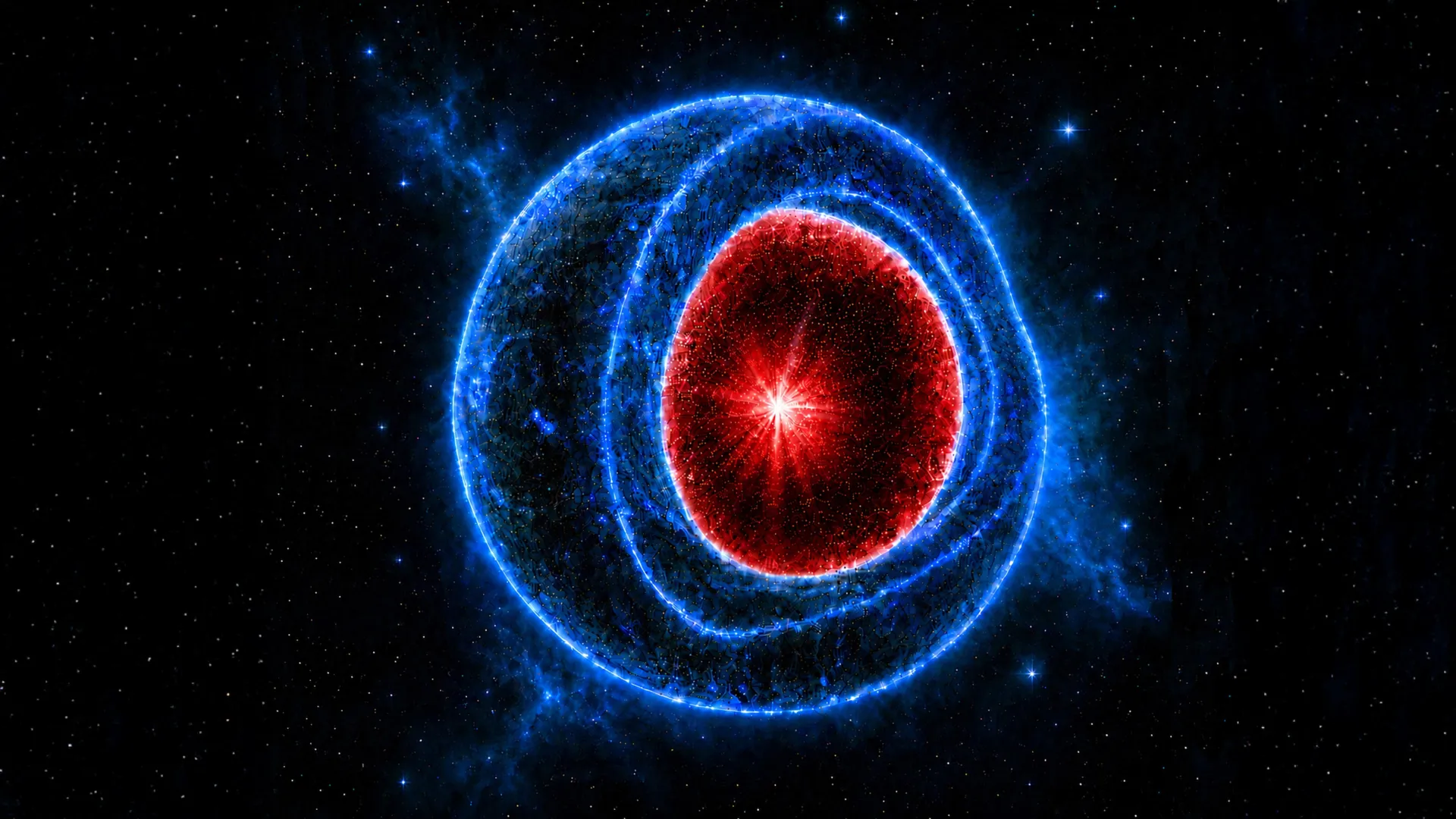
The life cycle of the most massive stars in the cosmos concludes with a dramatic and violent transition that has long stood as one of the most significant challenges to modern physics. For decades, the scientific consensus has held that when a star with several times the mass of our Sun exhausts its nuclear fuel, it undergoes a gravitational collapse so profound that it creates a black hole—a region of spacetime where gravity is so intense that nothing, not even light, can escape. However, the mathematical implications of black holes, specifically the existence of a singularity where density becomes infinite and the laws of physics break down, have remained a source of theoretical discomfort. A new study by theoretical physicists Daniel Jampolski and Professor Luciano Rezzolla of Goethe University Frankfurt proposes a groundbreaking alternative: the collapse of a massive star may not result in a singularity, but rather in the birth of a "mini universe" that creates a stable, ultra-compact object known as a gravastar.
The Mathematical Crisis of the Singularity
To understand the significance of the gravastar model, one must first examine the inherent contradictions within the standard black hole theory. According to Albert Einstein’s General Theory of Relativity, a sufficiently compact mass can deform spacetime to such a degree that it forms a black hole. At the center of this structure lies the singularity—a point of zero volume and infinite density.
While the mathematics of General Relativity predicts singularities, many physicists view them as a signal that the theory is incomplete. In nature, "infinity" rarely exists in a physical sense; its appearance in a formula usually suggests that the underlying physical laws are being pushed beyond their limits. Furthermore, black holes present the "information paradox," a conflict with quantum mechanics which suggests that information cannot be destroyed. If matter falls into a black hole and is crushed into a singularity, the information associated with that matter appears to vanish from the observable universe, violating the fundamental principles of quantum physics.
The event horizon—the boundary of a black hole—further complicates the issue. It acts as a one-way veil, preventing any observation of the interior. Consequently, the internal structure of these massive objects remains a matter of theoretical conjecture, allowing for alternative models that might resolve the paradoxes of infinite density and information loss.
The Emergence of the Gravastar Concept
In 2001, physicists Pawel Mazur and Emil Mottola proposed an alternative to the black hole model, which they dubbed the "gravastar"—a portmanteau of Gravitational Vacuum Star. Unlike a black hole, a gravastar does not possess a singularity or an event horizon. Instead, it is envisioned as a spherical object consisting of a thin shell of extremely dense matter.
The interior of a gravastar is not empty, nor is it filled with ordinary matter. Instead, it is theorized to contain "vacuum energy" or dark energy. In the context of cosmology, dark energy is the mysterious force responsible for the accelerated expansion of the universe. In a gravastar, this dark energy exerts a powerful outward pressure (negative pressure) that counteracts the inward pull of gravity. This balance prevents the star from collapsing into a single point, maintaining a stable, finite radius.
Until recently, however, the gravastar remained a purely static concept. While researchers could describe what a gravastar might look like, they lacked a "dynamic solution"—a mathematical description of how a star actually transforms from a cloud of gas and plasma into a gravastar through the process of gravitational collapse.
A Dynamic Solution: The Mini Universe Model
The research conducted by Daniel Jampolski and Luciano Rezzolla, recently published in the journal Physical Review D, provides the first formal dynamic solution to Einstein’s field equations that explains this transition. Their model suggests that as a massive star collapses, it reaches a threshold of density where the known laws of matter change.
According to their findings, at the final stages of a star’s collapse, a "Big Bang" event occurs within the interior of the falling matter. This is not the Big Bang that created our entire cosmos, but a localized, miniature version. This internal expansion is driven by the sudden emergence of dark energy. As the interior of the star begins to expand like a new universe, it pushes against the outer layers of the star that are still falling inward due to gravity.
"The Big Bang of the emerging universe can unfold once the star has already collapsed almost to the point of becoming a black hole," explains Daniel Jampolski. This creates a state of hydrostatic equilibrium where the expansion of the "mini universe" perfectly balances the gravitational collapse of the stellar shell. The result is a gravastar: a stable, ultra-compact object that mimics the gravitational signature of a black hole from the outside but possesses a radically different internal structure.
The Structure of Nested Gravastars
One of the more exotic implications of the Jampolski-Rezzolla model is the possibility of "nested" gravastars. In their mathematical solution, the researchers found that the process of a mini-Big Bang could potentially occur multiple times during a single collapse.
This would result in a series of shells within shells, much like a Russian Matryoshka doll. Each shell would represent a boundary between different stages of expansion and contraction. While this "nestar" (nested gravastar) concept sounds like science fiction, it emerges naturally from the equations of General Relativity when dark energy is introduced as a factor in gravitational collapse. This structure would further distribute the mass of the object, ensuring that no single point ever reaches infinite density, thereby satisfying the requirement for a physical model that avoids singularities.
Timeline of Black Hole and Gravastar Research
The evolution of these theories reflects a century of progress in astrophysical thought:
- 1915: Albert Einstein publishes the General Theory of Relativity, describing gravity as the curvature of spacetime.
- 1916: Karl Schwarzschild provides the first exact solution to Einstein’s equations, predicting the existence of what would later be called black holes.
- 1939: Robert Oppenheimer and Hartland Snyder model the collapse of a star, suggesting the inevitable formation of a singularity.
- 1967: The term "black hole" is popularized by John Wheeler.
- 2001: Pawel Mazur and Emil Mottola propose the gravastar as a singularity-free alternative.
- 2015: The LIGO observatory detects gravitational waves from merging black holes, confirming the existence of ultra-compact objects.
- 2019: The Event Horizon Telescope (EHT) captures the first image of the "shadow" of a black hole in the galaxy M87.
- 2024: Jampolski and Rezzolla present the first dynamic solution for gravastar formation via an internal Big Bang.
Implications for Modern Astrophysics
The proposal of a dynamic gravastar model does not necessarily mean that black holes do not exist. Rather, it provides a viable alternative that can be tested against observational data. For years, astronomers have observed objects that behave exactly as black holes are predicted to behave. They exert massive gravitational influence, they are surrounded by accretion disks of superheated gas, and they emit jets of radiation.
However, the "shadows" of black holes imaged by the Event Horizon Telescope and the gravitational wave signatures detected by LIGO and Virgo are not yet precise enough to distinguish between a black hole with an event horizon and a gravastar with a physical, albeit very thin, shell.
Professor Luciano Rezzolla emphasizes that the search for alternatives is a vital part of the scientific method. "Looking for alternatives to black holes should not suggest a skepticism towards black holes," Rezzolla stated. He noted that black holes remain the simplest explanation for gravitational collapse. However, he argued that theoretical physicists must remain unbiased. "History teaches us that it is not unusual for [exotic interpretations] to become the [accepted wisdom]."
If gravastars do exist, they would solve the information paradox. Because there is no event horizon, information is theoretically not lost forever behind an impenetrable barrier. Furthermore, the absence of a singularity would mean that the laws of physics remain valid throughout the entire volume of the object.
Future Observational Verification
The next step for the scientific community is to determine how to distinguish a gravastar from a black hole through observation. Current and future gravitational wave detectors may hold the key. When two ultra-compact objects collide, they produce a "ringdown" signal—a vibration in spacetime as the new object settles into stability.
Theoretical models suggest that the ringdown of a gravastar might contain "echoes" caused by the reflection of waves off the solid shell of the gravastar, whereas a black hole would produce a much cleaner signal because the waves would simply fall through the event horizon.
Additionally, future improvements in the resolution of the Event Horizon Telescope could allow scientists to look for signs of a physical surface just outside the predicted Schwarzschild radius. If even a faint amount of radiation is found to be emitted from the "surface" of what we currently call a black hole, it would provide strong evidence for the gravastar model.
As researchers continue to refine the mathematics of the Jampolski-Rezzolla solution, the possibility that our universe contains billions of "mini universes" hidden inside the husks of dead stars remains one of the most provocative ideas in modern science. Whether black holes or gravastars represent the ultimate truth of stellar death, the exploration of these exotic objects continues to push the boundaries of how we understand the fabric of reality.