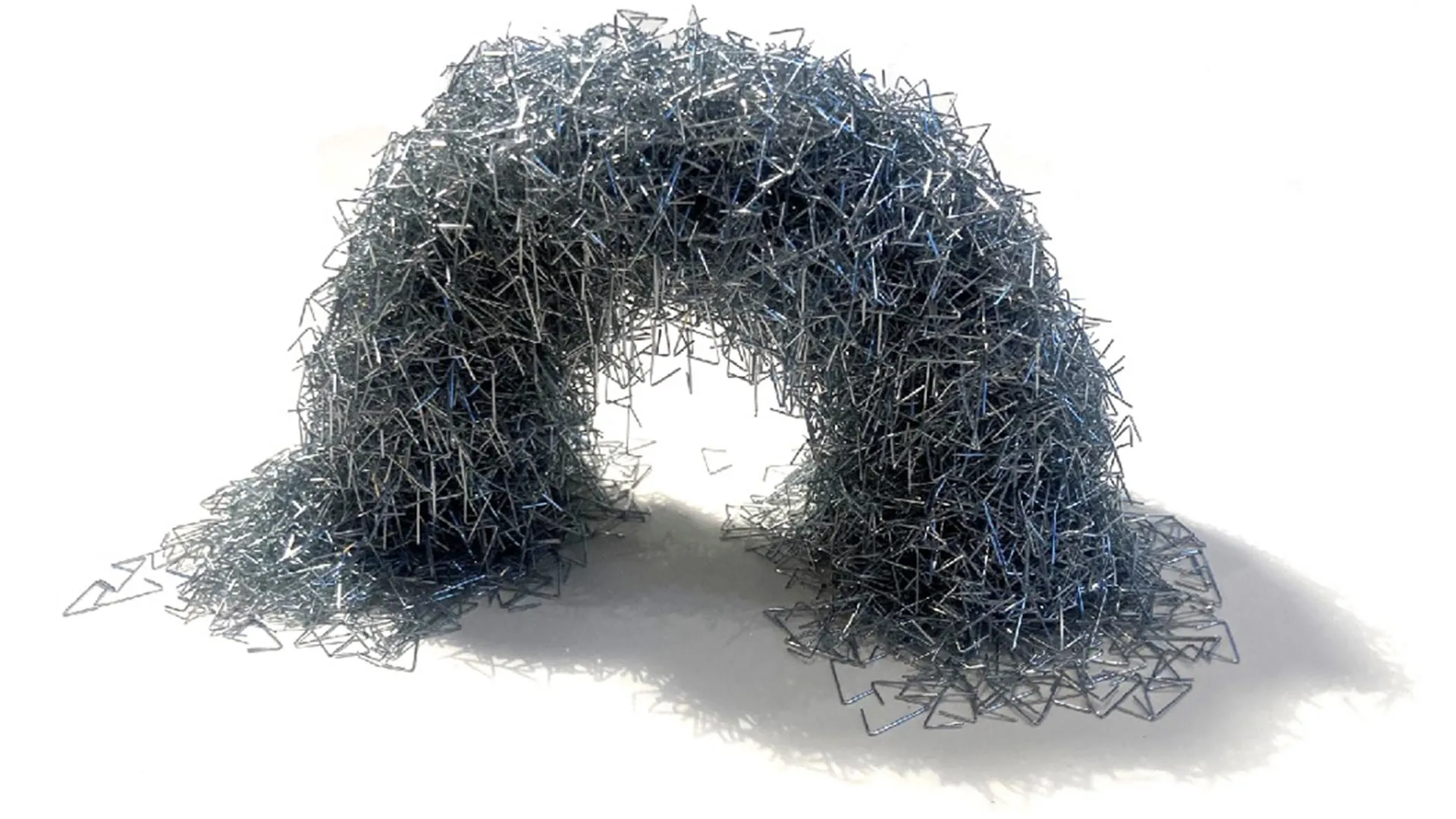
A research team at the University of Colorado Boulder has uncovered a breakthrough in material science by analyzing the structural behavior of a common desktop object: the office staple. According to a study recently published in the Journal of Applied Physics, a tightly compressed bundle of staples exhibits a unique physical paradox—while composed of hundreds of individual, unattached pieces, the mass behaves as a singular, cohesive solid that is remarkably difficult to pull apart. This phenomenon, known as entanglement, has provided the foundation for a new class of engineered materials that are simultaneously strong, adaptable, and fully reversible.
Led by Professor Francois Barthelat at the Paul M. Rady Department of Mechanical Engineering, the Laboratory for Advanced Materials & Bioinspiration is leveraging these findings to design a new generation of "interlocking granular materials." Unlike traditional solids that rely on chemical bonds or adhesives, these materials derive their integrity from the geometric shape of their constituent particles. By shifting the focus from the chemistry of the material to the geometry of its components, the researchers believe they have found a pathway toward sustainable construction and advanced robotics.
The Physics of Geometrical Entanglement
The core of the CU Boulder research centers on the concept of entanglement—a state where particles become so physically intertwined that they can no longer move independently. In nature, this is a common strategy for structural integrity. Bird nests, for instance, are composed of thousands of twigs that are not glued together but are interwoven so tightly that they can withstand high winds and the weight of growing offspring. Similarly, human bone achieves its durability through the complex interplay of mineralized components and flexible proteins.
In the world of synthetic materials, however, achieving this balance has proven difficult. Most granular materials, such as sand or gravel, are composed of convex particles. Because these particles are smooth and rounded, they cannot interlock; they simply slide past one another unless contained.
"Let’s take sand as an example," explained Youhan Sohn, a PhD student in Barthelat’s lab and a key researcher on the project. "Sand is smooth and convex-shaped, meaning it cannot interlock from grain to grain. However, we found that if we change the shape of a grain of sand, we can drastically affect its behavior and mechanical properties, including the particle’s ability to link with other particles."
By moving from convex shapes to concave, "open" geometries—specifically the "U" shape of a staple—the team discovered that particles could be made to "hook" onto their neighbors. This creates a collective resistance to tension, allowing a pile of loose pieces to act as a solid block capable of supporting weight and resisting deformation.
Chronology of the Research and Methodology
The project began several years ago as an exploration into the fundamental building blocks of matter. Professor Barthelat’s team has long studied bio-inspired designs, but the shift toward entangled granular materials is a more recent development in their portfolio.
The research progressed through three distinct phases:
- Computational Modeling: The team utilized Monte Carlo simulations to predict how various geometries would interact. These simulations allowed the researchers to virtually test thousands of particle shapes—from simple rods to complex lattices—to determine which designs maximized the number of contact points and interlocking opportunities.
- The Identification of the "Staple" Geometry: The simulations pointed toward a "two-legged" U-shaped design as the optimal balance between simplicity and entanglement potential. While more complex shapes could entangle, the staple-like geometry provided a unique efficiency in how it distributed stress across the collective mass.
- Physical "Pickup Tests": To validate the digital findings, the team manufactured physical versions of these particles and conducted empirical tests. This included "pickup tests," where a bundle of entangled particles was lifted to see if it would hold its shape under gravity, and stress tests to measure the force required to pull the mass apart.
The results confirmed that the staple-shaped particles created a material with high tensile strength—the ability to resist being pulled apart—and high toughness—the ability to absorb energy and resist fracturing. In traditional engineering, strength and toughness are often at odds; a material that is very hard is often brittle, while a material that is tough is often soft. The entangled staple mass, however, manages to bridge this gap.
The Role of Vibration in Material Reversibility
One of the most significant findings of the CU Boulder study is the role of external stimuli in controlling the material’s state. While the entangled staples can form a rigid structure, that structure is not permanent. The researchers discovered that by applying specific vibration patterns, they could "tune" the material’s properties.
"It’s a strange material because it’s obviously not a liquid. However, it’s also not quite solid," Professor Barthelat noted.
Gentle vibrations or low-frequency movements act as a settling mechanism, encouraging the particles to find deeper interlocking positions and strengthening the overall mass. Conversely, high-intensity vibrations or specific "shaking" patterns cause the particles to disentangle, returning the solid-like mass to a loose collection of individual pieces.
This reversibility is a game-changer for industrial applications. In modern manufacturing, once a material is cast in concrete or welded in steel, it is difficult to revert. The CU Boulder team’s "on-demand" solid could allow for structures that are built to be strong but designed to be dismantled.
Supporting Data: Strength vs. Disassembly
During the testing phase, the researchers quantified the difference between standard granular materials and their entangled counterparts. While a column of dry sand has zero tensile strength (it cannot be pulled; it simply falls apart), the entangled staple-like particles exhibited a measurable "cohesion equivalent" that allowed the mass to be suspended in mid-air.
PhD student Saeed Pezeshki highlighted the importance of this duality: "Our entangled granular material using the staple-like particle demonstrates both high strength and toughness at the same time."
The data suggests that the "two-legged" geometry allows for a higher "coordination number"—the average number of neighbors each particle touches—compared to traditional grains. This increased connectivity creates a redundant network; even if one "staple" slips, dozens of others remain locked, preventing a catastrophic failure of the material.
Implications for Sustainable Construction and Infrastructure
The most immediate impact of this research could be felt in the construction industry, which is currently one of the world’s largest contributors to carbon emissions, largely due to the production of cement and the waste generated by demolition.
The vision proposed by the CU Boulder team involves a "circular" approach to infrastructure. Imagine a bridge or a temporary support structure built not with poured concrete, but with millions of entangled, staple-shaped components. These structures would provide the necessary load-bearing capacity for their service life. However, when the structure is no longer needed, instead of using wrecking balls and explosives—which create tons of unrecyclable debris—engineers could apply a specific vibration frequency to the structure. The "solid" bridge would effectively melt back into a pile of individual staples, which could then be collected and transported to a new site for reuse.
This "dry construction" method would eliminate the need for chemical binders and significantly reduce the energy required for both building and recycling.
Future Applications: From Swarm Robotics to Shape-Shifters
Beyond civil engineering, the research has caught the attention of the robotics community. The ability of a material to transition from a fluid-like state to a solid-like state is the holy grail of soft robotics and swarm intelligence.
Saeed Pezeshki noted that colleagues in the field are already envisioning "swarm robotics" applications. In this scenario, thousands of tiny, independent robots—each shaped like an interlocking particle—could move independently to a location. Once there, they would entangle themselves to form a tool, a ladder, or a protective shield. When the task is complete, they would disentangle and move on to the next objective.
Professor Barthelat likened the concept to the iconic T-1000 "liquid metal" antagonist from Terminator 2: Judgment Day. "It’s kind of like that… who can change shape to slide under a door and then transform back to a human’s size on the other side," he said. While he admitted that scaling this to a sophisticated level remains an expensive challenge, the fundamental physics demonstrated by the staples proves that such a transition is possible without complex electronics in every particle.
Next Steps: The "Burr" Design and Scaling
The CU Boulder team is not stopping at the staple design. Their latest experiments are pushing the boundaries of geometry even further by adding more "legs" to the particles. They are currently testing designs that mimic the "burrs" found on certain plants—seeds covered in tiny hooks that cling to fur and fabric.
These multi-legged designs are expected to create even deeper entanglement, potentially allowing for materials that can withstand even greater loads while remaining reversible. The researchers are also exploring different materials for the particles themselves, moving from metal to high-strength polymers and recycled plastics to further enhance the sustainability of the concept.
While the technology is still in the laboratory phase, the publication in the Journal of Applied Physics marks a significant milestone. The team is now looking toward industrial partnerships to explore how these entangled materials can be manufactured at scale.
As the global community seeks ways to build more efficiently and reduce environmental impact, the humble office staple may have provided the blueprint for the resilient, recyclable cities of the future. The ability to create strength through geometry rather than chemistry offers a new lens through which to view the physical world—one where the "tangled mass" is not a problem to be solved, but a solution to be engineered.