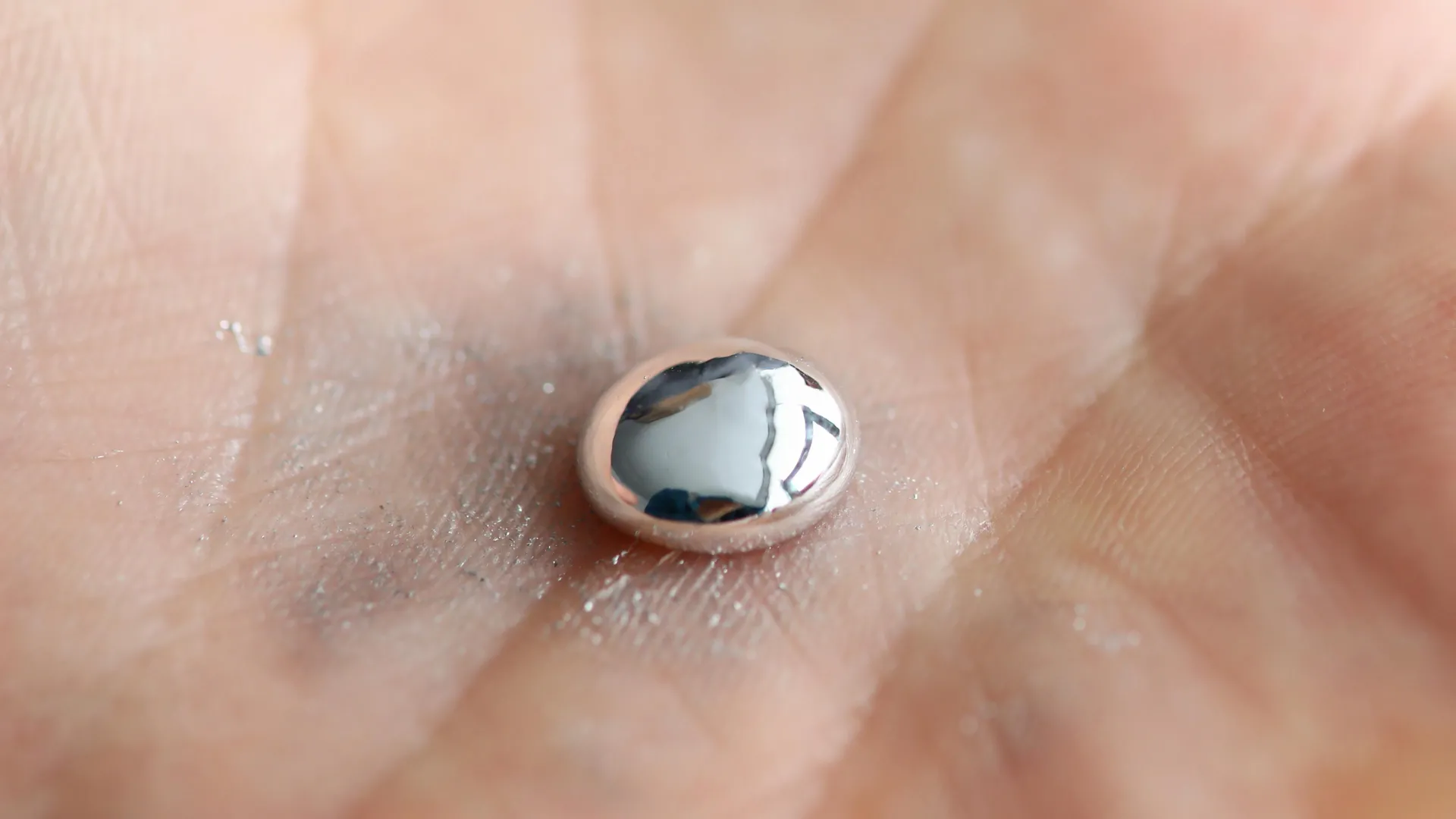
The elemental metal gallium, a substance that has fascinated chemists since its discovery in the late 19th century, has long been regarded as one of the most idiosyncratic members of the periodic table. Known primarily for its ability to melt in the palm of a human hand or inside a warm cup of tea, gallium serves as a cornerstone of modern electronics, yet its fundamental atomic behavior has remained partially shrouded in mystery for over a century. A groundbreaking study led by researchers at the University of Auckland, in collaboration with the MacDiarmid Institute for Advanced Materials and Nanotechnology, has finally pierced through decades of scientific misconceptions. By re-evaluating the metal’s structure at varying temperatures, the team has discovered that gallium’s atomic bonds exhibit a "re-entrant" behavior—vanishing at the point of melting only to reappear as the liquid is heated further—a finding that challenges thirty years of established materials science literature.
The Atomic Anomalies of Element 31
To understand the significance of the University of Auckland’s discovery, one must first look at why gallium is considered "strange" among its metallic peers. Most metals exist as a collection of individual atoms held together by "metallic bonding," a state where electrons are shared globally across a lattice, often described as a "sea of electrons." Gallium, however, defies this standard. In its solid state, gallium atoms prefer to pair up into "dimers," or bonded pairs. This results in the formation of covalent bonds, a type of chemical link where atoms share specific pairs of electrons. While covalent bonding is the hallmark of non-metals like carbon or oxygen, it is exceptionally rare in the metallic realm.
Furthermore, gallium is one of the few substances on Earth—alongside water, silicon, and bismuth—that is denser in its liquid state than in its solid state. This property is why solid gallium floats in its own melt, much like ice cubes float in a glass of water. These structural peculiarities contribute to its remarkably low melting point of just 29.76 degrees Celsius (85.57 degrees Fahrenheit). For decades, the prevailing scientific consensus held that while these covalent bonds defined solid gallium, they were completely destroyed upon melting, leaving the liquid metal as a disordered, purely metallic fluid. The new research, published in the journal Materials Horizons, proves this assumption was fundamentally flawed.
A Breakthrough in the Liquid State
The research was spearheaded by Dr. Steph Lambie during her doctoral studies at the University of Auckland, alongside Professor Nicola Gaston and Dr. Krista Steenbergen of Victoria University of Wellington. The team’s investigation focused on the structural evolution of gallium as it transitions from a solid to a liquid and continues to heat up.
By meticulously analyzing decades of disparate data and performing advanced computational modeling, Dr. Lambie identified a phenomenon that had been overlooked by the global scientific community. While the covalent bonds do indeed break apart at the moment of melting, they do not stay broken. Instead, as the temperature of the liquid gallium increases, the covalent bonds begin to reform at the atomic level.
"Thirty years of literature on the structure of liquid gallium has had a fundamental assumption that is evidently not true," stated Professor Nicola Gaston. This "re-entrant" covalency—the return of shared electron bonds at high temperatures—suggests that the liquid state of gallium is far more complex and structured than previously imagined.
Thermodynamics and the Mystery of the Melting Point
The discovery provides a new, more robust explanation for why gallium melts at such a low temperature compared to its neighbors on the periodic table (such as aluminum, which melts at 660.3 degrees Celsius). The researchers propose that the key lies in entropy—the measure of disorder within a system.
When the covalent bonds in solid gallium break, there is a massive increase in the freedom of the atoms. This sudden jump in entropy makes the liquid state thermodynamically much more favorable at lower temperatures. However, the fact that these bonds can reappear at higher temperatures indicates that the energy landscape of gallium is uniquely tuned to favor these "dimer" pairings even when the metal is in a fluid state. This nuanced understanding of the relationship between bonding and entropy could allow scientists to better predict the behavior of other "low-temperature" liquid metals and alloys.
A Timeline of Gallium: From Prediction to Modern Tech
The history of gallium is a testament to the predictive power of chemistry. In 1871, the Russian chemist Dmitri Mendeleev, the father of the periodic table, noticed a gap beneath aluminum. He named this missing element "eka-aluminum" and accurately predicted its density, melting point, and chemical reactivity before it had ever been seen.
In 1875, the French chemist Paul Émile Lecoq de Boisbaudran discovered the element using spectroscopy while examining a sample of zinc blende. He named it "gallium" in honor of his homeland, France (from the Latin Gallia). Since then, gallium has transitioned from a laboratory curiosity to a vital industrial resource.
- 1871: Mendeleev predicts the existence of "eka-aluminum."
- 1875: Lecoq de Boisbaudran isolates gallium and confirms Mendeleev’s predictions.
- Mid-20th Century: Gallium begins to see use in high-temperature thermometers and specialized alloys.
- 1970s-1990s: The rise of the semiconductor industry places gallium at the forefront of technology, particularly through Gallium Arsenide (GaAs).
- 2024: University of Auckland researchers resolve a 30-year debate regarding the element’s liquid structure.
Industrial Importance and the Future of Nanotechnology
While the Auckland study is a feat of fundamental science, its implications stretch deep into the heart of the modern technology sector. Gallium is an "enabling" metal. It is the primary component in Gallium Nitride (GaN) and Gallium Arsenide (GaAs) semiconductors, which are more efficient than traditional silicon. GaN technology is currently revolutionizing power electronics, allowing for smaller, faster-charging blocks for smartphones and more efficient power conversion in electric vehicles (EVs).
The ability of gallium to remain liquid near room temperature while maintaining high thermal and electrical conductivity makes it indispensable for:
- Telecommunications: Used in 5G infrastructure and high-frequency satellite communication.
- Optoelectronics: Found in LEDs (Light Emitting Diodes) and laser diodes used in medical surgery and optical drives.
- Solar Energy: High-efficiency multi-junction solar cells, often used in space exploration, rely on gallium.
- Aerospace: Used as a cooling agent and in specialized sensors for defense systems.
The Auckland research is particularly relevant to the burgeoning field of nanotechnology. Because gallium can dissolve other metals, it acts as a "solvent" for creating liquid metal catalysts. Professor Gaston and her team have previously demonstrated how liquid gallium can be used to grow intricate, "snowflake-like" structures of zinc. Understanding the covalent bonding behavior of gallium at high temperatures allows researchers to better manipulate these "self-assembling structures," where disordered materials spontaneously organize into complex, functional forms.
Seeking the Origins of Life on Mars
Beyond electronics and manufacturing, gallium is playing a surprising role in the search for extraterrestrial life. Researchers at the University of Auckland’s School of Environment and Te Ao Mārama – Centre for Fundamental Inquiry are currently investigating gallium’s ability to act as a chemical "fingerprint."
Because of its unique bonding properties and its interaction with organic molecules, scientists believe gallium may be able to preserve traces of ancient microbial life. If microbes were present in the wet, early history of Mars, gallium-bearing minerals might have trapped biological signatures in a way that remains stable over billions of years. This research could inform future missions to the Red Planet, providing a new metric for identifying "biosignatures" in Martian soil and rock samples.
Analysis of Scientific and Global Impact
The revelation that a fundamental assumption in materials science was incorrect for thirty years serves as a reminder of the iterative nature of science. For the MacDiarmid Institute and the University of Auckland, this discovery cements their position as leaders in the study of "soft" and liquid matter.
From a broader perspective, the ability to accurately model the atomic structure of liquid metals is essential for the development of "green" technologies. As the world shifts toward a hydrogen economy and more efficient electrical grids, liquid metal batteries and advanced catalysts will be required. Gallium, with its low toxicity compared to mercury and its unique covalent-metallic hybrid nature, is a prime candidate for these applications.
The study, titled "Resolving Decades of Debate: The Surprising Role of High-Temperature Covalency in the Structure of Liquid Gallium," serves as both a correction to the historical record and a roadmap for future innovation. By looking closer at an element we thought we already understood, Dr. Lambie and her colleagues have opened a new chapter in the study of the periodic table’s most enigmatic metal. As nanotechnology continues to shrink the scale of our machines, understanding the "glue" that holds atoms together—even in a liquid state—will be the difference between theoretical possibility and industrial reality.