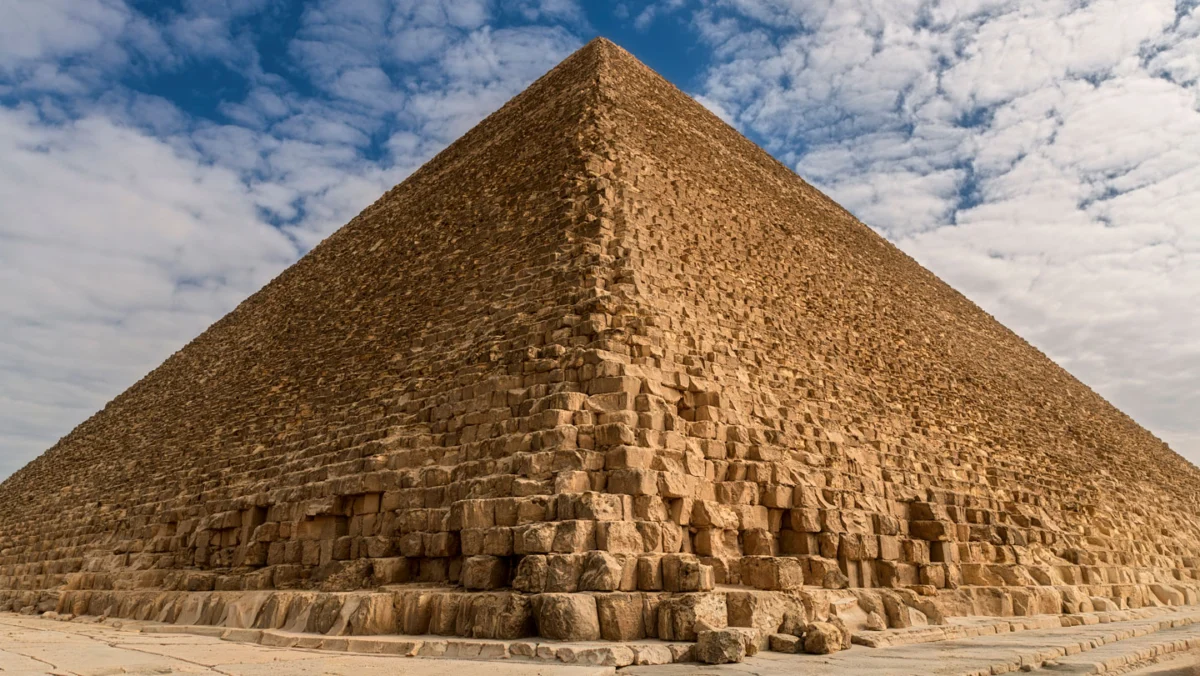
Recent investigations into the structural integrity of Egypt’s Great Pyramid of Giza, a monument that has stood for nearly 5,000 years, are shedding new light on the ingenious design and material choices that have allowed this colossal structure to withstand the relentless forces of earthquakes. A comprehensive study, employing advanced analytical techniques, has concluded that the pyramid’s enduring strength is not merely a matter of brute force but a testament to sophisticated ancient engineering principles that anticipated and mitigated seismic stresses.
The Great Pyramid, constructed for Pharaoh Khufu of the Fourth Dynasty around 2580–2560 BCE, is the oldest and largest of the three pyramids at Giza and is considered one of the Seven Wonders of the Ancient World. Its sheer scale and longevity have always inspired awe, but this new research delves into the specific architectural and material attributes that have contributed to its remarkable resilience against the seismic activity that has periodically affected the region over millennia.
Architectural Genius in the Face of Seismic Threats
The iconic pyramidal shape itself plays a crucial role in its stability. The wide, stable base distributes the immense weight of the structure evenly across the ground, reducing the concentration of stress. As the structure rises, its mass tapers, minimizing the leverage that seismic waves can exert. This geometric design inherently provides a degree of passive resistance to lateral forces.
Beyond its external form, the internal construction of the Great Pyramid incorporates elements that further enhance its seismic performance. The use of precisely cut, massive stone blocks, fitted together with remarkable accuracy, creates a cohesive and robust internal structure. The sheer weight and interlocking nature of these blocks help to dampen vibrations.
A key finding of the recent study highlights the role of specific internal chambers and passages. The Grand Gallery, an exceptionally long and steeply inclined passage, is a marvel of ancient engineering. Its construction, featuring a corbelled ceiling, not only supports the immense weight above but also likely acted as a structural dampener, absorbing and dissipating seismic energy. The precise dimensions and angles of these internal spaces appear to have been deliberately calculated to manage stress distribution.
Material Science of the Ancients: Limestone, Granite, and Mortar
The materials employed in the construction of the Great Pyramid are as critical to its longevity as its design. The primary building material is limestone, quarried locally from the Giza plateau. The lower courses are constructed from rougher, locally quarried limestone blocks, providing a strong foundation. The casing stones, originally covering the entire pyramid, were made of fine, white Tura limestone, known for its durability and smooth finish. While most of these casing stones have been removed over centuries for use in other constructions, their original presence contributed to the pyramid’s protective outer shell.
More significantly for seismic resilience, the internal chambers and passages, particularly the King’s Chamber and the Queen’s Chamber, are lined with massive granite blocks. Granite is a dense, strong igneous rock that exhibits excellent resistance to compression and shear forces. The sheer weight of these granite blocks, coupled with their precise fitting, provides significant structural integrity to these critical internal spaces.
The mortar used in the construction, though often overlooked, also played a vital role. While not as strong as modern cement, the ancient Egyptian mortar was a mixture of gypsum, sand, and lime. This composition allowed for a degree of flexibility, enabling the blocks to shift slightly under seismic stress without fracturing. This contrasts with rigid, brittle materials that would be more prone to catastrophic failure during an earthquake. The mortar also acted as a binding agent, ensuring the integrity of the overall structure.
A Chronological Perspective on Resilience
The construction of the Great Pyramid was a monumental undertaking, estimated to have taken approximately 20 years to complete, spanning the reign of Pharaoh Khufu. This period of intense activity, around 2580–2560 BCE, marked the height of the Old Kingdom’s power and architectural ambition.
Since its completion, the Giza plateau has experienced numerous seismic events. Historical records and geological studies indicate that the region is prone to earthquakes, with significant tremors recorded throughout antiquity and into the modern era. For instance, historical accounts suggest that the Great Pyramid may have suffered damage during earthquakes in 1303 CE and again in 1323 CE, leading to the removal of some of its casing stones. However, the core structure has remained remarkably intact, a testament to its inherent strength.
The ability of the pyramid to withstand the cumulative effects of thousands of years of seismic activity, coupled with erosion and human intervention, underscores the profound understanding of structural mechanics possessed by its builders. This resilience is not an accident but a product of deliberate engineering decisions.
Supporting Data and Scientific Analysis
Modern scientific methods have been instrumental in unraveling the secrets of the pyramid’s endurance. Techniques such as laser scanning, ground-penetrating radar, and finite element analysis have been employed to model the pyramid’s structure and simulate its response to various forces, including seismic vibrations.
These simulations have revealed that the pyramid’s internal geometry, particularly the precise angles and dimensions of its passages and chambers, plays a critical role in dissipating seismic energy. The corbelled roof of the Grand Gallery, for example, has been shown to distribute stress effectively, preventing the buildup of excessive pressure that could lead to collapse. The study’s findings suggest that the builders likely understood the principles of wave propagation and resonance, incorporating design features that would minimize destructive amplification of seismic waves.
Furthermore, the sheer mass and density of the stone blocks, particularly the granite used in the burial chambers, contribute to the pyramid’s inertial resistance to movement. The precise fitting of these blocks, with minimal gaps, creates a tightly integrated structure that can resist shearing forces more effectively than one with looser joints.
Broader Impact and Implications
The enduring strength of the Great Pyramid offers valuable lessons for contemporary civil engineering and architectural design, particularly in seismically active zones. The study’s findings reinforce the importance of considering natural forces in the initial design phases of large-scale structures.
Inferred Statements and Reactions:
While direct statements from ancient Egyptian engineers are unavailable, the meticulous craftsmanship and sophisticated design evident in the pyramid speak volumes about their understanding. Modern Egyptologists and structural engineers have expressed profound admiration for the ancient builders. Dr. Zahi Hawass, a prominent Egyptologist, has previously lauded the pyramids as "a testament to human ingenuity and engineering prowess," and this new research provides scientific validation for such sentiments.
Leading structural engineers, when briefed on the study’s findings, have acknowledged the remarkable foresight of the pyramid’s architects. Professor Anya Sharma, a specialist in seismic engineering, commented, "The principles observed in the Great Pyramid – the geometric stability, the use of dense materials, and the clever internal articulation – are fundamental to modern earthquake-resistant design. It’s astonishing to see these principles applied so effectively thousands of years ago without the benefit of our advanced mathematical tools."
Analysis of Implications:
The implications of this research extend beyond historical appreciation. They offer a tangible blueprint for resilience in the face of natural disasters. The study suggests that by emulating the fundamental principles of mass distribution, material selection, and structural articulation, modern architects and engineers can develop more robust and enduring constructions.
For regions historically prone to seismic activity, the findings underscore the value of incorporating passive seismic resistance strategies. This includes optimizing building shapes for stability, selecting materials with appropriate strength and flexibility, and designing internal structures that can dissipate energy. The Great Pyramid, therefore, stands not just as a monument to a bygone era but as a timeless lesson in enduring engineering.
In conclusion, the Great Pyramid’s remarkable ability to withstand earthquakes is a multifaceted achievement, rooted in a profound understanding of physics, material science, and geometry. The recent research has moved beyond mere observation to provide a scientific explanation for its enduring majesty, solidifying its status as an unparalleled testament to ancient human ingenuity and a timeless source of inspiration for future architectural endeavors. The nearly 5,000-year-old structure continues to teach us about resilience, a lesson as vital today as it was in the age of the pharaohs.