The landscape of global cybersecurity is on the precipice of a fundamental shift as researchers move closer to realizing a "quantum-secure" internet. In a significant leap for the field of quantum information science, an international collaboration between leading universities in Germany and China has successfully demonstrated a robust, long-distance quantum key distribution (QKD) system. By utilizing on-demand semiconductor quantum dots (SQDs) and a sophisticated time-bin encoding protocol, the team achieved stable quantum communication over a 120-kilometer optical fiber link, marking a critical milestone in the transition from laboratory experimentation to field-deployable quantum networks.
The results of this study, recently featured as the cover art for the prestigious journal Light: Science & Applications, provide a blueprint for high-performance, intercity quantum communication. The experiment addresses two of the most persistent challenges in quantum cryptography: the need for high-purity single-photon sources and the requirement for system stability in the face of environmental fluctuations.
The Evolution of Quantum Key Distribution
To understand the magnitude of this achievement, one must consider the historical context of quantum cryptography. Since the proposal of the first QKD protocol (BB84) in 1984, the primary goal has been to enable two parties to produce a shared, random secret key known only to them. This key can then be used to encrypt and decrypt messages using classical methods. The security of QKD is not based on mathematical complexity—which could eventually be broken by powerful enough computers—but on the laws of physics. In quantum mechanics, the act of measuring a quantum system inevitably disturbs it; therefore, any attempt by an eavesdropper to intercept the key would be immediately detectable.
Early QKD systems relied heavily on "weak coherent pulses" (attenuated lasers). While effective, these sources occasionally produce multiple photons at once, opening the door to "photon number splitting" attacks. To mitigate this, semiconductor quantum dots have emerged as a superior alternative. These "artificial atoms" are engineered to emit exactly one photon at a time upon demand, offering a level of security and efficiency that traditional lasers cannot match.
Technical Architecture: Semiconductor Quantum Dots and the C-Band
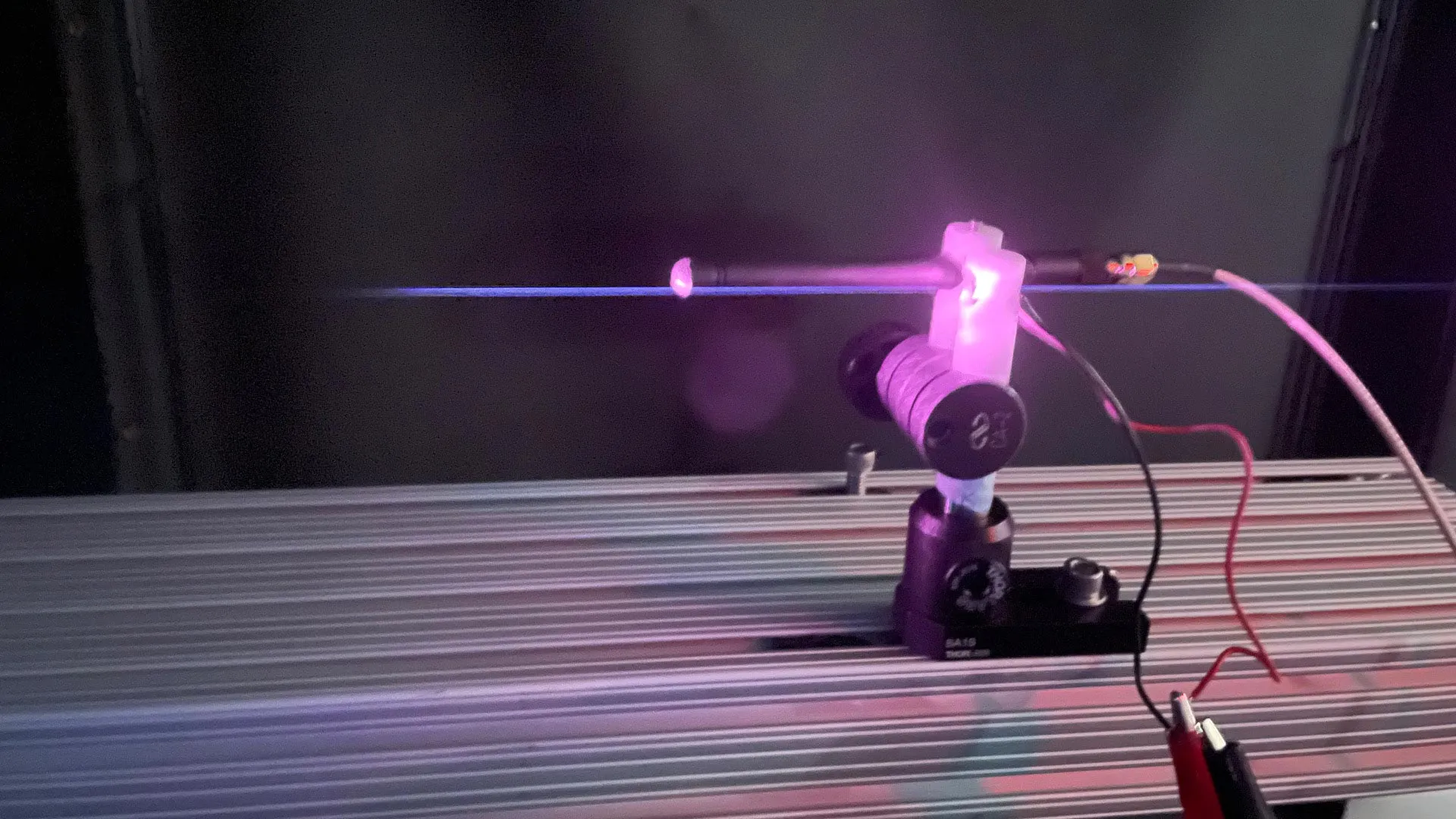
The heart of this new system is a telecom-band semiconductor quantum dot device. For quantum communication to be practical, it must operate within the existing infrastructure of global telecommunications. This means generating photons in the "C-band"—a specific range of infrared light around 1550 nanometers where optical fiber exhibits the lowest signal loss.
The research team employed a quantum dot enhanced by a Purcell cavity. The Purcell effect is a phenomenon in which the spontaneous emission rate of a quantum system is increased by its environment. By placing the quantum dot in a microcavity, the researchers were able to significantly boost the brightness and purity of the single photons produced. In this experiment, the source operated at a rate of approximately 76 MHz, providing a high-frequency stream of photons essential for high-speed data transmission.
Overcoming Environmental Instability with Time-Bin Encoding
While the photon source is the engine of the system, the encoding method is the steering mechanism. Many previous QKD demonstrations utilized polarization encoding, where information is stored in the orientation of the photon’s electric field. However, polarization is notoriously fragile. As photons travel through kilometers of fiber optic cable, they encounter temperature changes, physical vibrations, and mechanical stress, all of which can rotate the polarization and lead to high error rates.
To solve this, the German-Chinese team turned to time-bin encoding. In this scheme, information is stored in the precise arrival time of the photon—specifically, whether it arrives in an "early" or "late" time slot. Because the arrival time of a photon is far more resilient to the stresses of fiber transmission than its polarization, time-bin encoding provides intrinsic stability.
The researchers implemented a self-stabilized time-bin encoder to generate three distinct qubit states. This setup converts the single photons from the quantum dot into quantum signals with high precision. On the receiving end, the team utilized an actively stabilized interferometer equipped with a phase shifter. This allows the system to automatically compensate for minor drifts in the hardware, ensuring that the decoder remains perfectly synchronized with the encoder.
Experimental Results and Data Analysis
The experimental setup was put to a rigorous test over a 120-kilometer link of standard optical fiber. This distance is particularly significant as it represents a typical "intercity" distance, the scale required to link major metropolitan hubs in a regional quantum network.
During the demonstration, the system maintained remarkable performance metrics:
- Source Brightness: The quantum dot source operated at 76 MHz, ensuring a high volume of potential key material.
- Quantum Bit Error Rate (QBER): Even at the maximum distance of 120 km, the system maintained an average QBER of less than 11%. This is well within the threshold required for successful error correction and privacy amplification.
- Secure Key Rate (SKR): Under practical "finite key" conditions—a rigorous mathematical standard that accounts for the fact that real-world keys are not infinitely long—the setup achieved an average secure key rate of approximately 15 bits per second.
- Operational Stability: The system operated continuously for six hours without manual intervention, demonstrating the efficacy of the active feedback control and the Sagnac interferometer (SNI) used in the design.
While 15 bits per second may seem modest compared to modern broadband speeds, it is a substantial figure for quantum-secure communication. This rate is sufficient for the continuous transmission of encrypted text messages using a "one-time pad" cipher, which provides information-theoretic security that is mathematically impossible to crack.
Chronology of the Breakthrough
The path to this 120-kilometer demonstration involved several years of incremental progress across the global scientific community.
- The Development Phase (2015-2018): Early research focused on improving the purity of SQDs. Scientists worked to eliminate "multi-photon emission" and improve the indistinguishability of the photons produced.
- The Telecom Shift (2019-2021): Researchers began successfully shifting the emission of high-quality quantum dots from the visible spectrum to the 1550 nm C-band, a necessary step for fiber integration.
- Encoding Refinement (2022-2023): Teams began experimenting with time-bin encoding as an alternative to polarization, though initial setups were often bulky and prone to mechanical drift.
- The Current Milestone (2024): The German-Chinese collaboration successfully integrated Purcell-enhanced telecom dots with an actively stabilized, field-ready time-bin architecture, culminating in the 120-kilometer breakthrough.
Official Reactions and Expert Commentary
The research team has been vocal about the implications of their work. In the published study, the scientists emphasized that telecom-band QDs with Purcell enhancement are now "promising candidates for integration into practical QKD systems." They noted that the ability of these devices to provide high-brightness photons suitable for intercity fiber communication effectively removes one of the primary hardware bottlenecks in the field.
Regarding the stability of the system, the researchers stated, "The system is operated continuously for 6 hours, highlighting the intrinsic robustness of the time-bin scheme enabled by the system including the Sagnac interferometer and active feedback control." This stability is what differentiates this experiment from previous "hero experiments" that could only run for minutes at a time under perfect laboratory conditions.
Independent analysts in the quantum technology sector have reacted positively, noting that the use of standard optical fiber is a key "win." By showing that quantum signals can survive 120 kilometers of the same glass used by major internet service providers, the team has demonstrated that the "quantum internet" will not require a complete overhaul of existing global cabling.
Broader Impact and Future Implications
The successful demonstration of a 120-kilometer time-bin QKD system has far-reaching implications for several sectors:
National Security and Diplomacy:
Governments are increasingly concerned about the threat of "harvest now, decrypt later" attacks, where adversaries steal encrypted data today in hopes of decrypting it with a future quantum computer. Field-deployable QKD systems like the one demonstrated by the German-Chinese team offer a defense against this threat by providing encryption that does not rely on computational hardness.
The Scalability of Quantum Networks:
A major hurdle for quantum networks is the "no-cloning theorem," which prevents the amplification of quantum signals. This means that after a certain distance, the signal simply becomes too weak to detect. To go beyond 120 kilometers, "quantum repeaters" are needed. The semiconductor quantum dots used in this experiment are highly compatible with the proposed designs for quantum repeaters, making this research a foundational step toward transcontinental quantum networks.
Integration with Existing Infrastructure:
Because this system uses the telecom C-band and standard fiber, it is "plug-and-play" compatible with current telecommunications hubs. This reduces the capital expenditure required for companies and governments to adopt quantum encryption.
Advancing the Solid-State Roadmap:
There are many competing technologies for single-photon generation, including trapped ions and spontaneous parametric down-conversion (SPDC). This result strongly reinforces the position of solid-state semiconductor quantum dots as the most viable path forward for high-rate, scalable quantum hardware.
As the research moves forward, the team expects to further increase the secure key rate by optimizing the quantum dot’s extraction efficiency and increasing the clock rate of the electronics. The transition from 15 bits per second to kilobits per second would allow for encrypted voice and even low-resolution video calls, further expanding the utility of this technology.
This achievement underscores a pivotal shift in quantum research: the move from proving that quantum communication is possible to proving that it is practical, stable, and ready for the real world. The 120-kilometer link serves as a testament to the power of international scientific collaboration and the enduring potential of semiconductor technology to secure the digital future.