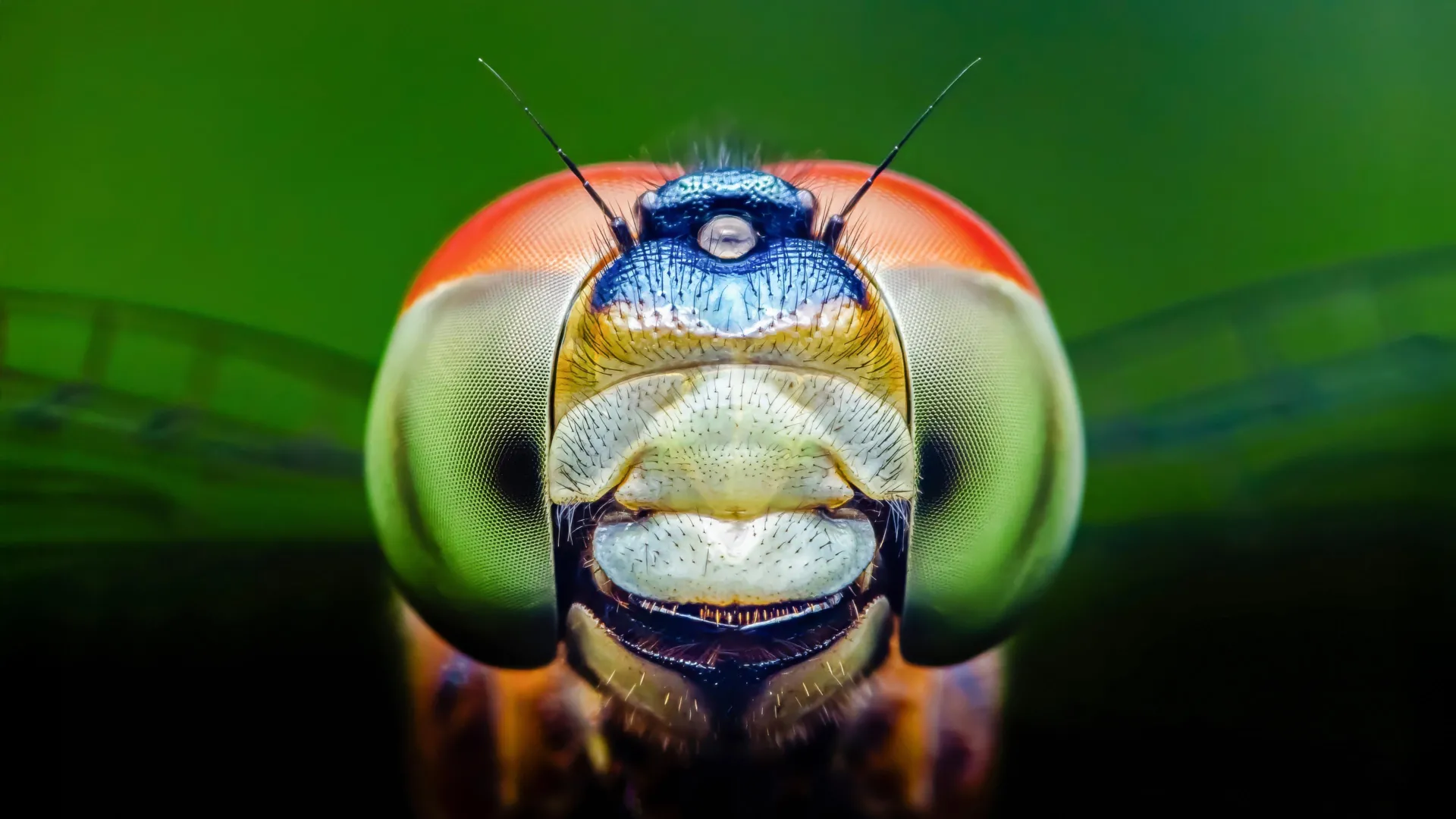
Researchers at Osaka Metropolitan University (OMU) have unveiled a groundbreaking discovery that illuminates the intricate mechanisms of parallel evolution, a phenomenon where distinct species independently develop similar biological solutions. Their latest findings, published in Cellular and Molecular Life Sciences, reveal that dragonflies possess a remarkable red-light detection system that bears striking similarities to that of mammals, including humans. This revelation, stemming from the identification of a unique red opsin in dragonflies, extends far beyond entomology, holding significant potential for advancements in medical technologies, particularly in the burgeoning field of optogenetics.
The Enigma of Red Light Perception: A Tale of Two Species
At the heart of color vision in humans and other mammals lies a class of proteins known as opsins. These light-sensitive molecules, embedded within the photoreceptor cells of the eye, are crucial for translating light signals into neural impulses that the brain interprets as color. Humans possess three primary types of opsins, each exquisitely tuned to specific wavelengths of light: blue, green, and red. This tripartite system enables us to perceive a rich spectrum of colors, forming the basis of our complex visual experience.
Insects, while boasting diverse visual capabilities, have historically presented a puzzle regarding their red-light sensitivity. While many insects can perceive ultraviolet and green light, the ability to detect red wavelengths has been less common and often poorly understood. Dragonflies, however, have long stood out in the insect world for their purported capacity to perceive red light. This observation has fueled scientific curiosity for decades, prompting investigations into the underlying molecular mechanisms.
The OMU research team, spearheaded by Professors Mitsumasa Koyanagi and Akihisa Terakita of the Graduate School of Science, has now provided definitive evidence and a detailed molecular explanation for this phenomenon. Their meticulous research pinpointed a specific opsin protein in dragonflies that exhibits an extraordinary sensitivity to light at approximately 720 nanometers (nm). This wavelength is significant because it lies at the extreme edge of the visible red spectrum for humans, and in many cases, beyond the typical range of human red-light perception.
Professor Terakita elaborated on the significance of their findings, stating, "This is one of the most red-sensitive visual pigments ever found. Dragonflies can likely see deeper into red light than most insects." This enhanced sensitivity suggests that dragonflies possess a visual acuity for red light that surpasses that of their insect counterparts, raising questions about the ecological advantage of such a capability.
Unraveling the Ecological Imperative: Why Deep Red Vision Matters for Dragonflies
The evolutionary pressures that drive the development of specific sensory capabilities are often rooted in survival and reproduction. For dragonflies, the OMU researchers propose that their heightened sensitivity to deep red light plays a crucial role in their mating rituals. This hypothesis is directly linked to the concept of reflectance, a property that describes how much light a surface scatters or bounces back. In the complex aerial ballet of dragonflies, the way an individual reflects light, particularly in specific wavelengths, can be a critical signal for recognition and attraction.
To test this theory, the research team conducted detailed measurements of light reflectance from male and female dragonflies. Their analysis revealed subtle yet significant differences in how these insects reflect red and near-infrared light. These variations are hypothesized to be visual cues that allow male dragonflies to rapidly identify potential mates while in flight, a critical advantage in their dynamic hunting and courtship environments. The ability to distinguish between sexes based on these subtle spectral differences in the red and near-infrared spectrum could be a key factor in successful reproduction.
This ecological imperative provides a compelling evolutionary context for the development of their specialized red opsin. It suggests that the ability to perceive these specific wavelengths is not merely a passive sensory trait but an active component of their survival and reproductive strategy, honed over millions of years of evolution.
A Striking Case of Parallel Evolution: Molecular Echoes Across Distant Lineages
Perhaps the most astonishing aspect of the OMU researchers’ discovery lies in the striking convergence of evolutionary pathways. The mechanism by which the dragonfly red opsin detects red light has been found to be virtually identical to that employed by red opsins in mammals, including humans. This independent development of the same molecular strategy by two vastly different and distantly related lineages is a powerful testament to the efficacy of certain biological solutions.
"Surprisingly, the mechanism by which dragonfly red opsin detects red light is identical to that of red opsin in mammals, including humans," stated first author Ryu Sato, a graduate student on the project. "This is an unexpected result, suggesting that the same evolutionary process occurred independently in distantly related lineages."
This phenomenon of parallel evolution underscores a fundamental principle in biology: under similar environmental pressures or functional demands, evolution can converge on similar molecular or structural solutions. The fact that insects and mammals, separated by hundreds of millions of years of independent evolutionary history, have arrived at the same intricate molecular machinery for sensing red light is a remarkable scientific finding. It suggests that the specific amino acid sequence and structural configuration of this opsin are exceptionally well-suited for detecting red wavelengths, making it an evolutionarily favored design.
The discovery challenges previous assumptions about the diversity of evolutionary solutions and highlights the potential for deep, underlying commonalities in biological systems even across seemingly disparate life forms. It provides a compelling case study for evolutionary biologists and molecular geneticists alike, offering new avenues for understanding the constraints and opportunities of evolutionary processes.
Engineering Dragonfly Vision for Biomedical Applications: A Leap Towards the Infrared
Beyond its implications for evolutionary biology, the OMU team’s work has unlocked significant potential for technological and medical advancements. Their research delved into the molecular intricacies of the dragonfly opsin, uncovering a critical detail that could revolutionize light-based therapies. They identified a single specific amino acid position within the opsin protein that acts as a key determinant of its light-sensing capabilities.
By strategically modifying this pivotal position in the protein, the researchers were able to precisely alter its spectral sensitivity. This manipulation allowed them to shift the opsin’s peak absorption wavelength further towards longer wavelengths, effectively pushing its sensitivity closer to the infrared spectrum. This ability to engineer the opsin’s light response with such precision is a significant breakthrough.
Building upon this foundational discovery, the team went a step further. They engineered a modified version of the dragonfly opsin protein that exhibits an even greater sensitivity to longer wavelengths. Crucially, they demonstrated that cells engineered to express this modified opsin could be successfully activated by near-infrared light. This achievement marks a critical milestone, paving the way for novel applications where light can be used to control cellular activity at depths previously inaccessible to visible light.
Optogenetics: Harnessing Near-Infrared Light for Deeper Biological Access
The potential applications of this engineered dragonfly opsin are particularly profound in the field of optogenetics. Optogenetics is a revolutionary scientific discipline that employs light-sensitive proteins, such as opsins, to precisely control and study the activity of specific cells within living organisms. By genetically engineering cells to express these light-responsive proteins, researchers can then use light to activate or inhibit these cells, offering unprecedented control over biological processes.
The primary limitation of current optogenetic tools, which often rely on visible light, is the limited penetration depth of light into biological tissues. Visible light is readily absorbed and scattered by tissues, restricting its therapeutic or diagnostic reach to superficial layers. However, longer wavelengths of light, such as near-infrared, can penetrate much deeper into the body. This characteristic makes them ideal for applications requiring access to deeper tissues, such as the brain, internal organs, or even individual cells within complex biological systems.
The OMU team’s success in engineering an opsin that responds to near-infrared light directly addresses this critical limitation. Professor Koyanagi articulated the significance of their engineered opsin: "In this study, we succeeded in shifting the sensitivity of a modified near-infrared opsin from Gomphidae dragonflies even further toward longer wavelengths and confirmed that the modified near-infrared opsin can induce cellular responses in response to near-infrared light." He further emphasized its potential, stating, "These findings demonstrate this opsin as a promising optogenetic tool capable of detecting light even deep within living organisms."
This engineered dragonfly opsin could therefore serve as a powerful new tool for a wide range of biomedical applications. For instance, in neuroscience, it could enable researchers to precisely stimulate or inhibit specific neural circuits deep within the brain, facilitating a more nuanced understanding of brain function and the development of treatments for neurological disorders. In cancer therapy, it might be used to selectively activate therapeutic agents in tumor cells that are otherwise difficult to reach. Furthermore, its application in regenerative medicine could allow for more targeted control of cellular differentiation and tissue repair.
A Timeline of Discovery and Future Directions
The journey from initial observation to groundbreaking publication likely involved several key stages. While a precise chronological breakdown of the OMU study’s internal timeline is not publicly available, scientific research typically follows a structured progression.
Initial Observation and Hypothesis Formation: The long-standing observation of red-light sensitivity in dragonflies would have served as the initial impetus for research. Early hypotheses would have focused on identifying the photoreceptor mechanisms responsible.
Specimen Collection and Preparation: Obtaining and preparing dragonfly specimens for molecular and physiological analysis would have been an early practical step. This likely involved careful handling and preservation of their visual organs.
Molecular Identification and Characterization: The crucial phase of identifying and characterizing the specific opsin gene and protein responsible for red-light detection. This would have involved techniques like gene sequencing and protein expression studies.
Functional Assays and Spectral Analysis: Rigorous laboratory experiments to determine the precise wavelength sensitivities of the identified opsin. This would involve measuring the opsin’s response to light across a broad spectrum.
Evolutionary and Comparative Studies: Comparing the dragonfly opsin’s structure and function with those of other species, particularly mammals, to identify similarities and differences. This would underpin the parallel evolution findings.
Protein Engineering and Functional Testing: The innovative step of modifying the opsin protein’s structure and subsequently testing the functional consequences of these modifications, particularly regarding spectral shift.
Application-Specific Demonstrations: Testing the engineered opsin in relevant biological systems, such as cell cultures, to demonstrate its utility in optogenetics.
Publication and Dissemination: The culmination of the research in a peer-reviewed scientific publication, allowing the findings to be shared with the wider scientific community.
The OMU team’s findings represent a significant leap forward. The identification of a single amino acid residue as the primary determinant of spectral sensitivity offers a highly precise handle for future protein engineering efforts. This level of control could lead to the development of an entire suite of optogenetic tools tailored to specific wavelengths and applications, further expanding the possibilities within optogenetics and beyond.
The broader impact of this research is undeniable. It serves as a powerful reminder of the interconnectedness of life and the elegant, sometimes convergent, pathways evolution can take. Furthermore, it underscores the immense value of studying diverse organisms, even those as seemingly simple as insects, for unlocking solutions to complex human challenges in medicine and technology. The humble dragonfly, with its ancient lineage and remarkable visual system, has now provided a crucial key to unlocking deeper insights into both the history of life on Earth and the future of human health.