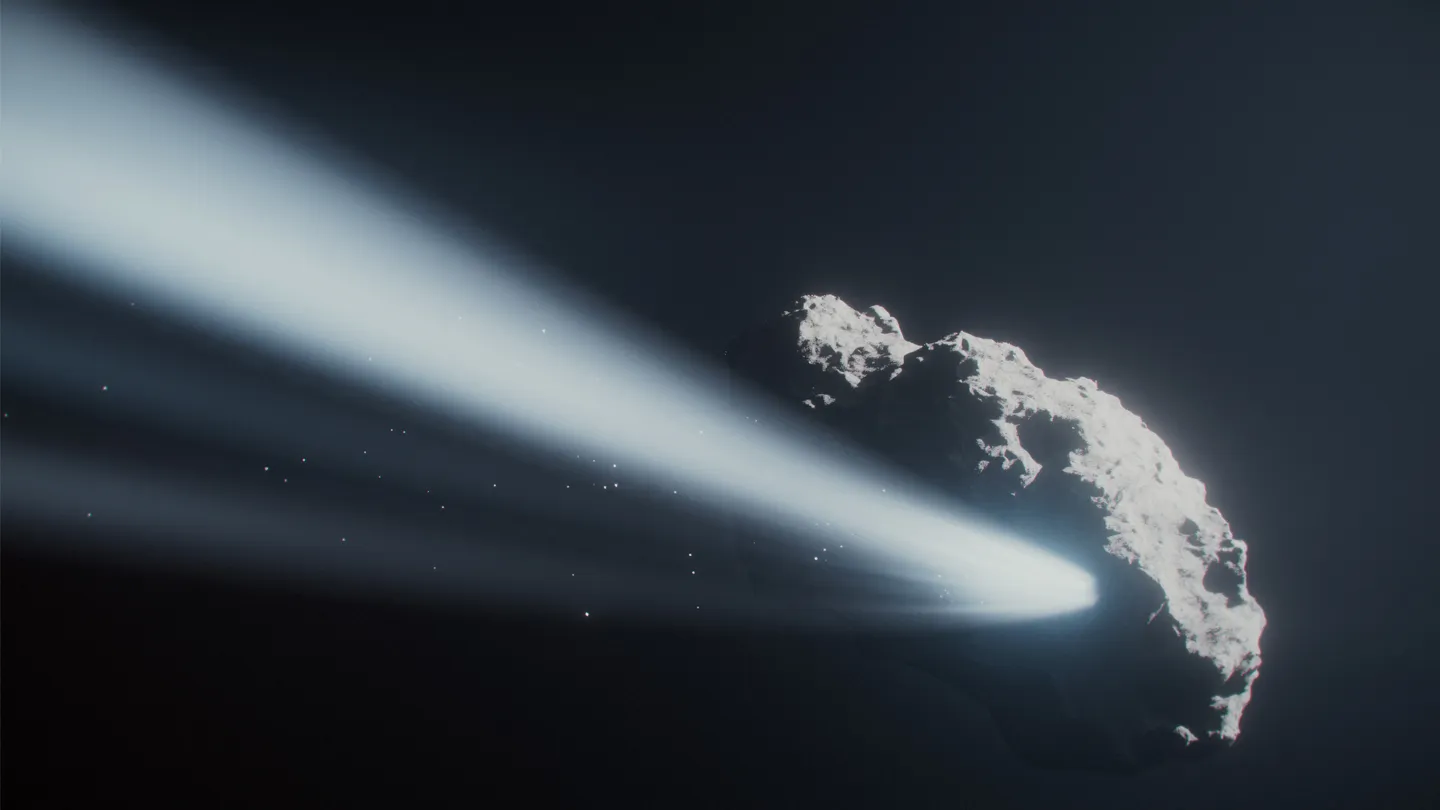
Astronomers have potentially observed a comet reversing its spin for the first time, a phenomenon attributed to the outgassing of volatile materials. Comet 41P/Tuttle-Giacobini-Kresák, a periodic comet that orbits the Sun every 5.4 years, appears to have undergone a dramatic change in its rotational behavior sometime between April and December 2017. This unprecedented observation, detailed in a study published in The Astronomical Journal, offers new insights into the dynamic processes that shape these icy celestial bodies.
A Cosmic Pirouette: The Curious Case of Comet 41P
The comet, officially designated 41P/Tuttle-Giacobini-Kresák, is no stranger to scientific scrutiny. Discovered in 1907 by Horace Tuttle, and later independently observed by M. Giacobini and K. Kresák, it is a member of the Jupiter-family of comets, characterized by their relatively short orbital periods. These comets are believed to originate from the Kuiper Belt, a vast reservoir of icy bodies beyond Neptune, and their orbits are often influenced by the gravitational pull of Jupiter.
The peculiar event concerning 41P/Tuttle-Giacobini-Kresák was identified through meticulous analysis of observational data. David Jewitt, a professor of astronomy at UCLA and a leading expert on comets, spearheaded the research. His team utilized data from NASA’s Hubble Space Telescope, along with other observatories, to track the comet’s rotation. Previously, 41P was known to spin with a period of approximately 50 hours. However, observations made in 2017 revealed a significant shift.
The primary driver of this rotational reversal is believed to be the sublimation of ice and the subsequent release of gas from the comet’s nucleus. As comets approach the Sun, their icy components vaporize, creating the characteristic coma and tail. This outgassing process is not uniform across the comet’s surface. Uneven jets of gas can exert forces, akin to tiny rocket engines, that can alter the comet’s spin.
The Chronology of a Spin Flip
The timeline of this extraordinary event is crucial to understanding its implications. Prior to 2017, observations indicated that comet 41P was rotating in a particular direction. In April 2017, observations showed the comet spinning at a rate of about 50 hours per rotation. However, by December of the same year, the comet’s rotation had slowed to a near standstill before beginning to rotate in the opposite direction. This drastic change suggests a period of significant instability and energetic outgassing.
The Hubble Space Telescope played a pivotal role in capturing the subtle changes in the comet’s behavior. Its unparalleled imaging capabilities allowed astronomers to monitor the comet’s brightness and shape, which can be influenced by its rotational state and outgassing activity. By analyzing the light curves and morphology of the comet over time, researchers could infer changes in its spin.
The study published by Jewitt and his colleagues analyzed data collected over several years. The critical period was the latter half of 2017. During this time, the comet exhibited unusually bright outbursts, indicative of increased sublimation and the expulsion of material. These outbursts are not uncommon for comets, but the scale and consistency of those observed from 41P in 2017 were significant.
Supporting Data: The Mechanics of Outgassing
The force exerted by outgassing jets on a comet’s nucleus is a well-established principle in cometary science. These jets, often directed by the comet’s internal structure and surface features, can create torques. Imagine a figure skater pulling in their arms to spin faster; similarly, the expulsion of mass from a comet can alter its rotational momentum.
In the case of 41P, the sublimation of volatile ices, such as water ice and carbon monoxide ice, likely occurred unevenly. As these ices vaporize, they create jets of gas that escape the nucleus. If these jets are not symmetrically distributed around the comet’s rotation axis, they can exert a net torque. Over time, this torque can either accelerate or decelerate the comet’s spin, and in extreme cases, reverse its direction.
The researchers estimate that the total mass lost by comet 41P during this period of intense activity was substantial. While precise measurements are challenging, the observed outbursts suggest that a significant fraction of the comet’s surface material was ejected. This loss of mass, coupled with the directional thrust of the gas jets, provided the necessary force to overcome the comet’s existing rotational momentum and initiate a reversal.
The study also considered other potential explanations for the observed spin change, such as tidal forces from the Sun or Jupiter. However, given the comet’s distance from these celestial bodies during the observed period and the magnitude of the spin change, outgassing was deemed the most plausible mechanism. The sheer volume and directed nature of the gas streams would have provided the most potent and direct influence on the comet’s rotation.
Broader Implications for Cometary Dynamics
The discovery that a comet can reverse its spin has profound implications for our understanding of cometary evolution and the dynamics of small bodies in the solar system. Comets are essentially primitive remnants from the formation of the solar system, and their behavior provides clues about the conditions that existed billions of years ago.
The ability of outgassing to dramatically alter a comet’s rotation suggests that these objects are far more dynamic than previously assumed. It implies that cometary nuclei are not static, inert bodies but are subject to continuous modification by solar radiation and the subsequent sublimation of their icy constituents. This process can lead to significant structural changes over time, including fragmentation and the shedding of material.
Furthermore, this phenomenon could explain some of the observed variations in cometary activity. A comet that has undergone a spin reversal might exhibit different outgassing patterns and outburst behaviors compared to one with a stable rotation. This could lead to a more complex understanding of why some comets become more active than others as they approach the Sun.
The observation also highlights the importance of long-term monitoring of comets. Events like the spin reversal of 41P may be rare, but they can provide invaluable data for refining our models of cometary physics. Future missions and observational campaigns will likely be designed to better capture such dynamic processes in action.
Expert Reactions and Future Research
While the findings are significant, the scientific community will undoubtedly scrutinize them further. However, the reputation of David Jewitt and the quality of the data collected suggest that this observation is robust.
Dr. Karen Meech, a planetary scientist at the University of Hawaiʻi at Mānoa who was not involved in the study, commented on the significance of the findings. "This is a truly remarkable observation," she stated. "The idea that outgassing could be so powerful as to reverse a comet’s spin has been theorized, but to have direct evidence is a game-changer. It underscores how active and dynamic these icy bodies really are."
The implications for future research are vast. Astronomers will now be looking for similar events in other comets. The development of more sensitive instruments and advanced observational techniques will be crucial in detecting and characterizing these spin reversals. Understanding the frequency of such events will help paint a more complete picture of cometary evolution.
Moreover, this discovery could influence our understanding of asteroid and other small body evolution. While asteroids are generally considered to be rocky, some may contain subsurface ice that could lead to outgassing events, albeit likely less dramatic than those observed in comets.
The comet 41P/Tuttle-Giacobini-Kresák, once a routine object of study, has now become a pivotal case in cometary science. Its unexpected pirouette in the depths of space has opened a new window into the energetic and transformative processes that shape the solar system’s most ancient wanderers. The ongoing study of this and other comets promises to unveil further secrets about our cosmic origins.