An international research collaboration, featuring scientists from the Southwest Research Institute (SwRI), has unveiled groundbreaking insights into the potential origins of complex organic molecules (COMs) on Jupiter’s four largest moons. These COMs, considered fundamental precursors to life as we know it, may have been incorporated into the icy worlds during their very formation, according to findings published in two companion papers in The Planetary Science Journal and Monthly Notices of the Royal Astronomical Society. This comprehensive research sheds new light on how the essential ingredients for life could have been delivered to the Jovian system billions of years ago.
Unraveling the Origins of Organic Molecules in the Outer Solar System
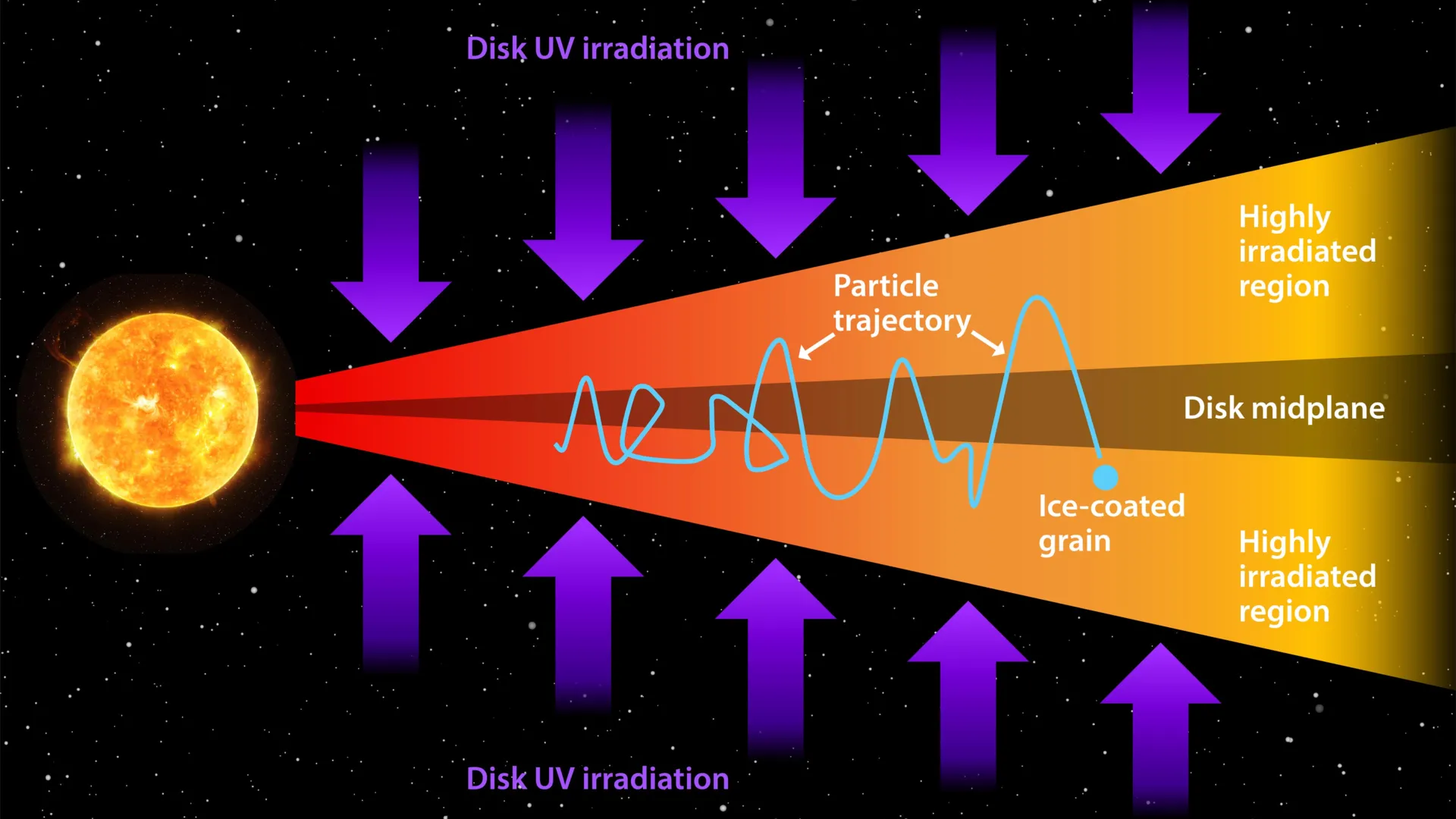
Complex organic molecules are carbon-based compounds that also incorporate vital elements such as oxygen and nitrogen, indispensable for the development and sustenance of living organisms. Laboratory experiments have convincingly demonstrated that these compounds can spontaneously form under conditions mimicking the early solar system. Specifically, when icy dust grains containing methanol, or mixtures of carbon dioxide and ammonia, are exposed to ultraviolet (UV) radiation or gentle heating, the chemical reactions necessary for COM synthesis can occur. These conditions are prevalent in protoplanetary disks, the vast, rotating clouds of gas and dust that surround young stars and serve as the nurseries for planetary systems.
The research team employed sophisticated modeling techniques to reconstruct the chemical processes and physical journeys of these icy particles. Their approach integrated models of disk evolution with detailed simulations tracking the movement of individual icy grains. This powerful combination allowed them to precisely quantify the radiation levels and temperature fluctuations experienced by these particles throughout their formative journeys.
Dr. Olivier Mousis, a lead author of one of the studies and a researcher in SwRI’s Solar System Science and Exploration Division, elaborated on the methodology. "By combining disk evolution with particle transport models, we could precisely quantify the radiation and thermal conditions the icy grains experienced," Dr. Mousis stated. "Then we directly compared our simulations with other laboratory experiments that produce COMs under realistic astrophysical conditions. The results showed that COM formation is possible in both the protosolar nebula environment and Jupiter’s circumplanetary disk."
The international consortium comprised scientists from SwRI in the United States, Aix-Marseille University in France, and the Institute for Advanced Studies in Ireland. Their collective efforts involved constructing highly detailed simulations of two crucial environments: the protosolar nebula, the immense cloud from which the Sun and all the planets eventually coalesced, and Jupiter’s circumplanetary disk. This latter disk was a swirling mass of gas and dust that encircled the young gas giant and ultimately gave rise to its extensive moon system, including the four large Galilean moons: Io, Europa, Ganymede, and Callisto.
By incorporating a component that tracked the transport of dust grains, the researchers were able to follow the migratory paths of icy particles. This meticulous tracing allowed them to reconstruct the physical and chemical history of the material that eventually coalesced to form these significant Jovian moons.
Delivering the Seeds of Life to the Galilean Moons
The simulations yielded compelling results, indicating that a substantial fraction of the icy grains present in the early solar system likely formed COMs. These organic-rich particles were then transported into the region where Jupiter’s moons were actively assembling. In some of the modeled scenarios, an astonishing nearly half of the particles tracked actively transported newly synthesized organic molecules from the broader protosolar nebula into Jupiter’s circumplanetary disk. Crucially, this material appears to have been incorporated into the nascent moons with minimal subsequent chemical alteration, preserving its complex organic structure.
Adding another layer of complexity and potential for organic richness, the research also suggests that some COMs may have formed much closer to Jupiter itself. The simulations indicate that certain regions within Jupiter’s circumplanetary disk experienced temperatures sufficiently high to drive the chemical reactions necessary for COM synthesis. This dual-source hypothesis implies that the Galilean moons may have inherited organic material from two distinct origins: the vast, primordial solar nebula and localized chemical activity occurring within Jupiter’s immediate orbital environment billions of years ago.
Ocean Worlds and the Enduring Quest for Habitability
The implications of these findings are particularly profound when considering the potential habitability of Jupiter’s icy moons. Europa, Ganymede, and Callisto are all known or strongly suspected to harbor vast subsurface oceans of liquid water beneath their frigid outer crusts. The presence of liquid water, combined with internal energy sources likely derived from tidal heating caused by Jupiter’s immense gravitational pull, makes these moons prime candidates in the ongoing search for extraterrestrial life.
If COMs, the fundamental building blocks of organic chemistry, were intrinsically embedded within the material that formed these moons from their inception, then these worlds may also possess the essential molecular ingredients required for prebiotic chemistry. This includes the formation of complex biomolecules such as amino acids and nucleotides, which are the foundational components of proteins and nucleic acids (DNA and RNA), respectively.
"Our findings suggest that Jupiter’s moons did not form as chemically pristine worlds," Dr. Mousis emphasized. "Instead, they may have accreted, or accumulated, a significant inventory of COMs at birth, providing a chemical foundation that could later interact with the liquid water in their interiors." This perspective fundamentally alters our understanding of the starting conditions for life’s potential emergence beyond Earth.
The scientific community is eagerly anticipating further data from upcoming missions designed to probe these intriguing worlds. NASA’s Europa Clipper mission and the European Space Agency’s Jupiter Icy Moons Explorer (JUICE) spacecraft are currently en route to the Jovian system. Their primary objectives are to meticulously investigate the structure, composition, and habitability of these moons, with a particular focus on Europa.
Dr. Mousis concluded by highlighting the scientific utility of this new research. "Establishing credible pathways for COMs formation and delivery provides scientists with a critical framework for interpreting upcoming measurements of Jupiter’s surface and subsurface chemistry," he stated. "By linking laboratory chemistry, disk physics and particle transport models, our work may highlight how habitable conditions are rooted in the earliest stages of planetary formation." This research serves as a vital bridge, connecting our understanding of early solar system processes with the potential for life on worlds beyond our own.
A Deeper Dive into the Early Solar System’s Chemical Forge
The period of protoplanetary disk formation, typically occurring within the first few million years of a star’s life, is a critical epoch for planetary development. The protosolar nebula, a vast expanse of gas and dust, began to collapse under its own gravity, forming the Sun at its center. The remaining material flattened into a disk, from which planets, asteroids, and comets eventually coalesced. Within this dynamic disk, temperatures varied significantly with distance from the young Sun, creating distinct chemical zones.
The inner solar system, closer to the Sun, was too hot for volatile compounds like water and ammonia to condense into ice. Instead, rocky and metallic materials dominated. Further out, in the region where Jupiter and the other giant planets formed, temperatures were low enough for ices of water, ammonia, methane, and carbon dioxide to be abundant. This icy material, in the form of dust grains, became a crucial medium for chemical reactions.
The discovery of COMs in comets and meteorites that have fallen to Earth has long suggested their prevalence in the early solar system. However, the precise mechanisms and locations of their formation and subsequent delivery to outer planets and their moons have remained a subject of intense scientific inquiry. The SwRI-led research directly addresses this by simulating the conditions within a protoplanetary disk and a circumplanetary disk, providing a tangible pathway for these vital molecules to reach destinations like Jupiter’s moons.
Timeline of Discovery and Future Exploration
- ~4.6 Billion Years Ago: The Sun and the protosolar nebula form. Temperatures in the outer solar system allow for the condensation of ices, forming dust grains.
- ~4.5 Billion Years Ago: Jupiter begins to form, accreting a massive circumplanetary disk of gas and dust. Icy grains within this disk are exposed to UV radiation and varying temperatures, leading to the formation of complex organic molecules (COMs).
- ~4.5 Billion Years Ago: The Galilean moons – Io, Europa, Ganymede, and Callisto – begin to form within Jupiter’s circumplanetary disk, accreting material rich in COMs.
- Present Day: Researchers at SwRI, Aix-Marseille University, and the Institute for Advanced Studies conduct advanced simulations modeling the formation and transport of COMs in the early solar system and within Jupiter’s circumplanetary disk.
- Published Findings: Companion papers detailing these simulations and their implications are published in The Planetary Science Journal and Monthly Notices of the Royal Astronomical Society.
- Future Exploration: NASA’s Europa Clipper mission and ESA’s JUICE spacecraft are en route to the Jovian system, with anticipated arrival dates in the coming years, to conduct in-situ investigations of the Galilean moons’ composition and potential habitability.
The scientific community anticipates that the data returned by these missions will provide critical validation for the theoretical models presented in these new studies, potentially confirming the widespread presence of organic building blocks on these distant, ocean-bearing worlds. The ongoing quest to understand the origins of life is increasingly looking to the outer solar system, and this latest research provides a compelling narrative for how the fundamental ingredients for life may have been present from the very dawn of planetary formation.