

The Ascent to Pharmaceutical Leadership
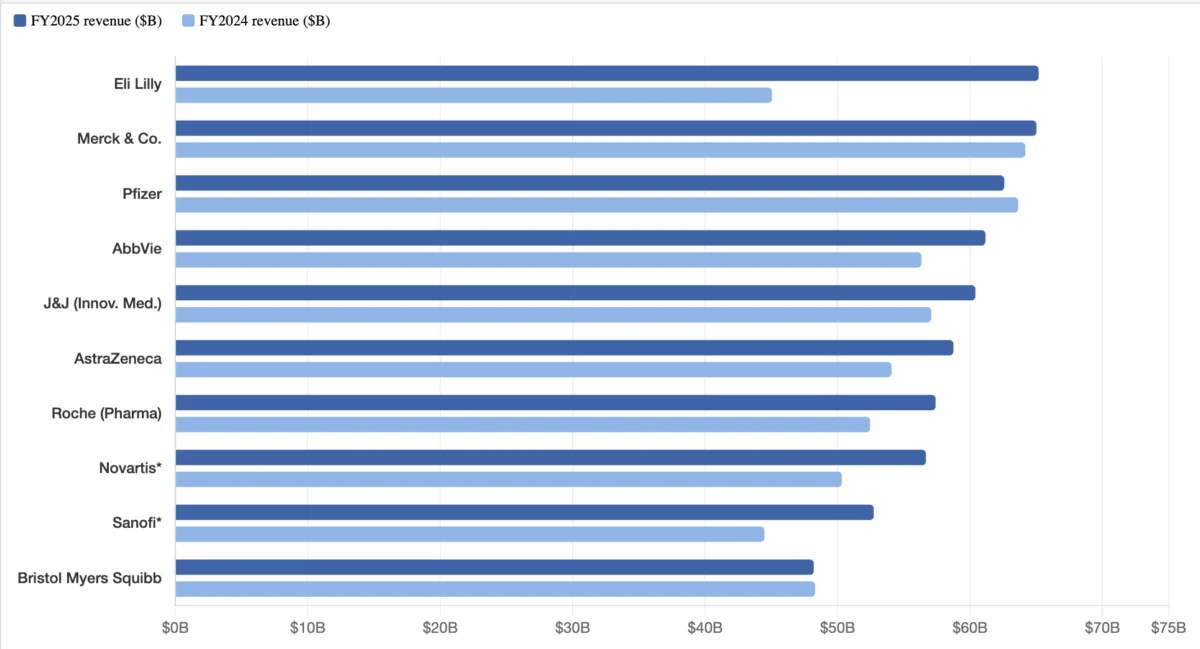
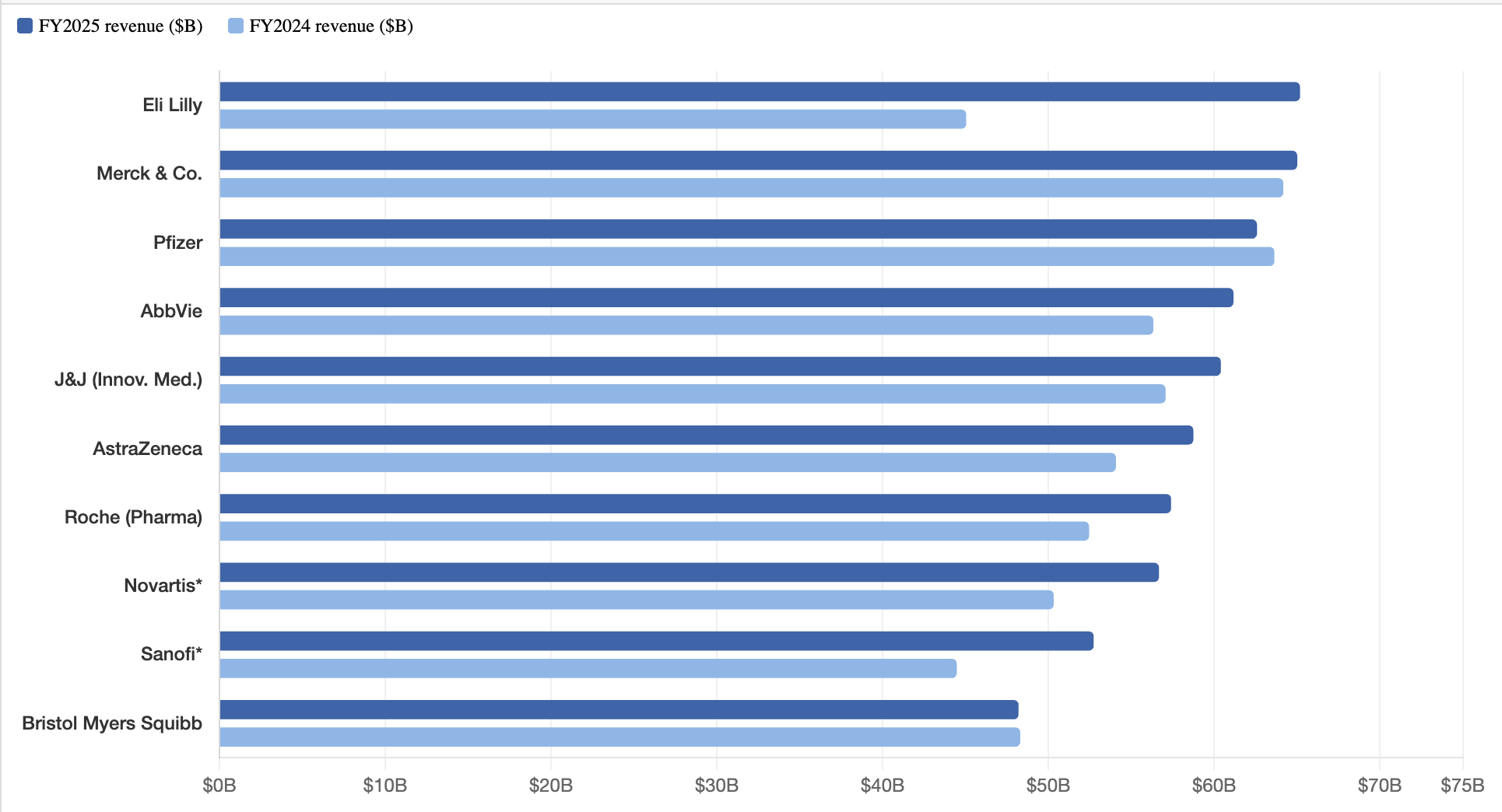
Eli Lilly’s journey to the top has been nothing short of meteoric. In 2020, the company’s annual revenue stood at $24.5 billion. Within a mere five years, this figure has nearly tripled, demonstrating an unparalleled expansion rate in an industry often characterized by incremental gains. The reported $65.2 billion for FY2025 represents an approximate 44.7% year-over-year revenue surge, translating to an astonishing gain of roughly $20.1 billion in a single fiscal year. This dramatic growth contrasts sharply with Merck’s performance, which remained essentially flat during the same period, as detailed in Eli Lilly’s official financial reports.
The rapid acceleration in Lilly’s financial performance has also led to an upward revision of future expectations. The company’s 2026 guidance, now projected at $80-$83 billion, already outpaces the earlier base-case model of $77.2 billion, signaling continued confidence in its pipeline and market position. This trajectory suggests that Lilly is not merely experiencing a temporary surge but is solidifying its new leadership position with sustained momentum.
Tirzepatide: The Unprecedented Engine of Growth
At the heart of Lilly’s unprecedented financial success lies tirzepatide, the active pharmaceutical ingredient behind both Mounjaro and Zepbound. This single franchise alone generated a combined $36.5 billion in revenue in FY2025. Mounjaro, approved for the treatment of Type 2 Diabetes, saw its revenue nearly double, reaching $23.0 billion, a remarkable 99% increase year-over-year. Following closely, Zepbound, indicated for chronic weight management, nearly tripled its revenue to $13.5 billion, representing an astounding 175% growth rate.
To put this figure into perspective, the $36.5 billion generated by the tirzepatide franchise alone now exceeds the total annual revenue of entire pharmaceutical companies such as Bristol Myers Squibb or Sanofi. This highlights the immense market demand and commercial power of these therapies, which have redefined treatment paradigms for metabolic diseases.
Background of a Breakthrough: Understanding Tirzepatide
Tirzepatide is a novel GIP (glucose-dependent insulinotropic polypeptide) and GLP-1 (glucagon-like peptide-1) receptor agonist. This dual-agonist mechanism distinguishes it from earlier GLP-1 monotherapy drugs, offering enhanced efficacy in blood glucose control and significant weight reduction.
- Mounjaro (tirzepatide) for Type 2 Diabetes: Approved by the U.S. Food and Drug Administration (FDA) in May 2022, Mounjaro quickly established itself as a highly effective treatment option for adults with Type 2 Diabetes. Clinical trials demonstrated its superiority in glycemic control and body weight reduction compared to other diabetes medications, including other GLP-1 agonists and basal insulin. The drug’s once-weekly injectable formulation also contributed to its patient convenience and adherence.
- Zepbound (tirzepatide) for Chronic Weight Management: Building on the profound weight loss observed in diabetes trials, Lilly pursued and secured FDA approval for tirzepatide under the brand name Zepbound for chronic weight management in adults with obesity or overweight with at least one weight-related comorbidity in November 2023. This approval opened up an even larger market, addressing a global health crisis that affects hundreds of millions of people. The SURMOUNT clinical trial program showcased unprecedented weight loss results, with participants achieving average weight reductions significantly higher than those seen with previous anti-obesity medications.
The scientific innovation behind tirzepatide represents a major leap forward in treating highly prevalent and interconnected conditions: Type 2 Diabetes and obesity. These conditions are not merely lifestyle issues but complex chronic diseases with severe health consequences, including cardiovascular disease, kidney disease, certain cancers, and reduced quality of life. The high efficacy of tirzepatide has positioned it as a transformative therapy, offering hope to millions worldwide.
Broader Portfolio and Strategic Diversification
While Mounjaro and Zepbound have undeniably been the primary drivers of Lilly’s recent growth, the company also boasts a robust and diversified portfolio of other successful therapies. Key products like Jardiance (empagliflozin) for Type 2 Diabetes and heart failure, Verzenio (abemaciclib) for breast cancer, and Taltz (ixekizumab) for autoimmune diseases suchade psoriasis and psoriatic arthritis, continue to contribute significantly to Lilly’s revenue. This diversification provides a stable foundation, ensuring that the company is not solely reliant on a single product franchise, even one as successful as tirzepatide.
Lilly’s strategic vision has been focused on identifying and investing in areas of high unmet medical need, particularly in diabetes, oncology, immunology, and neuroscience. The company’s consistent investment in research and development (R&D) has cultivated a rich pipeline, ensuring future growth beyond the current blockbusters. This long-term commitment to innovation is a hallmark of Lilly’s strategy and a critical factor in its sustained success.
The Competitive Landscape: A Shifting Paradigm
Lilly’s ascent to the top spot signals a notable shift in the pharmaceutical competitive landscape. For years, companies like Pfizer, Johnson & Johnson, Roche, and Merck have often vied for the top positions, driven by diverse portfolios spanning vaccines, oncology, immunology, and consumer health. Merck, a consistent leader, has long relied on its oncology blockbuster Keytruda (pembrolizumab) and vaccine franchise (e.g., Gardasil) for significant revenue. While Keytruda remains a dominant force, Merck’s overall revenue was essentially flat in FY2025, suggesting that its growth from established products was insufficient to offset other pressures, potentially including patent expirations on older drugs or increased competition in specific therapeutic areas.
The metabolic disease market, particularly for GLP-1 agonists, has become one of the most dynamic and lucrative sectors in pharmaceuticals. Lilly’s success with tirzepatide places it in direct competition with Novo Nordisk, the Danish pharmaceutical company that pioneered the GLP-1 class with drugs like Ozempic (semaglutide) for diabetes and Wegovy (semaglutide) for weight loss. While Novo Nordisk has also experienced explosive growth, Lilly’s dual-agonist mechanism has allowed it to carve out a significant and rapidly expanding share of the market. The intense competition between these two giants is driving further innovation, manufacturing scale-up, and market expansion in the obesity and diabetes space, promising continued advancements for patients.
Analyst and Investor Reactions
The financial community has reacted with enthusiasm to Lilly’s performance. Industry analysts have lauded the company’s foresight and execution, particularly in bringing tirzepatide to market so effectively. Wall Street has consistently revised its price targets for Lilly’s stock upwards, reflecting strong investor confidence in its growth prospects. The company’s market capitalization has soared, solidifying its position among the world’s most valuable pharmaceutical enterprises.
Analysts point to several factors contributing to this optimism: the vast untapped market for obesity treatment, the proven efficacy of tirzepatide, Lilly’s strong commercial execution, and a promising pipeline that includes potential new treatments for Alzheimer’s disease (donanemab) and other conditions. The ability to exceed ambitious growth forecasts has further cemented Lilly’s reputation as a top-tier pharmaceutical innovator and a highly attractive investment.
Challenges and Future Outlook
Despite its current dominance, Lilly faces several challenges typical of a rapidly growing pharmaceutical leader.
- Manufacturing Capacity: The unprecedented demand for Mounjaro and Zepbound has strained Lilly’s manufacturing capabilities. Scaling up production to meet global demand while ensuring consistent supply and quality is a critical ongoing challenge. The company has announced significant investments in new manufacturing facilities to address this, but these are long-term projects.
- Competition: While currently leading, the GLP-1 market is attracting significant interest from other pharmaceutical companies. New entrants and next-generation therapies from competitors, including oral formulations and combination therapies, could intensify competition in the coming years. Maintaining a competitive edge will require continuous innovation and strategic pricing.
- Pricing Pressure and Access: The high cost of novel anti-obesity and diabetes medications has raised concerns among payers, healthcare systems, and patient advocacy groups. Lilly, like other manufacturers in this space, will face increasing pressure regarding pricing and ensuring broad patient access, particularly as these drugs transition from niche treatments to widely adopted therapies.
- Pipeline Diversification: While tirzepatide is a powerhouse, a sustained leadership position requires a diversified pipeline. Lilly’s investments in other therapeutic areas, particularly Alzheimer’s disease with donanemab, will be crucial for long-term growth as current blockbusters eventually face patent expirations.
- Regulatory Scrutiny: As with any highly effective medication, ongoing post-market surveillance and regulatory scrutiny are essential. Managing potential side effects, real-world data, and public perception will be vital for maintaining trust and market position.
Looking ahead, Lilly’s 2026 guidance of $80-$83 billion signals confidence in continued robust growth. The company’s strategic focus on innovation, coupled with its proven ability to commercialize breakthrough therapies, positions it favorably to sustain its leadership. The impact of tirzepatide extends beyond financial metrics; it represents a paradigm shift in how chronic diseases like obesity and Type 2 Diabetes are managed, offering improved health outcomes for millions of patients and reshaping the global healthcare landscape.
Methodological Note
This analysis, reflecting a practical pharma-focused ranking, is built from company fiscal-year reporting, with segment carve-outs where necessary. It is designed to provide a clear picture of the world’s top-earning pharmaceutical companies based on reported revenue. While efforts are made to ensure comparability, it is important to acknowledge that the diverse operational structures and reporting standards across pharmaceutical giants mean that a perfectly "apples-to-apples" comparison across all metrics can be complex. However, for the purposes of overall revenue leadership, the presented figures offer a robust and indicative measure of market standing.











Leave a Reply