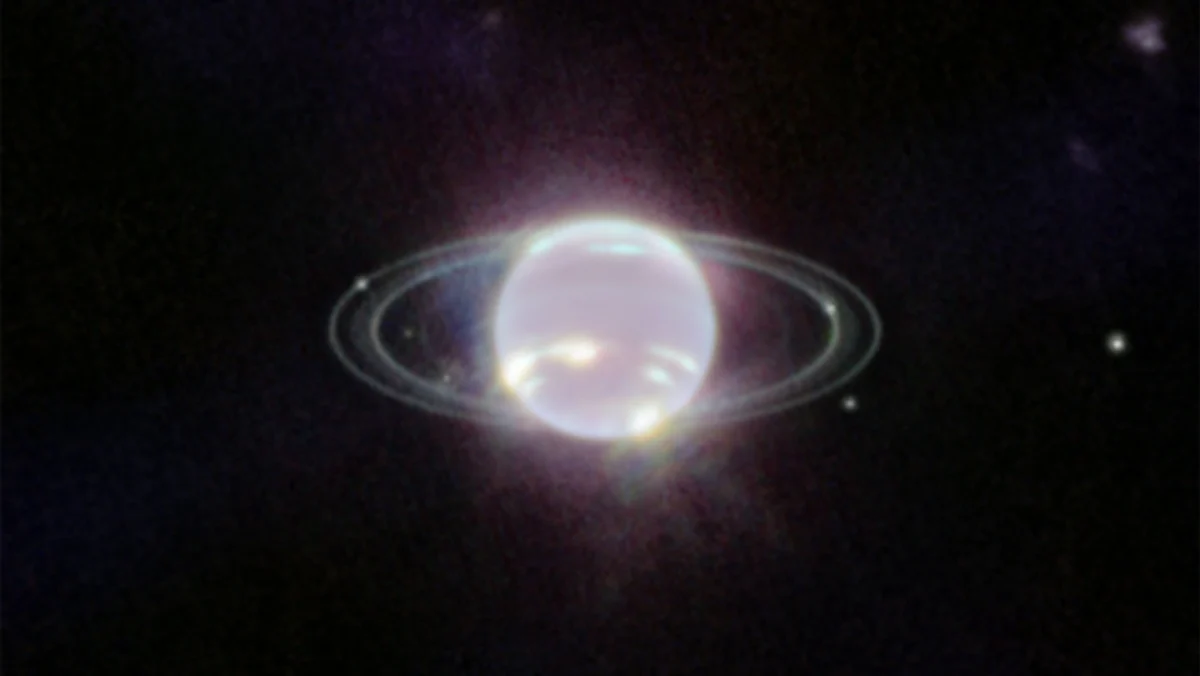
Challenging Orbital Origins: Nereid’s Peculiar Trajectory Hints at a Different Cosmic Past
Recent scientific scrutiny of Neptune’s enigmatic moon, Nereid, is prompting a significant reevaluation of its celestial origins. For decades, Nereid has been a subject of fascination for planetary scientists, not only for its irregular orbit but also for the prevailing theory that it was a Kuiper Belt Object (KBO) captured by Neptune’s immense gravitational pull. However, new data and sophisticated orbital simulations are casting doubt on this long-held hypothesis, suggesting a more complex and potentially more violent history for this distant moon. The implications of these findings could reshape our understanding of planetary system formation and the dynamics of outer solar system evolution.
Nereid, the third-largest of Neptune’s moons, possesses a highly eccentric and inclined orbit, a characteristic that has long pointed towards an external origin. Unlike the regular, nearly circular orbits of Neptune’s inner moons, Nereid’s path around the ice giant is anything but predictable. Its distance from Neptune varies dramatically, ranging from approximately 1.3 million kilometers to 10 million kilometers, with an orbital period of about 360 days. This extreme eccentricity and significant inclination (about 27 degrees) have historically been interpreted as strong evidence of a capture event. The dominant theory proposed that Nereid, originating from the frigid, distant Kuiper Belt – a vast reservoir of icy bodies beyond Neptune – was gravitationally ensnared by Neptune’s powerful influence.
The Kuiper Belt Capture Hypothesis: A Long-Standing Paradigm
The Kuiper Belt, a region extending from Neptune’s orbit (approximately 30 astronomical units, or AU, from the Sun) out to about 50 AU, is believed to be home to hundreds of thousands of icy bodies larger than 100 kilometers in diameter, and potentially trillions of comets. These objects are remnants from the early solar system, never having coalesced into planets. Their composition and orbital characteristics are a treasure trove of information about the conditions under which our solar system formed.
The capture of a KBO by a gas giant like Neptune would have been a dramatic event. Such an interaction would require a precise alignment of velocities and trajectories. As a KBO approached Neptune, the planet’s gravity could have acted as a cosmic net, altering the object’s path and locking it into orbit. However, the process of capture is not straightforward. Without some form of energy dissipation, such as a close encounter with another celestial body or interaction with Neptune’s extended atmosphere or a primordial disk of material, a passing KBO would likely have been flung away, rather than captured. The eccentric orbit of Nereid suggested that such an event had indeed occurred, albeit with significant gravitational nudging that resulted in its peculiar trajectory.
New Data, New Questions: Unraveling Nereid’s Orbital Enigma
The recent reevaluation of Nereid’s orbital dynamics stems from more precise measurements and advanced computational modeling. Scientists have been able to refine the orbital parameters of Nereid with greater accuracy, revealing subtle discrepancies that challenge the simplistic capture scenario. These updated models suggest that a simple, one-time capture event from the Kuiper Belt, as traditionally envisioned, may not fully account for Nereid’s current orbital state.
One of the key challenges lies in the stability of Nereid’s orbit. While it is eccentric, it has remained relatively stable over billions of years. The gravitational interactions within the Neptune system, including those with other moons and Neptune’s own oblateness, can significantly influence orbital evolution. Sophisticated simulations that incorporate these complex gravitational forces are revealing that Nereid’s orbit might be more sensitive to past perturbations than previously understood.
Furthermore, the composition of Nereid, while not directly observed in great detail, is inferred from its albedo and reflectivity. If Nereid were a typical KBO, it would be expected to have a composition rich in ices like water, methane, and ammonia, and potentially a reddish hue due to tholins – complex organic molecules formed by ultraviolet radiation. While Nereid’s surface properties are not definitively known, preliminary observations do not exclusively point to a KBO origin.
Alternative Scenarios: Internal Formation and Tidal Evolution
The persistent questions surrounding Nereid’s origin have led researchers to explore alternative hypotheses. One compelling alternative suggests that Nereid might not be a captured interloper at all, but rather a remnant from Neptune’s early formation. During the formation of the solar system, gas giants are thought to have accretied a significant amount of material, forming a circumplanetary disk of gas and dust. It is possible that Nereid, or a larger progenitor body from which Nereid formed, originated within this primordial disk around Neptune.
In this scenario, Nereid would have been part of Neptune’s original satellite system. Its current eccentric orbit could then be explained by subsequent gravitational interactions with other large moons in the system, particularly Triton, Neptune’s largest moon. Triton, itself believed to be a captured KBO, has a retrograde orbit, meaning it orbits Neptune in the opposite direction to the planet’s rotation and most other moons. The immense gravitational influence of Triton, especially during its initial capture and subsequent orbital evolution, could have significantly perturbed the orbits of Neptune’s inner moons, potentially flinging them into highly eccentric and inclined paths.
The Role of Triton: A Gravitational Dance of Chaos
The hypothesis that Triton played a crucial role in shaping Nereid’s orbit is gaining traction. Triton’s capture into Neptune’s orbit is thought to have been a cataclysmic event. As Triton settled into its retrograde orbit, it would have disrupted the orbits of any pre-existing moons in a chaotic gravitational ballet. This disruption could have easily ejected smaller moons or significantly altered the orbits of larger ones like Nereid.
If Nereid formed within Neptune’s original circumplanetary disk, its orbit would have been more regular initially. However, the powerful gravitational tides exerted by Triton, especially during its early, likely more eccentric orbit around Neptune, could have gradually pumped up Nereid’s eccentricity and inclination over billions of years. This process, known as orbital resonance, can efficiently transfer energy between celestial bodies, leading to dramatic changes in their orbital parameters.
Chronology of Understanding: From Discovery to Reevaluation
Nereid was discovered on May 1, 1949, by astronomer Gerard Kuiper during his survey for trans-Neptunian objects. Its peculiar orbit was noted early on, but detailed analysis and understanding of its dynamics were limited by the technology of the time. Voyager 2’s flyby of Neptune in 1989 provided the first close-up observations of the planet and its moons, including Nereid, offering more precise data on its orbital characteristics. However, even these observations were not sufficient to definitively resolve the questions surrounding its origin.
The advent of powerful ground-based telescopes and the deployment of the Hubble Space Telescope in the 1990s and early 2000s allowed for more sustained observations of the outer solar system. More recently, the capabilities of the James Webb Space Telescope (JWST), with its unprecedented infrared sensitivity, have begun to revolutionize our understanding of distant celestial bodies. While JWST has primarily focused on distant galaxies and exoplanets, its advanced imaging capabilities are also being applied to objects within our own solar system, potentially providing new spectral data on Nereid’s composition and further refining its orbital parameters.
Supporting Data and Simulations: The Power of Computational Astronomy
Modern astronomical research relies heavily on sophisticated computer simulations. These simulations allow scientists to model complex gravitational interactions over vast timescales, testing various scenarios for orbital evolution. For Nereid, researchers have developed models that incorporate the gravitational influence of Neptune, its other moons (including Triton), and even the Sun.
By running these simulations forward and backward in time, scientists can explore whether Nereid’s current orbit is consistent with a Kuiper Belt capture scenario or an internally formed origin followed by tidal evolution. The results of these simulations are crucial in evaluating the plausibility of different hypotheses. For instance, simulations that demonstrate the gradual excitation of Nereid’s orbit due to Triton’s gravitational influence over billions of years lend strong support to the internal formation hypothesis. Conversely, simulations that struggle to reproduce Nereid’s current orbital state through a simple capture event weaken the Kuiper Belt hypothesis.
Implications for Planetary Science: A Broader Cosmic Context
The reevaluation of Nereid’s origin has significant implications for our understanding of planetary system formation and evolution. If Nereid originated internally, it would suggest that the early satellite systems of gas giants were more dynamic and potentially more chaotic than previously assumed. It would also highlight the profound impact that the capture of large moons, like Triton, can have on the entire satellite system.
This research also contributes to the broader study of exoplanets. By understanding the formation and evolution of moons in our own solar system, scientists can gain valuable insights into the potential diversity of planetary systems elsewhere in the galaxy. The processes that shape the orbits of moons around Neptune may be mirrored in the complex orbital dynamics observed in exoplanetary systems.
Future Research: Unveiling the Secrets of the Ice Giants
The ongoing debate about Nereid’s origin underscores the need for further observational data and theoretical work. Future missions to the outer solar system, or more advanced telescopic observations, could provide crucial information about Nereid’s composition, helping to definitively determine whether it shares the characteristics of Kuiper Belt Objects. Continued advancements in computational modeling will also be essential in refining our understanding of the complex gravitational interactions that govern the Neptune system.
The story of Nereid is a compelling reminder that even seemingly well-understood celestial bodies can hold profound mysteries. As our scientific tools and understanding evolve, the icy moons of Neptune continue to offer tantalizing clues about the dynamic and often violent history of our solar system and the broader universe. The question of Nereid’s true origin remains an active area of research, promising further revelations about the fascinating and complex processes that shaped the worlds around us.