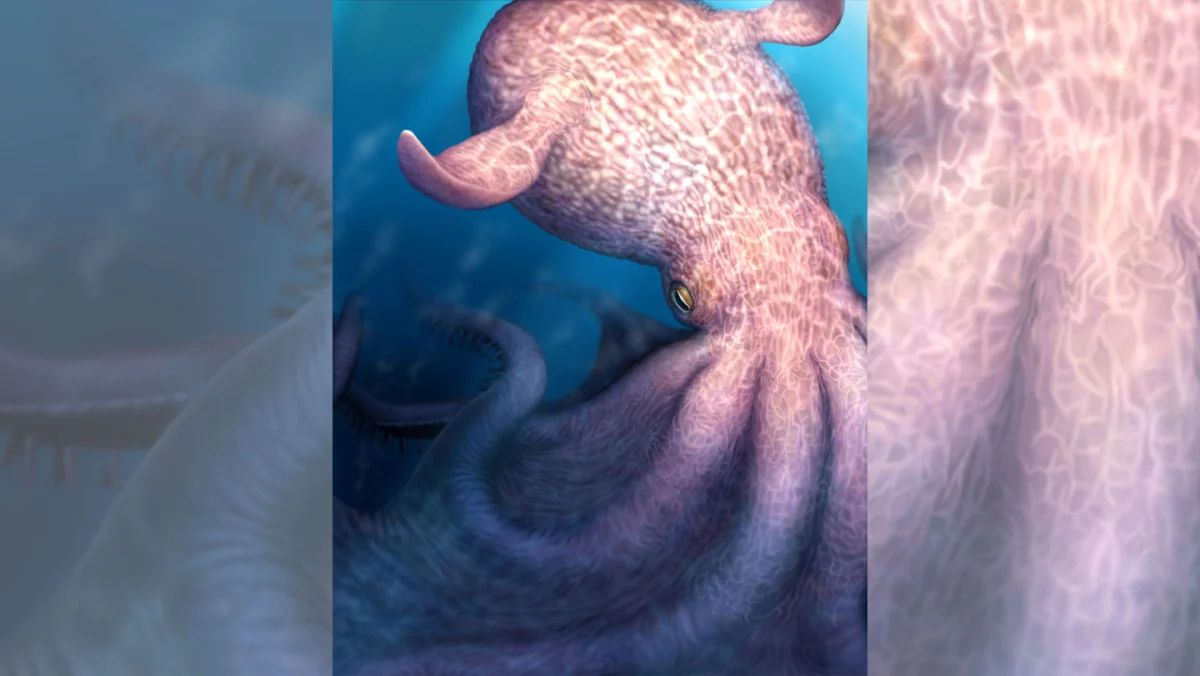
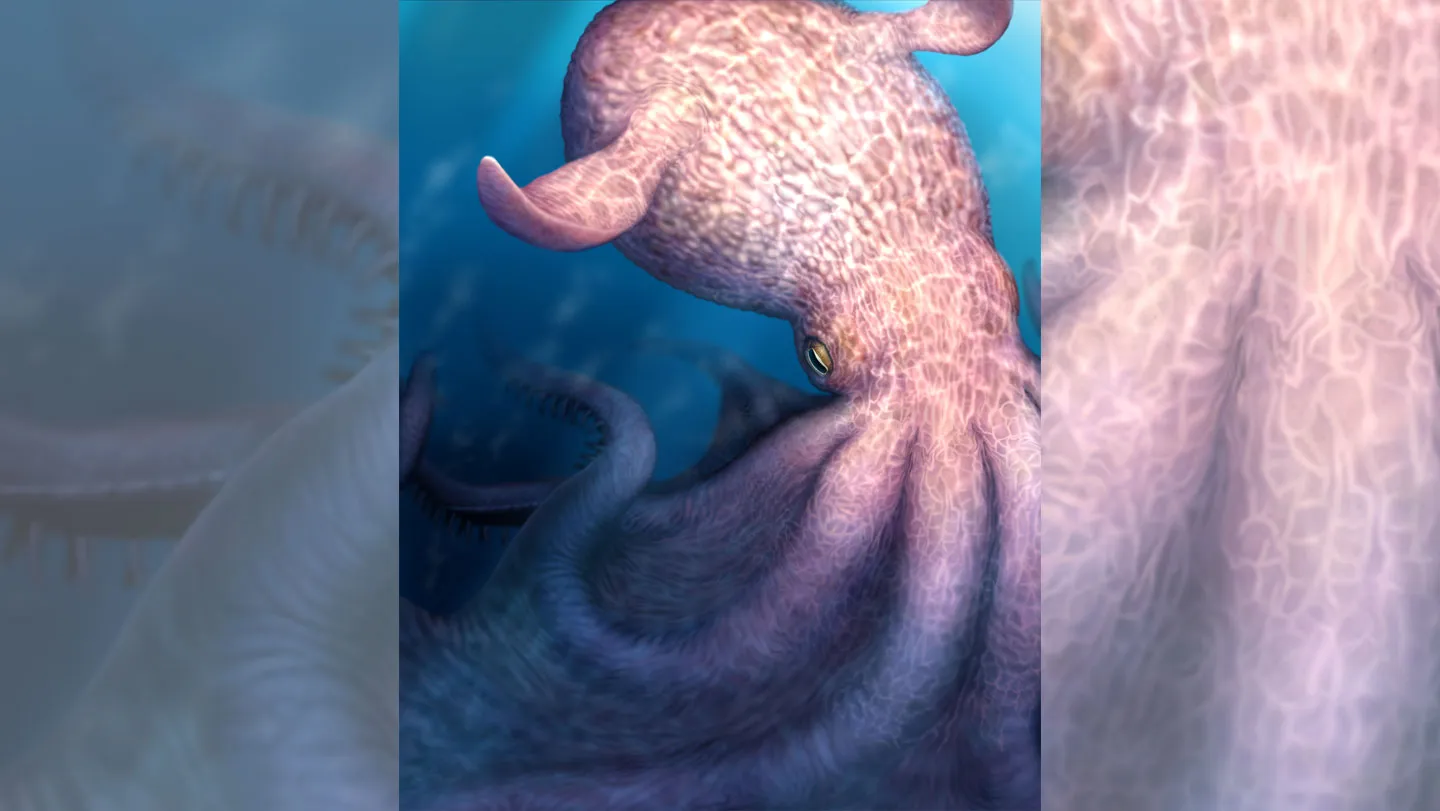
The legendary kraken, a mythical beast of the deep capable of dragging ships to their watery graves, has long captured the human imagination. Now, a remarkable fossil discovery is bringing a real-life echo of this legend to light, revealing that colossal, tentacled predators, rivaling the size of modern whales, once stalked the oceans during the age of dinosaurs. Researchers have identified fossilized jaws belonging to an ancient octopus species, Nanaimoteuthis haggarti, that may have been the largest invertebrate to ever exist, challenging our understanding of prehistoric marine ecosystems.
The groundbreaking findings, published in the journal Science on April 23rd, suggest that these gargantuan cephalopods reached lengths of up to 19 meters (approximately 62 feet), dwarfing even today’s largest living cephalopods, the giant squid. These ancient titans of the sea occupied the apex predator role during the Cretaceous Period, an era dominated by terrestrial dinosaurs, approximately 72 to 100 million years ago.
Unearthing Ancient Giants: The Challenge of Fossilizing Soft-Bodied Creatures
Studying extinct cephalopods presents a significant challenge for paleontologists. Unlike their bony counterparts, the soft, gelatinous bodies of octopuses and squids are rarely preserved in the fossil record. Typically, only the more durable parts, such as the beak-like jaws, survive the ravages of time and geological processes to become fossilized. This scarcity of hard parts has historically limited our ability to reconstruct the size, diversity, and ecological roles of these ancient marine invertebrates.
"It’s difficult to study fossil octopuses because most of their soft bodies often decompose before fossilization," explains Yasuhiro Iba, a paleontologist at Hokkaido University in Sapporo, Japan, and lead author of the study. "Precious few hard parts, like their beaklike jaws, are left behind to fossilize."
A New Look at Old Fossils and Innovative Techniques
The research team, led by Iba, re-examined 15 previously discovered fossil cephalopod jaws, unearthed in Japan and from Vancouver Island in Canada. These specimens, dating back to the Late Cretaceous, had previously been attributed to five different extinct species. However, by meticulously measuring these jaws and comparing them with those of extant and other extinct cephalopod species, the researchers began to suspect a different story.
Adding to their investigation, the team employed a sophisticated technique to uncover and document an additional 12 jaw fossils embedded in rocks from Japan. This method involved grinding down the rocks layer by layer and photographing each stage. Crucially, the researchers leveraged artificial intelligence (AI) to create detailed digital models of fossils that were too fragile to extract using conventional paleontological methods. This innovative approach allowed for a more comprehensive analysis of these delicate specimens.
Redefining Species and Unveiling Ancient Relatives
Through this rigorous analysis, Iba and his colleagues reclassified the 27 cephalopod jaws, consolidating them into just two species: Nanaimoteuthis jeletzkyi and the significantly larger N. haggarti. Their comparative studies of jaw morphology suggest that these ancient creatures were early relatives of modern finned octopuses. Today’s finned octopuses, such as the iconic dumbo octopus, are adapted to deep-sea environments and possess distinctive webbing between their arms and a pair of flapping fins on their mantle.
The newly described N. haggarti not only confirms the existence of large prehistoric octopuses but also suggests a lineage of truly colossal invertebrates. The largest lower jaw attributed to N. haggarti was found to be approximately 50 percent larger than that of a modern giant squid, which can reach lengths of up to 12 meters. Based on these jaw dimensions and comparisons with related species, the researchers estimate that N. haggarti, with its expansive mantle and arms, could have spanned an astonishing seven to 19 meters in length.
A New Apex Predator in the Cretaceous Seas
The sheer size of N. haggarti positions it as a formidable presence in the Cretaceous marine food web. Its estimated length suggests it would have been a direct competitor with, or even surpassed, the largest marine predators of its time. These included formidable marine reptiles such as the mosasaurs, apex predators of the Late Cretaceous seas, and the long-necked plesiosaurs, which patrolled the ancient oceans.
"The animal may have been among the largest invertebrates in Earth’s history," states Iba. This discovery significantly expands our understanding of the diversity of life and the complexity of marine ecosystems during the age of dinosaurs. For a long time, the top of the marine food web was largely presumed to be dominated by large vertebrates. "Our study shows that giant invertebrates – octopuses – also occupied that role in the Cretaceous," Iba adds.
Clues to Diet and Predatory Habits
Further analysis of the fossilized jaws provides intriguing insights into the feeding habits of N. haggarti. Consistent wear and damage patterns observed on the jaws suggest that these octopuses were powerful and voracious predators. The evidence points to them routinely biting into tough materials such as shells and bones, indicating a diet that likely included large invertebrates and possibly even smaller vertebrates.
This dietary inference, coupled with their immense size, suggests that N. haggarti played a significant role in shaping the Cretaceous marine ecosystem. Their predatory pressure could have influenced the populations of their prey species and contributed to the overall dynamics of the food web.
Broader Implications for Paleontology and Marine Biology
The identification of such a massive invertebrate predator has significant implications for our understanding of prehistoric marine ecosystems. It suggests that the biodiversity and complexity of these ancient environments may have been underestimated. The presence of a cephalopod at the top of the food chain alongside large marine reptiles indicates a more nuanced ecological structure than previously assumed.
Christian Klug, a paleontologist at the University of Zurich, while acknowledging the limitations of extrapolating size from fossil jaws alone, concurs with the study’s main conclusion. "There is no doubt that these animals ranged among the top predators," Klug commented. He suggests that future fossil discoveries might refine the precise ecological roles and exact sizes of these ancient cephalopods.
The potential ecological niche occupied by N. haggarti raises further questions about its interactions with other marine life. Adiël Klompmaker, a paleontologist at the University of Alabama in Tuscaloosa, expressed enthusiasm for future discoveries that could shed more light on the creature’s diet. "That would tell us what they ate," Klompmaker said. "Shelly invertebrates such as large ammonites, or did they also go after large vertebrates?"
The discovery of Nanaimoteuthis haggarti is a testament to the ongoing process of scientific discovery and the power of re-examining existing fossil collections with new techniques and perspectives. As paleontologists continue to explore the fossil record, more secrets of these ancient "krakens" and the dynamic prehistoric oceans they inhabited are likely to be unearthed, further enriching our knowledge of Earth’s evolutionary history.