

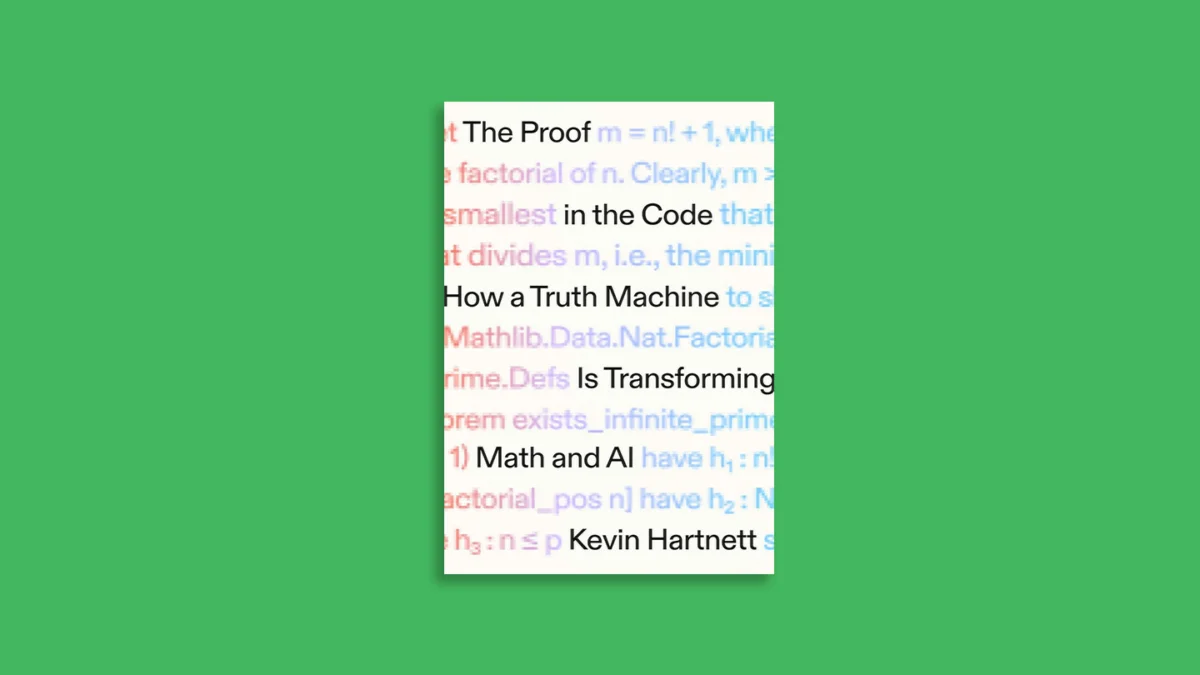
The landscape of mathematics is undergoing a profound transformation, driven by the burgeoning capabilities of artificial intelligence in tackling complex proofs. A new book, "The Proof in the Code" by journalist Kevin Hartnett, meticulously chronicles this seismic shift, detailing the journey of sophisticated computer programs from niche academic curiosities to powerful tools capable of verifying and even assisting in the generation of mathematical truths. This evolution, rooted in the development of proof assistant software, particularly the widely adopted program Lean, is ushering in an era where the rigorous, logical underpinnings of mathematics are being reinforced and expanded by computational power.
The Dawn of AI in Mathematical Olympiads
A significant marker of this burgeoning AI capability occurred in 2024 when Google Deepmind’s AlphaProof, an AI program trained on advanced mathematical reasoning, participated unofficially in the International Mathematical Olympiad (IMO). The IMO, a prestigious global competition where top high school students tackle six challenging mathematical problems over two intensive days, witnessed AlphaProof achieve a silver-medal level score of 28 out of a possible 42 points. This achievement, while unofficial, sent ripples through the scientific community, highlighting the accelerating prowess of AI in a domain long considered the exclusive bastion of human intellect.
AlphaProof’s success is a testament to the advancements in automated theorem proving, a field dedicated to developing AI systems that can rigorously prove mathematical statements. Just a few years prior, automating mathematical reasoning was considered an ambitious, even daunting, undertaking. However, the persistent efforts of researchers at institutions like Google Deepmind have not only pushed the boundaries of AI’s reasoning abilities but have also laid the groundwork for AI tools that could potentially mitigate the pervasive issue of "hallucinations" – instances where AI generates fabricated information – by grounding their outputs in verifiable logical structures.
The Genesis of Lean and Its Mathematical Embrace
The success of programs like AlphaProof owes a significant debt to the proof assistant program Lean. Initially launched in 2013 by Leo de Moura while he was a software engineer at Microsoft Research, Lean was designed as a tool for verifying software code. Its fundamental purpose was to ensure the logical integrity and absence of errors in complex programming. However, its inherent design, built upon precise syntax and a series of logical steps, mirrored the structure of mathematical proofs. This inherent similarity laid the foundation for its eventual adoption by the mathematical community.
Hartnett’s "The Proof in the Code" meticulously traces the journey of Lean from its origins as a software verification tool to its current status as a celebrated program among mathematicians and AI researchers. The book delves into the dedication of de Moura, who pursued the development of software with no immediate commercial application, and the determined efforts of a dedicated cadre of mathematicians who championed its adoption within their field. The narrative unfolds through the stories of various individuals globally who recognized Lean’s potential to revolutionize the verification of mathematical truths and actively contributed to making the program more accessible and user-friendly. This collective endeavor paints an inspiring picture of interdisciplinary collaboration.
The Symbiotic Relationship Between Mathematics and Code
A key insight explored in the initial chapters of Hartnett’s book is the profound parallelism between the disciplines of mathematics and computer programming. Hartnett articulates this connection by observing that "Both are written in exact syntax as a series of logical steps, each one leading to the next." He further elaborates, "A gap in the logic of a proof is like a bug in software code." Just as a program executes flawlessly when its code adheres to correct logic, a new mathematical theorem emerges from a correctly formulated proof. This fundamental congruence made Lean’s transition from software verification to mathematical proof assistance a natural, albeit challenging, progression.
Interactive Theorem Provers: Verifying the Unverifiable
The advent of proof assistants, also known as interactive theorem provers, marked a pivotal moment. These programs, including Lean, possess the remarkable ability to meticulously verify new mathematical proofs, which can often be hundreds of pages long and require months of human review. While these AI systems are not yet capable of independently generating novel proofs, their capacity to ensure the error-free nature of human-generated proofs significantly accelerates the pace at which new mathematical facts can be established and integrated into further research.
However, the initial implementation of proof assistants presented significant hurdles. They were often clunky and required mathematicians to adopt an entirely new way of expressing their work. The process involved translating complex mathematical problems from natural language into formal code, a demanding task that necessitated the creation of extensive libraries containing coded definitions and theorems of fundamental mathematical concepts.
The "2 is Not Equal to 1" Hurdle: A Metaphor for Early Challenges
A compelling anecdote illustrating these early challenges is recounted by Kevin Buzzard, a mathematics professor at Imperial College London. When tasked with developing problem sets for his undergraduate students to learn Lean, Buzzard encountered an unexpected obstacle. As Hartnett notes, "Lean asked him to prove that 2 is not equal to 1." This statement, so intuitively and universally understood as true by humans that it would never require justification in everyday discourse, presented a fundamental requirement for Lean. The program, adhering to its strict logical framework, demanded a formal proof of this basic inequality before allowing its use within a larger proof. This seemingly trivial demand underscored the vast chasm between human mathematical intuition and the explicit, step-by-step logic required by computational proof assistants.
Building the Mathematical Universe in Lean
For a considerable period, the utility of Lean for mathematicians was constrained by the limited scope of its internal mathematical libraries. The addition of more mathematical content was intrinsically linked to an increased number of mathematicians engaging with and contributing to the program. Hartnett’s narrative highlights the concerted efforts undertaken by mathematicians to popularize Lean and expand its foundational knowledge base.
A significant undertaking, for instance, involved the translation of "perfectoid spaces" into Lean. This complex and cutting-edge area of arithmetic geometry, a vibrant field of mathematical research, demanded months of dedicated work and the development of many thousands of lines of code. These efforts, however, proved to be a turning point. By 2025, the number of users actively employing Lean had surged into the tens of thousands, spanning both academic institutions and technology companies. These users were embarking on increasingly ambitious projects, including AI researchers who found in Lean a rich repository of advanced mathematical knowledge essential for training sophisticated math-solving AI models like AlphaProof.
The Pursuit of a "Truth Machine"
At the core of both Leo de Moura’s vision and the aspirations of the mathematicians who embraced Lean lies the concept of a "truth machine." Hartnett describes this as "a computer program that can provide a complete, 100 percent guarantee that a chain of logic is correct." For de Moura, this truth was primarily concerned with ensuring the flawless execution of computer programs, guaranteeing that software like Microsoft Word was free from bugs and logical errors. For mathematicians, a truth machine promised a future where mathematical discoveries could be made with unprecedented rigor, organization, and exactitude, minimizing the possibility of subtle errors that could undermine entire lines of reasoning.
Implications and the Future of Mathematical Discovery
The integration of AI into mathematical proof verification and assistance carries profound implications. It has the potential to democratize access to advanced mathematical knowledge by providing tools that can help students and researchers navigate complex proofs. Furthermore, it could accelerate the pace of discovery by freeing mathematicians from the most tedious aspects of proof verification, allowing them to focus on conceptual breakthroughs and the exploration of new mathematical frontiers.
The book’s narrative structure, which sometimes jumps between timelines and introduces characters and anecdotes without explicit connection, can present a challenge for readers seeking a linear progression. However, for those with a keen interest in mathematics, "The Proof in the Code" offers a richly textured and compelling account of Lean’s journey and its pivotal role in ushering in a new and dynamic chapter in the history of mathematics. This ongoing symbiosis between human ingenuity and artificial intelligence promises to redefine the boundaries of what is mathematically possible, leading to discoveries and insights that were previously unimaginable. The rigorous verification provided by AI tools ensures that these new frontiers are built upon a foundation of unassailable logical certainty.

















Leave a Reply