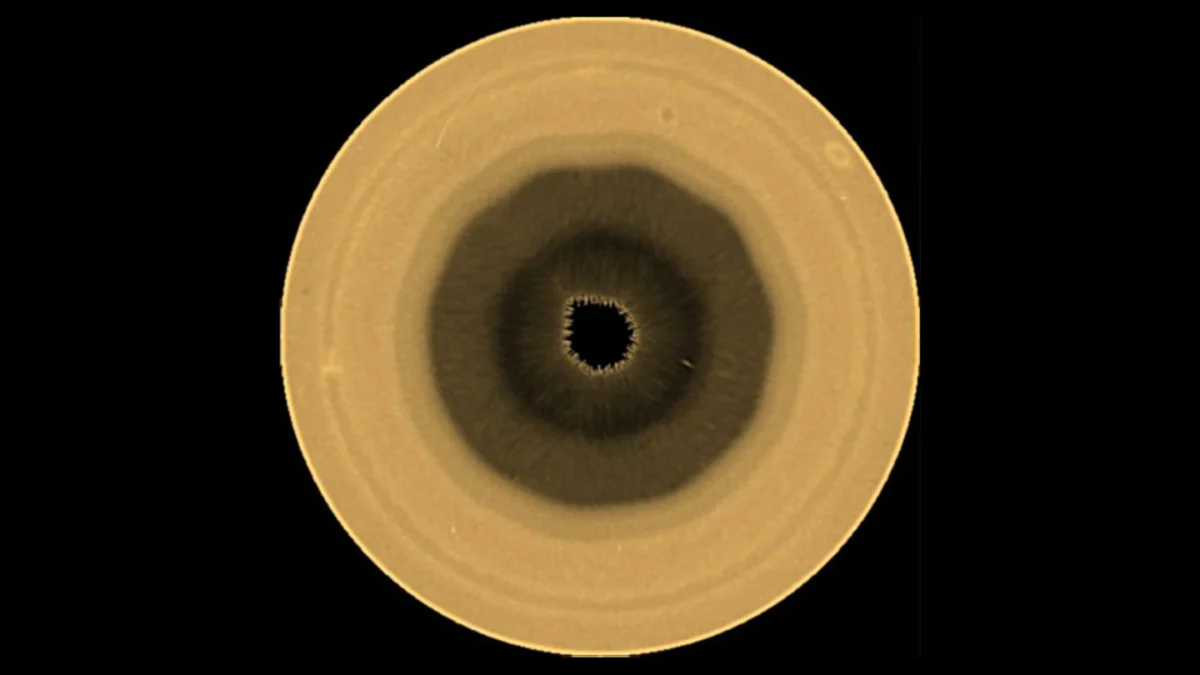
The recent discovery of a ten-sided atmospheric wave structure surrounding Saturn’s south pole has introduced a significant anomaly into planetary science, forcing researchers to re-examine their understanding of gas giant dynamics. Captured by the Hubble Space Telescope on August 29, 2025, this geometric phenomenon manifests as a distinct, stable polygon embedded within the planet’s turbulent southern atmosphere. The presence of such a complex, large-scale feature is particularly baffling to planetary scientists because it remained completely undetected during the extensive 13-year observation window provided by NASA’s Cassini mission, which concluded in 2017.
A Departure from Historical Observations
For over a decade, the Cassini-Huygens spacecraft provided an unprecedented high-resolution portrait of Saturn. Throughout its mission, Cassini monitored the planet’s poles, famously documenting the "Hexagon"—a persistent, six-sided jet stream structure encircling Saturn’s north pole. That feature has been a cornerstone of atmospheric studies since its discovery by Voyager 1 in 1980. However, the south pole, while known for a powerful polar vortex, never displayed a geometric symmetry comparable to the north until this recent Hubble observation.
The sudden emergence of a decagon—a ten-sided polygon—suggests that the atmospheric conditions governing these stable waves are far more fluid and transient than previously theorized. Scientists are now tasked with determining whether this is a recurring feature that simply went dormant during the Cassini era, or if it represents a fundamental shift in the planet’s internal energy dissipation or atmospheric circulation patterns.
Chronology of the Discovery and Monitoring
The detection of the decagon was made possible by the Hubble Space Telescope’s Outer Planet Atmospheres Legacy (OPAL) program. Since 2014, the OPAL project has provided annual global maps of the outer gas giants to track long-term changes.
- 1980–1981: The Voyager missions provide the first glimpse of Saturn’s north polar hexagon.
- 2004–2017: The Cassini spacecraft orbits Saturn, providing 13 years of continuous monitoring. During this time, the south pole is observed extensively, but no stable geometric polygons are reported.
- 2023–2024: Subtle shifts in southern hemisphere cloud activity are noted during routine Hubble monitoring, though they are initially dismissed as localized storms.
- August 29, 2025: Hubble’s high-resolution imaging captures the clear outline of a 10-sided atmospheric wave structure, triggering an immediate reassessment of archived data.
- September 2026: Formal analysis by the University of the Basque Country (EHU) and international partners confirms the stability and scale of the structure, leading to the current scientific discourse.
Fluid Dynamics and Polygon Stability
The existence of large-scale polygons on a rotating sphere is a classic problem in fluid dynamics, often explained by the Rossby wave theory. On gas giants, these waves are essentially ripples in the jet streams. When the wind speeds, density, and temperature gradients align correctly, these waves can become "locked" into a repeating geometric pattern.
In the case of Saturn’s north pole, the hexagon is anchored by a persistent, high-speed jet stream. The new southern decagon, however, appears to operate under different physical constraints. Researchers suggest that the number of sides in such a polygon is intrinsically linked to the speed of the zonal winds and the degree of horizontal shear. The transition from a circular flow to a ten-sided structure implies that Saturn’s southern atmospheric circulation has undergone a subtle but critical change in its wind profile.
This development is forcing meteorologists to revisit the "Barotropic Instability" model. If the planet’s atmosphere can spontaneously generate a ten-sided wave, it suggests that the interior thermal energy, which drives these winds, might be fluctuating in ways that were not captured by short-term mission cycles.
Scientific Implications and Data Analysis
The lack of this feature during the Cassini mission is the most provocative aspect of the finding. During its final years, Cassini flew high-inclination orbits that offered direct, top-down views of the south pole. If the decagon was not visible then, it implies one of three possibilities: the feature is a seasonal phenomenon that only appears under specific solar illumination; it is a manifestation of long-term internal cycles spanning decades; or it is a recent byproduct of changes in Saturn’s deep-seated atmospheric heat transport.
Preliminary data from the Hubble images show that the decagon possesses a distinct thermal signature, separate from the surrounding gas. By measuring the contrast in the cloud-top light reflections, researchers have determined that the structure spans thousands of kilometers, making it a planetary-scale feature. Unlike the north pole’s hexagon, which appears relatively static, the decagon shows subtle signs of "pulsing" or periodic expansion and contraction, which may provide clues about the depth of the jet stream supporting the structure.
Expert Reactions and Ongoing Investigation
Dr. A. Sánchez-Lavega, a leading planetary scientist at the University of the Basque Country, notes that the discovery serves as a reminder of the limitations of "snapshot" science in planetary exploration. "We often mistake the absence of evidence for the absence of the feature itself," Sánchez-Lavega noted in preliminary briefing materials. "The decagon proves that Saturn is not a static machine, but a dynamic, evolving laboratory of fluid physics."
NASA and ESA administrators have acknowledged the finding, noting that the data underscores the necessity of the OPAL program. The ability of the Hubble Space Telescope to continue observing these planets long after specialized probes have ceased operations is now considered critical for understanding the life cycles of atmospheric phenomena.
International research groups are currently performing high-fidelity computer simulations to replicate the conditions necessary for a 10-sided wave. By varying the input parameters—such as wind shear intensity and planetary rotation speed—they hope to determine if the decagon can be sustained by the same physical laws that govern the north pole’s hexagon.
Broader Impact on Planetary Meteorology
The discovery of the southern decagon has broader implications for how we view other planets in the solar system, particularly Jupiter and Neptune. Both planets possess complex, chaotic atmospheric features, yet neither has shown the rigid, geometric stability seen at Saturn’s poles. If Saturn can "switch" between these patterns, it suggests that the boundary between chaotic turbulence and structured order is much thinner than previously assumed.
Furthermore, this finding has sparked a debate regarding the frequency of future missions to the Saturnian system. While orbiter missions like Cassini provide unparalleled detail, they are finite in duration. The decagon incident provides a strong argument for sustained, long-term monitoring from Earth-orbiting assets and potential future flyby missions that can provide a "check-up" on these long-term atmospheric cycles.
As scientists continue to process the Hubble imagery, the focus has shifted toward predicting the longevity of the decagon. If the structure persists, it will provide a rare opportunity to study the lifecycle of a major planetary feature in real-time. If it vanishes, it will be equally telling, confirming that the atmosphere of Saturn is governed by transient processes that may be tied to the planet’s internal heat cycle, which operates on a timescale far longer than a standard human observation period.
The study of Saturn’s southern decagon is not merely an exercise in cataloging features; it is an essential step in refining our models of planetary atmospheres. As we look toward the next generation of space telescopes and potential future missions to the ringed planet, the decagon stands as a testament to the persistent mysteries that remain in our own cosmic backyard. For now, the scientific community waits to see if this geometric anomaly is a brief flare in the dark or the beginning of a new, long-term atmospheric chapter for the sixth planet from the sun.