A significant paradigm shift is underway in the pharmaceutical industry’s approach to small-molecule drug discovery, as a new collaborative platform, ADME-One, emerges to revolutionize how Absorption, Distribution, Metabolism, and Excretion (ADME) profiling is integrated into the early stages of drug development. Traditionally, comprehensive ADME assessment has been a costly and time-consuming bottleneck, reserved for the later "lead optimization" phase, once a promising compound series has already been identified and significant resources invested. This conventional strategy often leads to late-stage failures, necessitating expensive restarts and prolonged development timelines. However, a tripartite alliance comprising Ginkgo Datapoints, Tangible Scientific, and Inductive Bio is now challenging this established norm, leveraging the power of artificial intelligence (AI), advanced laboratory automation, and streamlined compound logistics to bring critical ADME and pharmacokinetic (PK) insights to the very outset of the discovery process—the "hit identification" stage.
The Conventional Bottleneck: ADME in Lead Optimization
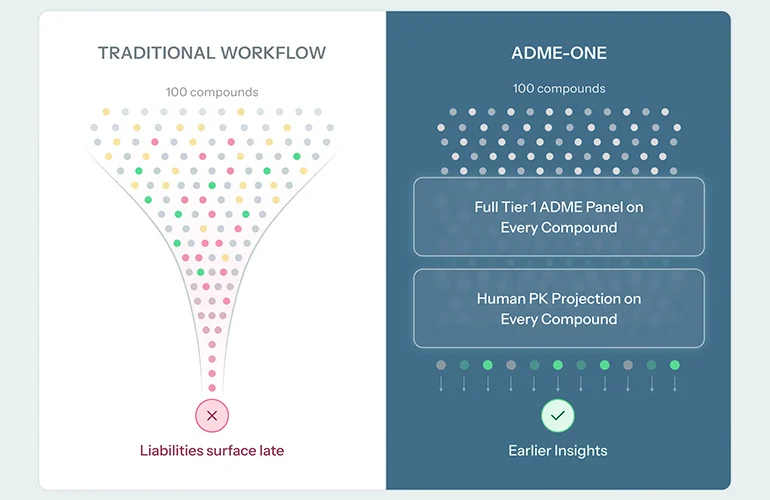
For decades, the standard operating procedure for small-molecule drug discovery teams involved a sequential, funnel-like approach. Initial high-throughput screening campaigns would identify "hits" based primarily on target potency. These hits would then undergo iterative cycles of chemical modification and re-evaluation to improve potency and selectivity, eventually yielding "lead" compounds. Only at this more advanced stage, often after months or even years of synthesis and preliminary biological testing, would extensive ADME profiling be undertaken. The rationale was largely economic: ADME assays are complex, resource-intensive, and historically required substantial amounts of compound. Investing heavily in these assays for a vast number of early-stage hits was deemed impractical and prohibitively expensive.
This traditional sequencing, however, carries a substantial hidden cost: a high attrition rate. A significant percentage of promising drug candidates fail in preclinical or clinical development not due to a lack of efficacy, but because of unfavorable ADME properties. Issues such as poor bioavailability, rapid metabolism, high clearance, undesirable distribution to off-target tissues, or unacceptable drug-drug interactions (DDIs) only surface late in the process. The consequences are profound, leading to billions of dollars in wasted R&D expenditure and delayed access to potentially life-saving medicines. Industry data consistently points to ADME-related issues as a leading cause of drug candidate failure, often accounting for 30-40% of all attrition during development. The average cost of bringing a new drug to market is estimated to be in the billions of dollars, with much of this expense attributable to failures that could potentially be mitigated with earlier, more comprehensive data.
Introducing ADME-One: A Collaborative Paradigm Shift
The ADME-One platform represents a concerted effort to dismantle this traditional bottleneck by integrating critical ADME and PK assessments into the earliest stages of drug discovery. This innovative service packages the specialized capabilities of three distinct entities:
- Ginkgo Datapoints: Contributes its automated Tier 1 ADME assays, conducted in its state-of-the-art laboratory in Boston. These assays include microsomal stability, cell permeability, kinetic solubility, CYP inhibition, and plasma protein binding – foundational parameters crucial for predicting a compound’s fate in the body.
- Tangible Scientific: Manages the complex workflow of compound logistics, ensuring seamless intake, precise plating, and real-time tracking of physical samples for each order. Their expertise in high-throughput sample management is critical for the platform’s efficiency.
- Inductive Bio: Provides its human pharmacokinetic projection capabilities through its Compass platform, which intelligently processes the individual ADME readouts from Ginkgo’s assays and synthesizes them into a holistic prediction of human PK and even an estimated dose.
The core ambition of ADME-One is to furnish medicinal chemists with an unprecedentedly early and comprehensive understanding of their compounds. By offering an integrated view of potency, ADME characteristics, projected human PK, and even an initial dose estimate during hit identification, the platform aims to prevent significant investment in compounds destined for failure due to unfavorable ADME profiles. This proactive approach seeks to curtail the arduous and expensive cycles of synthesis and optimization that historically consumed months, only to reveal insurmountable ADME challenges later on.
Dr. Alex Taylor, Head of Medicinal Chemistry at Inductive Bio, articulated the driving philosophy behind ADME-One: "We asked: Could we pull together all the assays needed to get your first projection of human PK at a price point where you’d now be doing this on most, if not all, of the compounds coming through?" This question underscores a fundamental goal: democratizing access to crucial PK data, making it affordable and accessible enough to become a standard part of the initial screening cascade. The vision is to empower chemists to integrate potency data with essential ADME metrics to generate an early, actionable estimate of human PK and potential dosage, thereby guiding design choices from the very beginning.
The Criticality of Early PK and Dose Optimization
One of the most significant advancements offered by ADME-One is its focus on providing early human pharmacokinetic (PK) projections and estimated dose information. Experienced medicinal chemists widely acknowledge that the ultimate objective in drug optimization is to achieve an optimal human dose. An ideal drug not only exhibits potent activity against its target but also achieves therapeutic concentrations in the body, remains there for an appropriate duration, is safely metabolized, and can be administered in a patient-friendly regimen.
The importance of dose extends far beyond efficacy, directly impacting safety and patient adherence. For instance, research has highlighted a correlation between high daily doses and an elevated risk of drug-induced liver injury (DILI). A "rule-of-two" analysis, led by FDA-affiliated researchers and published in Hepatology, pointed to high daily doses, particularly when combined with high lipophilicity, as a significant risk factor for DILI. While not a definitive verdict on safety, it serves as a crucial risk signal. Separately, a registry study revealed that drugs dosed at 50 mg per day or more exhibited higher rates of liver failure, transplant, and death compared to those administered below 10 mg. Lower doses generally translate to easier formulation, reduced pill burden, and improved patient compliance, as simpler dosing regimens are strongly associated with better adherence, a critical factor in real-world treatment success.
Historically, synthesizing the diverse data points required to accurately predict human PK and dose has been a formidable challenge. The complexity arises from the interplay of multiple ADME parameters—how a drug is absorbed, distributed throughout the body, metabolized, and ultimately excreted. A compound might demonstrate excellent potency in in vitro assays but fail due to rapid breakdown by liver enzymes (poor metabolic stability) or insufficient absorption. Conversely, a compound with moderate in vitro potency might achieve therapeutic efficacy at a low dose if its ADME properties allow for sustained exposure.
The example of triazole antifungals, fluconazole and itraconazole, vividly illustrates this complexity. Fluconazole is characterized by its small size, polarity, weak plasma protein binding, and renal clearance with minimal metabolic alteration. In stark contrast, itraconazole is highly lipophilic, extensively protein-bound (over 99%), widely distributed into tissues, and predominantly cleared by hepatic metabolism. On a simplistic, assay-by-assay scorecard, these profiles appear irreconcilable. Yet, both drugs became widely used and successful oral antifungals, demonstrating that a holistic view of ADME and PK, rather than isolated parameter values, is crucial. As Taylor noted, "sometimes compounds you think aren’t good enough to go forward, because they don’t meet your criteria for potency or metabolic stability, actually have a balance of all the properties such that they could go forward." The ADME-One platform aims to provide this integrated perspective much earlier, allowing for more nuanced decision-making.
The Engine of Change: AI, Automation, and Cost-Effectiveness
The viability of ADME-One’s early intervention strategy is fundamentally underpinned by advancements in AI, laboratory automation, and a concerted focus on cost reduction. The pharmaceutical industry, like many others, operates under intense economic pressure, a trend that has only intensified in recent years, pushing companies to "stay lean, be cost-competitive, be cost-conscious," as Taylor described. This pressure traditionally reinforced the "screening-funnel" approach, where resources were conserved by delaying expensive assays until later stages.
The advent of sophisticated laboratory automation has been a game-changer. Robotic systems can now execute complex biochemical assays with unparalleled precision, speed, and reproducibility, dramatically reducing the per-sample cost and increasing throughput. "The ability to run many compounds, a whole plate full, using the robotics on a weekly basis and turn that around in an automated way, that’s what’s made the difference," Taylor emphasized. This automation transforms ADME profiling from a laborious, manual process into a scalable, high-throughput operation, making it economically feasible to test a much larger number of compounds earlier.
Furthermore, Inductive Bio’s AI/Machine Learning (ML) models are central to translating raw ADME data into actionable PK predictions. These models learn from vast datasets of experimental ADME and PK information to predict how new, untested compounds will behave in vivo. By integrating these predictive capabilities with automated experimental validation, ADME-One creates a powerful feedback loop that refines predictions and accelerates the discovery process.
In a strategic move to address prevailing industry trends, the ADME-One platform is designed to be highly cost-competitive, with pricing positioned below industry standards and specifically tailored to compete with offshore Contract Research Organizations (CROs). This pricing strategy is a direct response to a growing demand for data sovereignty and the implications of regulatory initiatives like the BIOSECURE Act, which encourages U.S. and European developers to repatriate preclinical research and development activities. By operating entirely within the U.S. and promising results within days rather than weeks, ADME-One offers a compelling onshore alternative that combines speed, quality, and enhanced data security.
The Consortium Model and Data Security: A Virtuous Cycle
A crucial element of Inductive Bio’s offering, and by extension the ADME-One platform’s long-term sustainability and improvement, is its innovative consortium model for data sharing and machine learning. This model addresses the inherent tension between leveraging collective data for model improvement and protecting proprietary intellectual property.
Inductive Bio operates a separate consortium—a legal and technical framework—where its partners can securely pool their drug discovery data. The ingenious design ensures that "no partner can see anyone else’s data," as Taylor explained. This pooled, anonymized data is then used to train and enhance Inductive Bio’s global ML models, which form the predictive engine of the Compass platform. When an individual customer contributes its own experimental results through the ADME-One platform, these specific data points are used to fine-tune a "local model" on top of the global one. This tailored fine-tuning typically yields a significant performance gain for that specific customer’s chemistry space, providing more accurate and relevant predictions for their unique compounds.
Recognizing the paramount importance of data security and intellectual property protection in the highly competitive pharmaceutical landscape, Inductive Bio has invested substantial engineering effort into making the pooled data impossible to reverse-engineer. This means that even sophisticated attempts to analyze the collective dataset cannot reveal the identity or specific chemical structures of individual contributors. This robust security framework fosters trust and encourages broader participation, creating a "virtuous cycle" or "flywheel effect." As more partners contribute data, the breadth and diversity of chemical matter within the consortium expand, leading to more robust, generalizable, and accurate global models. These improved models, in turn, benefit all participants, attracting more users and further enriching the data pool.
Implications and Future Outlook: Prioritization in a Scientific Endeavor
The ADME-One platform is poised to have a transformative impact on drug discovery. By integrating early, high-quality ADME and PK predictions, it empowers medicinal chemists to make more informed decisions at the critical hit identification stage. This shift promises to:
- Reduce Attrition Rates: By identifying compounds with poor ADME properties earlier, resources can be redirected away from doomed candidates, improving the overall success rate of drug development programs.
- Accelerate Timelines: Faster feedback loops and better initial compound selection can significantly shorten the lead optimization phase and accelerate progression to preclinical development.
- Optimize Resources: Fewer costly synthesis cycles and late-stage failures translate directly into more efficient use of R&D budgets.
- Foster Innovation: Chemists, liberated from the burden of constantly battling ADME issues, can focus their creativity on novel chemical structures and challenging targets.
The "virtuous cycle" described by Taylor envisions chemists designing molecules on the Inductive platform, informed by real-time predicted ADME parameters and visualizations of human PK curves. Selected compounds then move seamlessly through synthesis and into the ADME-One platform for experimental validation. The resulting empirical data then feeds back into the models, continuously refining and improving their predictive accuracy for future design iterations.
Despite the profound capabilities of AI and automation, Taylor firmly frames their role as prioritization tools, emphasizing that drug discovery remains a fundamentally empirical science. "Drug discovery is science at the end of the day, and science is not engineering," he asserted. "There’s still so much that needs to happen empirically. You can give your best guess of what a compound is going to do, but at the end of the day you need to reduce it to practice, synthesize it, and test it."
This perspective underscores that while AI can intelligently guide decisions and predict outcomes, it does not replace the necessity of experimental validation. Instead, it refines the experimental process, making it more targeted and efficient. The ability to accurately predict critical parameters like ADME and PK becomes invaluable in deciding which expensive, time-consuming compounds warrant synthesis and testing first, especially given the inherent limitations of budgets and timelines that all drug discovery teams face. The ADME-One platform, therefore, represents not just a technological upgrade, but a strategic re-imagining of the drug discovery workflow, promising to make the journey from concept to clinic more efficient, cost-effective, and ultimately, more successful.