More than a decade ago, the American Society of Clinical Oncology (ASCO) initiated CancerLinQ, a pioneering platform designed with the ambitious goal of transforming routine patient encounters into a dynamic learning system. By aggregating electronic health record (EHR) data from oncology practices, CancerLinQ sought to establish a robust repository of real-world evidence, enabling continuous improvement in cancer care and research. This foundational vision has now been significantly expanded and accelerated under the stewardship of ConcertAI, an oncology-focused artificial intelligence (AI) and real-world data company, which acquired the platform from ASCO in a landmark agreement in December 2023.
CancerLinQ’s Genesis: ASCO’s Vision for a Learning System
ASCO, a leading professional organization for physicians who care for people with cancer, launched CancerLinQ as a non-profit initiative to address a critical need in oncology: the systematic collection and analysis of real-world clinical data. The traditional model of medical knowledge generation, heavily reliant on randomized controlled trials, often leaves a gap in understanding how treatments perform in diverse patient populations under routine clinical conditions. CancerLinQ aimed to bridge this gap by creating a feedback loop, where data from millions of patient visits could inform best practices, identify variations in care, and ultimately improve outcomes.
Before its acquisition by ConcertAI, CancerLinQ’s primary utility, as noted by Eron Kelly, ConcertAI’s chief executive, was its automated reporting function. "Before we bought it, CancerLinQ largely just delivered software that automated the measurement of ASCO certification quality measures, in order to get your ASCO certification," Kelly stated. This function, while valuable for practices seeking to meet quality benchmarks and maintain accreditation, represented only a fraction of the platform’s potential. It provided a structured way for practices to assess their adherence to established guidelines, but the deeper analytical and predictive capabilities inherent in such a vast dataset remained largely untapped. The underlying infrastructure, however, had already laid the groundwork for collecting comprehensive, de-identified patient data across a broad network of oncology practices, making it an invaluable asset for future AI-driven applications.
The Strategic Acquisition: ConcertAI’s Investment in Real-World Data and AI
ConcertAI’s acquisition of CancerLinQ in late 2023 marked a pivotal moment for both organizations and for the broader field of oncology data science. For ASCO, the collaboration with ConcertAI represented a strategic move to infuse cutting-edge AI and data science expertise into CancerLinQ, ensuring its continued evolution and broader impact. For ConcertAI, the acquisition significantly bolstered its existing portfolio of real-world data and AI solutions, providing access to a rich, longitudinally integrated dataset and an established network of oncology practices.
ConcertAI has been at the forefront of leveraging AI and real-world data to accelerate therapeutic development and improve patient care in oncology. The company’s vision for CancerLinQ went far beyond its previous capabilities. The goal was to transform it into an AI-powered system that seamlessly integrates into the physician’s workflow, offering actionable insights at the point of care. This vision aligns with a growing trend in healthcare, where companies like Flatiron Health, Tempus, and Komodo Health are increasingly focused on turning aggregated clinical data into sophisticated AI models and agentic AI tools to enhance various aspects of patient management and research. The acquisition was not merely about data aggregation but about intelligent data activation.
From Automation to Intelligence: Redefining Point-of-Care Oncology
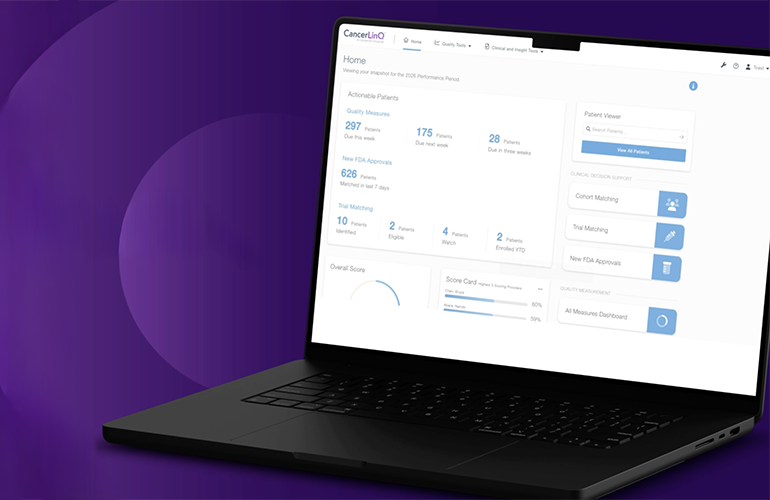
Since the December 2023 acquisition, ConcertAI has embarked on an intensive transformation of the CancerLinQ platform. The shift has been dramatic, moving beyond mere quality-measure automation to embrace a comprehensive AI-powered system that integrates several critical functions:
- Trial Matching: This is a cornerstone of the new platform, designed to connect eligible patients with relevant clinical trials. Given that access to cutting-edge therapies often occurs through trials, this function is vital for patient outcomes.
- Research Datasets: The platform now systematically generates curated research-grade datasets from the raw EHR data, making it easier for researchers to conduct studies, identify trends, and generate hypotheses.
- Clinical Decision Support: This feature provides physicians with real-time, evidence-based recommendations and insights derived from the vast pool of patient data, aiding in diagnosis, treatment planning, and monitoring.
Recent efforts have concentrated on integrating these insights directly into physicians’ live workflows. Eron Kelly elaborated on the sophisticated AI architecture underpinning this transformation: "We use a chain of AI models and agents to parse all that information, understand really challenging concepts like progression, or timelines within a diagnosis journey, and summarize that into a structured data model that can be queried from our SaaS software stack." This multi-layered AI approach is crucial for extracting nuanced clinical information from often unstructured or semi-structured EHR notes, a task that has historically been labor-intensive and prone to human error.
Bridging the Chasm Between Clinical Care and Research
A primary objective of the revitalized CancerLinQ platform is to significantly close the persistent gap between routine clinical care and clinical research. Dr. Shaalan Beg, ConcertAI’s chief medical officer for oncology, underscored this imperative, particularly in diseases where therapeutic advancements are rapidly redefining treatment standards. He noted that in such fast-evolving fields, the most current and effective treatment options are frequently accessible only through participation in clinical trials.
Dr. Beg provided a compelling recent example: ASCO data presented just days prior to the interview demonstrated a novel multi-selective RAS inhibitor that nearly doubled the median survival for patients with previously treated metastatic pancreatic cancer—from approximately six months to a remarkable 12 months. This represents a monumental leap in a disease notoriously resistant to treatment. "If you’re a pancreatic cancer patient right now and you want the best standard of care," Beg asserted, "the only way you’re going to get it is through clinical trials." This highlights the critical role of trial matching and decision support in ensuring that patients receive optimal, state-of-the-art care, which might otherwise remain out of reach. The disparity in access to clinical trials across different geographic regions and practice settings further amplifies the need for intelligent systems that can democratize this access.
The Surging Adoption of AI in Oncology Practice
The transformation of CancerLinQ aligns with a broader, rapid acceleration in the adoption and awareness of AI within the medical community. Data from the American Medical Association (AMA) illustrates this dramatic shift:
- In 2023, only 38% of physicians reported incorporating AI in one or more clinical cases.
- By 2026, this figure had surged to an impressive 72%.
- Physician awareness of AI also saw a significant jump, rising from 66% in 2025 to 81% in 2026.
These statistics underscore a growing comfort level and enthusiasm among clinicians for AI tools, moving from nascent curiosity to active integration into daily practice. This trend is not confined to oncology but is particularly impactful there, given the immense complexity of cancer diagnosis and treatment. ConcertAI positions its platform uniquely within this landscape, with Dr. Beg emphasizing its vendor-agnostic nature across all EHR systems and genomic/molecular labs. This universal compatibility allows for the collection of comprehensive, longitudinal, prospective data that serves both care delivery and research, a feature that was a key draw for Dr. Beg to the program.
AI as a "Lane Assist": Augmenting Physician Capacity and Workflow
Dr. Beg skillfully employs a self-driving car analogy to describe the role of ConcertAI’s tools in clinical workflows, likening it to "lane assist." He clarified, "For most of the clinical care doctors are asking for right now, it’s more like lane assist, keeping the car in its lane and giving nudges along the way." These "nudges" are critical, proactive interventions designed to enhance care quality and efficiency. Examples include alerts such as "here’s a care gap, you’re missing molecular data on this colon-cancer patient" or "here’s a trial, have you considered it?" These aren’t autonomous decisions but rather intelligent prompts that empower clinicians with timely, relevant information.
The AMA’s research corroborates this practical application, indicating that physician use and enthusiasm for AI predominantly cluster around documentation and summarization tasks. Summaries of research and standards of care have become the single most common AI use case, accounting for nearly 40% of applications—a 26-point increase since 2024. Documentation tools follow closely in terms of enthusiasm. This trend reflects a clear preference for AI tools that augment, rather than replace, human expertise, particularly in tasks that are time-consuming and cognitively demanding.
Dr. Beg firmly rejected the notion of fully autonomous AI in patient care: "We’re not working under the assumption that these tools will autonomously care for patients." Instead, the core pressure these tools are built to alleviate is one of capacity. The sheer volume and complexity of oncology knowledge have long outgrown the capacity of any single clinician. As Dr. Beg aptly put it, "The era of one physician taking care of all your needs is decades over." Modern cancer care routinely involves a multidisciplinary team—oncologists, nurse practitioners, geneticists, dietitians, physical therapists—and coordinating care across these roles presents significant challenges, often exacerbated by chronic understaffing. "I don’t know of any academic program or clinical trials office that says it’s fully staffed," Beg lamented. Against this backdrop, AI tools function as an essential efficiency layer, potentially saving oncologists a few minutes per patient, thereby enabling them to oversee a larger patient panel without compromising quality.
The impact on clinical trial screening is particularly profound. Dr. Beg highlighted that trial-matching capabilities can compress screening time to less than a third of what manual screening typically requires. The system integrates the entire workflow: once a probable match is flagged, it systematically evaluates 20 to 30 eligibility criteria, states its determination for each, and crucially, links directly back to the source documentation within the patient’s record. This eliminates the need for coordinators to tediously scour charts in separate windows, streamlining a historically cumbersome process. Furthermore, this capability extends the reach of clinical trials to patients at satellite sites within hub-and-spoke healthcare networks, democratizing access to innovative treatments.
The Power of Data: Ingesting and Structuring Complex Clinical Information
The foundation of CancerLinQ’s point-of-care capabilities and rapid trial matches is ConcertAI’s sophisticated data engine. This engine is designed to ingest a vast array of clinical data, encompassing both structured fields from EHRs and the often-unstructured content found in clinical notes, pathology reports, and genomic/NGS (next-generation sequencing) laboratory reports directly from sites across the CancerLinQ network. This comprehensive data capture is critical because much of the richest, most detailed patient information resides within free-text notes, which traditional structured data systems often miss. The pipeline meticulously processes this raw information, transforming it into a structured dataset that is refreshed weekly, ensuring that insights are always based on the most current patient information.

Architecting Trust: Chaining AI Models for Accuracy and Coherence
A central concern in deploying AI in clinical settings is trust: can clinicians rely on the AI’s output? Eron Kelly emphasized the intricate methodology employed to ensure data integrity and clinical relevance. "We use a chain of AI models and agents to parse all that information… and summarize that into a structured data model," he reiterated. The precision and recall metrics for their models are remarkably high, consistently achieving "0.9 and higher," indicating exceptional accuracy in both identifying relevant information and excluding irrelevant data.
ConcertAI’s answer to the trust question lies in a layered validation system where multiple AI agents cross-check one another. One layer specifically measures abstraction accuracy, assessing whether the model correctly interprets and extracts information from the chart. Another layer focuses on coherence, verifying that the sequence of events and clinical findings make logical sense. For instance, it might flag a proposed treatment that wouldn’t normally follow a specific radiation therapy, prompting a review. This multi-layered approach is designed to build and maintain clinician confidence in the system’s outputs, ensuring that the insights surfaced are not only accurate but also clinically plausible.
Dynamic Treatment Paradigms: Unlocking Missed Opportunities
The ability to dynamically re-evaluate historical patient data is a powerful feature of the enhanced CancerLinQ platform. Because ConcertAI holds the underlying pathology reports, it can identify patients whose tumors were characterized in a specific way years ago but would now qualify for newer targeted therapies under updated criteria. Dr. Beg offered a compelling example involving HER2 status in breast cancer. Historically, a HER2 score of "1+" was considered HER2-negative, meaning patients were not candidates for HER2-targeted therapies like trastuzumab. However, advancements have led to the development of HER2-targeted antibody-drug conjugates that are effective even at low HER2 expression levels. Consequently, patients once classified as HER2-negative with a "1+" score are now considered HER2-positive under current criteria and could potentially benefit from these newer treatments. The AI system can flag these patients, pulling them back into consideration for therapies they previously wouldn’t have received, thereby unlocking missed opportunities for improved outcomes. This dynamic re-evaluation capability underscores the platform’s role in facilitating precision medicine, ensuring that patients benefit from the latest scientific breakthroughs as treatment paradigms evolve.
Beyond Moonshots: The Philosophy of "Ground Shots" in Cancer Care
The quest for a "cure for cancer" has captivated the public imagination for over 50 years, from President Nixon’s "War on Cancer" in the 1970s to more recent initiatives like the federal Cancer Moonshot. This period has indeed been punctuated by remarkable breakthroughs, including the advent of checkpoint-inhibitor immunotherapy, revolutionary CAR-T cell therapies for blood cancers, and highly effective targeted drugs like imatinib. These "moonshots" represent monumental scientific achievements.
However, between these significant inflection points, many gains in cancer treatment have come incrementally: a better-targeted therapy here, a refined biomarker there, with survival measured in additional months rather than outright cures. While ambitious "moonshots" undoubtedly have their place in driving foundational research, Dr. Beg articulated a more immediate, ground-up philosophy for current impact, which he termed "ground shots." He argued, "I think we should focus on ground shots first, disseminating the treatments we already know work to the people who need them right now." This philosophy emphasizes optimizing the delivery and accessibility of existing effective therapies, ensuring that every patient benefits from the current best standards of care, regardless of their location or the specific practice they attend. The enhanced CancerLinQ platform, with its focus on point-of-care intelligence, trial matching, and identifying care gaps, is a tangible manifestation of this "ground shots" approach, aiming to maximize the impact of present knowledge while simultaneously contributing to future breakthroughs.
The Future Landscape of Oncology: Integrated Intelligence for Personalized Care
The transformation of CancerLinQ by ConcertAI represents a significant leap forward in the application of AI and real-world data in oncology. By shifting from a mere reporting tool to a comprehensive point-of-care intelligence platform, ConcertAI is actively shaping the future of cancer treatment. This integrated approach promises not only to streamline physician workflows and alleviate capacity pressures but also to democratize access to cutting-edge clinical trials and ensure that patients receive the most personalized and effective therapies available, even as treatment guidelines evolve.
The continued development of agentic AI tools, coupled with robust data validation processes, is critical for fostering trust and widespread adoption among clinicians. As AI models become more sophisticated, their ability to synthesize vast amounts of complex clinical data and present actionable insights will become indispensable in managing the ever-growing knowledge base in oncology. While challenges remain, including data privacy considerations and the continuous need to guard against algorithmic bias, the direction is clear: intelligent platforms like the revitalized CancerLinQ are poised to empower oncology teams, accelerate research, and ultimately improve outcomes for cancer patients worldwide, one "ground shot" at a time.