Physics has long operated on the principle of direct contact and localized forces. In classical mechanics, an object responds only to the physical fields it directly encounters—a charged particle accelerates in an electric field, and a magnet exerts a force where its magnetic field lines are densest. However, the advent of quantum mechanics nearly a century ago began dismantling these intuitive boundaries, revealing a universe governed by non-local interactions and invisible influences.
In a landmark achievement published in the journal Nature Physics, a team of researchers at the University of Oxford has successfully recreated one of the strangest manifestations of this quantum reality: the Aharonov-Bohm effect. Utilizing a sophisticated hybrid quantum computer, the Oxford physicists demonstrated that an invisible magnetic influence—one a simulated particle never physically touches—can bring that particle’s motion to a complete halt. This breakthrough not only validates a decades-old theoretical prediction in a novel experimental architecture but also opens new pathways for simulating complex lattice gauge theories that continue to baffle conventional supercomputers.
The experiment marks a significant milestone in quantum simulation, bridging theoretical predictions from 1959 with cutting-edge programmable quantum hardware. By merging discrete qubits with continuous-variable quantum oscillators, the research team has established a versatile framework for studying the fundamental forces of nature in a controlled laboratory environment.
The 1959 Prediction: When Math Precedes Observation
To understand the magnitude of the Oxford experiment, one must look back to the theoretical foundations laid in the mid-20th century. In 1959, theoretical physicists Yakir Aharonov and David Bohm published a paper that challenged classical intuitions about electromagnetism. They mathematically demonstrated that a charged particle could experience a measurable shift in its quantum state even if it traveled exclusively through a region where both the magnetic field and electric field were strictly zero.
In classical electrodynamics, electromagnetic fields are considered the fundamental physical entities. Maxwell’s equations dictate that charged particles respond to these fields. However, Aharonov and Bohm’s formulation highlighted the physical significance of the magnetic vector potential—a mathematical construct previously thought to be merely a convenient tool for calculating actual magnetic fields rather than a physical entity in its own right.
According to their prediction, if a beam of charged particles is split, sent around a localized magnetic flux shielded from the particles, and then recombined, the resulting interference pattern shifts. The particles’ paths never intersect the magnetic field, yet the vector potential alters their quantum phase—an internal property governing wave interference.
When the phenomenon was subsequently verified using real electrons in laboratory settings, it provided profound proof that the mathematical language of quantum mechanics corresponds to physical realities that defy classical logic. It established that potentials, rather than just fields, play a primary role in quantum mechanics. For decades, however, observing and manipulating this effect required highly specialized electron interferometers, limiting researchers’ ability to study how such phenomena interact with dynamical matter and fluctuating fields in more complex theoretical frameworks.
Building the Hybrid Quantum Simulator
The modern iteration of the Aharonov-Bohm experiment began taking shape in 2022. Dr. Sebastian Saner and Dr. Oana Bazavan, working alongside colleagues at the University of Oxford and collaborating with Dr. Alejandro Bermudez of the Instituto de Física Teórica in Madrid, set out to tackle a notoriously difficult challenge: simulating lattice gauge theories on quantum hardware.
Lattice gauge theories form the mathematical bedrock of modern particle physics. They describe how fundamental matter—such as quarks and electrons—interacts with gauge fields, which mediate forces like electromagnetism and the strong nuclear force. In these models, space is discretized into a grid or lattice, where matter resides at specific nodes, and gauge fields occupy the links connecting those nodes.
While these theories are essential for understanding high-energy physics and the Standard Model of particle physics, calculating how these systems evolve over time quickly overwhelms even the most powerful classical supercomputers. The computational complexity scales exponentially with the size of the system, rendering brute-force numerical simulations impossible for large lattices.
To circumvent this computational bottleneck, the Oxford team turned to quantum simulation—building a physical quantum system whose internal dynamics mirror the mathematical equations of the target theory.
The hardware architecture designed by the researchers relied on a hybrid approach, integrating two distinct types of quantum information processing:
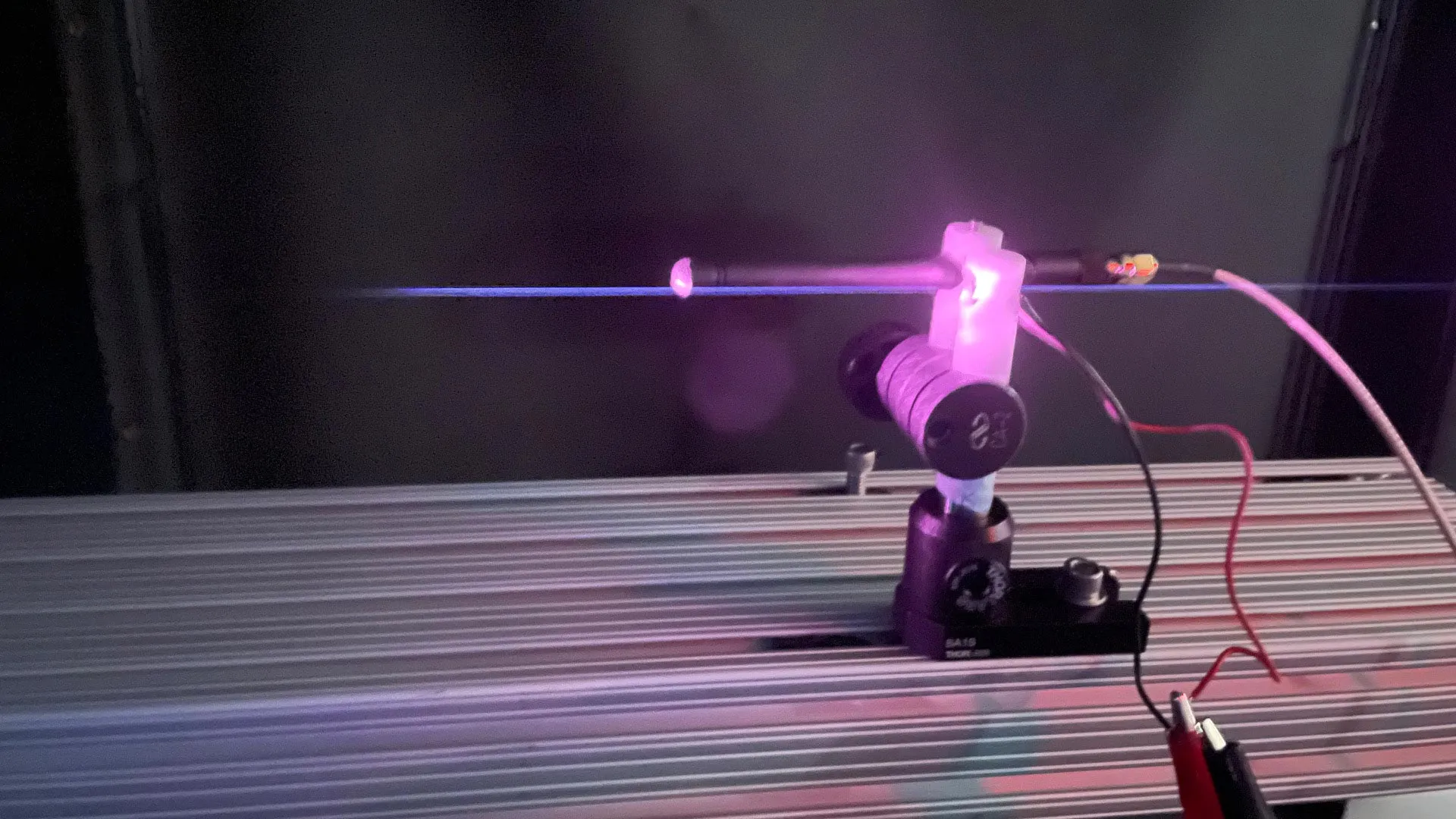
- Trapped-Ion Qubits: The researchers utilized electrically charged atoms (ions) suspended in a vacuum chamber using electromagnetic fields. The internal electronic states of these ions served as qubits, representing the dynamical gauge fields within the theoretical lattice.
- Quantum Oscillators: The quantized vibrational motion of these same trapped ions—their collective mechanical oscillations—acted as quantum oscillators, representing the matter particles moving across the grid.
By coupling these two components, the team constructed a closed loop consisting of two matter nodes connected by two gauge field links. Though compact, this minimalist architecture possessed all the necessary ingredients to capture the complex interplay between matter and magnetic flux.
Entanglement and Dynamical Fields: A Technical Breakthrough
One of the most innovative aspects of the Oxford experiment lies in how the researchers introduced the magnetic flux into their simulated system.
Initially, the team considered treating the magnetic flux as a static, unchanging background condition—a fixed environmental parameter through which the simulated matter would travel. However, implementing a static external constraint of this nature would have required hardware capabilities beyond the scope of their current trapped-ion setup.
Instead, the researchers engineered a more elegant and physically profound solution: they encoded the magnetic flux directly into the qubits themselves, placing them into an entangled quantum state. In quantum mechanics, entanglement links the states of multiple particles in a way that defies classical description; measuring or altering one instantly dictates the state of the other, regardless of distance.
By embedding the flux into the entangled qubits, the magnetic influence ceased to be a passive backdrop. Instead, it became an active, dynamic participant in the system’s overall quantum evolution.
"For us, the exciting step was to encode the magnetic flux in a gauge field that was itself dynamical," noted Dr. Sebastian Saner, lead author of the study. "Rather than having matter evolve in a fixed background, the matter and gauge field become part of the same quantum dynamics."
This technical workaround transformed the experiment from a simple replication of the 1959 Aharonov-Bohm effect into an exploration of a more complex scenario: a system where matter and the gauge field continuously influence one another.
Stopping Particle Motion Through Destructive Interference
With the hybrid loop operational, the researchers investigated the dynamics of a matter particle moving through the system via quantum tunneling. Quantum tunneling is a fundamental phenomenon whereby a particle penetrates or passes through a potential energy barrier that it classically should not have sufficient energy to cross.
When the Oxford team ran their simulation with zero magnetic flux, the matter particle tunneled freely back and forth around the loop between the two matter nodes.
The introduction of the simulated magnetic flux, however, drastically altered the outcome. Because the particle had two distinct pathways available to travel around the loop, the magnetic flux imparted a phase shift specific to each path. Quantum phase dictates how probability waves interfere with one another when multiple paths are available.
In this scenario, the phase difference introduced by the encoded flux caused the two probability waves to undergo destructive interference. The wave amplitudes canceled each other out entirely, halting the tunneling process and leaving the simulated matter particle completely frozen in its initial state.
This complete suppression of movement provided a striking visual and quantitative demonstration of the Aharonov-Bohm effect operating within a fully dynamical lattice gauge theory. It proved that quantum interference can be harnessed not only to guide particle trajectories but to lock quantum systems into stationary states through invisible field interactions.
Broader Implications and Parallel Discoveries in Quantum Physics
The publication of the Oxford study in Nature Physics coincided with complementary research from the University of Maryland, led by Professor Norbert Linke. The Maryland team independently utilized a hybrid quantum architecture to simulate the Yukawa potential—a crucial mathematical description governing nuclear forces between nucleons.
Although developed independently, the coordination of the Oxford and Maryland studies highlights a broader methodological shift in experimental physics. Both research groups demonstrated the immense utility of hybrid quantum computers—systems that deliberately combine discrete qubits with continuous-variable components like oscillators or modes of motion.
Experts in the field suggest that these hybrid platforms may serve as vital stepping stones toward fault-tolerant quantum computing. While large-scale, fully error-corrected universal quantum computers remain years away from routine deployment, near-term analog and hybrid quantum simulators are already delivering actionable scientific insights into intractable physical problems.
The ability to simulate lattice gauge theories with dynamical fields opens up exciting avenues for high-energy physics. Researchers hope to apply similar quantum simulation techniques to investigate phenomena that occur under extreme conditions, such as the behavior of quark-gluon plasmas inside particle accelerators, the interior dynamics of neutron stars, and the cosmological phase transitions that occurred moments after the Big Bang.
By recreating a paradoxical 1959 prediction inside a programmable quantum loop, the University of Oxford team has done more than validate a textbook physics concept. They have forged a new observational lens, proving that hybrid quantum architectures can faithfully recreate the subtle, counterintuitive rules that govern the subatomic world—bringing invisible forces into plain view.