In a development that promises to reshape the landscape of industrial chemistry, researchers at Seoul National University have identified and harnessed a previously overlooked microscopic variable that dictates the success or failure of chemical reactions. By exercising precise control over the acidity and alkalinity fluctuating directly adjacent to reaction electrodes—a phenomenon known as "local pH"—the research team dramatically enhanced the production efficacy of vital chemical ingredients. Through an innovative redesign of their electrochemical reactor, the scientists boosted the yield of targeted products from a meager 16% to an astounding 97%, opening new pathways for safer, cleaner, and more efficient manufacturing processes worldwide.
The breakthrough, spearheaded by Professor Jaeyune Ryu of the Department of Chemical and Biological Engineering at the Seoul National University College of Engineering, centers on organic electrosynthesis. This sophisticated methodology utilizes electrical energy to drive reactions that synthesize carbon-based chemical compounds. Published in the prestigious Journal of the American Chemical Society (JACS), the findings introduce a transformative design principle to chemical engineering, shifting the industry’s focus from macro-level variables to the hyper-localized chemical environments where molecular transformations physically take place.
The Hidden Mechanics of Organic Electrosynthesis
Traditionally, chemical manufacturing has heavily relied on external oxidizing and reducing agents to facilitate electron exchange and push reactions forward. While effective, many of these chemical agents are hazardous, difficult to handle, and generate significant chemical waste. Organic electrosynthesis emerged as a promising alternative, substituting hazardous reagents with clean electrical current. For years, scientists optimizing these systems focused primarily on macro-scale factors, including applied electrical voltage, the composition of the bulk solution, and the material selection for the electrodes.
However, Professor Ryu and his team suspected that a critical piece of the puzzle was being missed in the microscopic spaces immediately surrounding each electrode. When electrochemical reactions proceed, hydrogen ions—protons—are continually produced or consumed. Because these ions are generated faster than they can physically diffuse through the bulk liquid, the pH directly next to the electrode can diverge wildly from the pH measured in the broader solution.
Through comprehensive analysis, the team discovered that these localized acidity gradients exert profound control over a reaction’s fate. They dictate the generation of reactive oxygen species, alter the structural behavior of starting materials, and determine whether newly synthesized products remain stable or rapidly degrade. Consequently, a chemical reaction could fail entirely even when the macroscopic environment appeared to be optimized.
A Pervasive Industry Challenge
To evaluate whether this localized phenomenon was an isolated occurrence or a widespread industry hurdle, the Seoul National University team conducted an exhaustive review of scientific literature. They examined more than 600 papers dedicated to organic electrosynthesis published over the preceding decade, dating back to 2010.
The findings were revealing: approximately 89% of the analyzed studies involved reactions occurring at electrodes where both electrons and protons were simultaneously transferred. This data underscored that overlooked proton movement and localized pH shifts are virtually ubiquitous in electrochemical systems.
To measure the severity of these variations, the researchers quantified the microscopic gradients. Even when the bulk solution remained entirely neutral, the immediate vicinity of the cathode—where reduction reactions take place—could reach a strongly alkaline environment of approximately pH 11. Conversely, the region surrounding the anode, dedicated to oxidation, could plunge to a highly acidic pH of roughly 2.5. Under such extreme localized conditions, vital reactive oxygen species become depleted, starting materials mutate into unproductive chemical forms, and desired products decompose before they can be harvested. Adjusting the acidity of the overall solution proves entirely ineffective, as the critical chemistry is governed entirely by the microscopic interface at the electrode wall.
Innovating the Baeyer-Villiger Oxidation
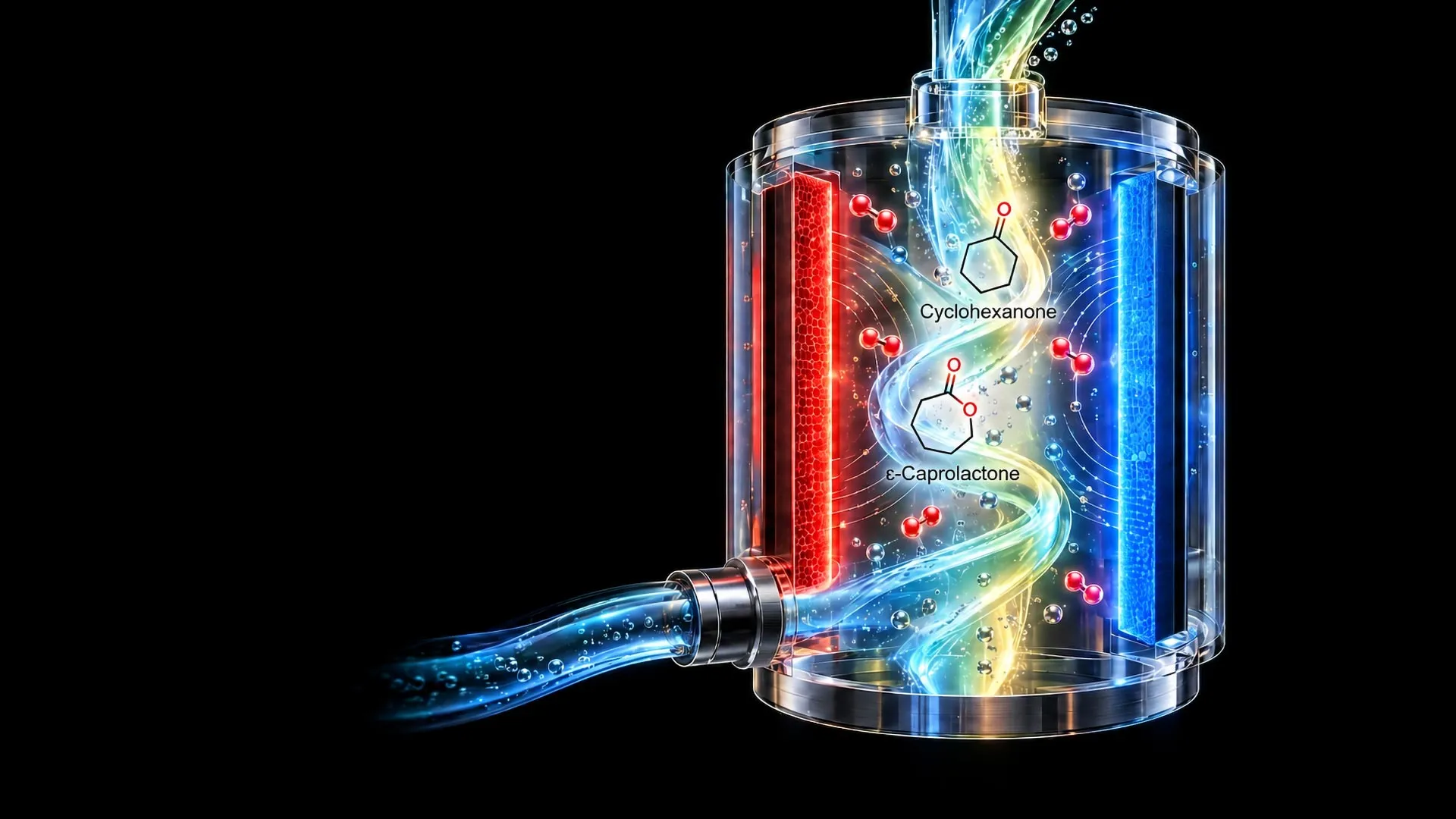
To demonstrate the power of local pH management, the research team focused on the Baeyer-Villiger oxidation, a well-established industrial process that inserts an oxygen atom into a ketone molecule to transform it into an ester or a lactone. Lactones serve as essential ring-shaped building blocks for biodegradable plastics and polyurethanes. Traditionally, this reaction requires hazardous peroxyacids as oxidizing agents, creating significant handling risks and chemical waste streams.
In contrast, the Seoul National University team developed a sustainable, electricity-driven approach. Instead of introducing external oxidants, they utilized electricity to activate oxygen gas directly at the electrode surface, generating the necessary reactive oxygen species for the oxygen-transfer reaction. Isotope-tracing experiments verified that the oxygen incorporated into the final products originated directly from ambient oxygen gas rather than from water molecules.
Furthermore, the researchers identified a synergistic cooperation between the two electrodes. Oxygen reduction at the cathode generates reactive oxygen species, while hydrogen peroxide produced along the way is subsequently converted back into reactive oxygen species at the anode. This closed-loop mechanism sustains the supply of necessary chemical agents—provided that local acidity is kept in check.
Engineering the Solution: Reactor Redesign and Amplified Selectivity
Armed with an understanding of local pH dynamics, the team utilized advanced computer simulations and electrochemical measurements to redesign their chemical reactor. Their primary objective was to prevent extreme acidity gradients from establishing themselves by managing fluid dynamics and physical distances.
By placing the electrodes closer together—reducing the inter-electrode gap from 20 millimeters to 4 millimeters—and forcing the electrolyte liquid to flow continuously between them, the researchers successfully counterbalanced the acidic and alkaline zones. The circulating liquid effectively neutralized the localized extremes, maintaining a stable chemical environment where the desired reactions could proceed unimpeded.
The operational results were dramatic. Under uncontrolled local pH conditions, the target compound accounted for a mere 16% of the resulting products. With the optimized reactor design and controlled electrolyte flow, selectivity soared to 97%.
Further performance metrics underscored the brilliance of the engineering adjustments. As fluid flow rates were increased from the lowest to the highest settings, the production rate of target compounds per unit time multiplied approximately 14 times. Reducing the distance between the electrodes produced a 2.2-fold increase in production rates. Most tellingly, when the electrolyte liquid was held static without forced circulation, the yield of the desired product dropped virtually to zero, despite identical voltages and starting materials. This confirmed that reactor architecture and microscopic environmental control are just as critical to chemical success as the chemical ingredients themselves.
Versatile Industrial Applications for Plastics, Electronics, and Pharmaceuticals
To prove the versatility of their methodology, the researchers expanded their experiments beyond a single chemical pathway. Utilizing their optimized local pH control strategy, they successfully synthesized lactones from 18 distinct ketone compounds.
Among these achievements was the production of $varepsilon$-caprolactone with an impressive 82% yield. This specific compound serves as the primary precursor for polycaprolactone, a biodegradable polymer widely utilized in advanced medical technologies, including surgical sutures and targeted drug-delivery systems. Additionally, the team applied their local environment control framework to the manufacture of epoxides, successfully obtaining high-value products from six different alkene starting materials. Epoxides are indispensable chemical intermediates utilized in high-performance adhesives, protective surface coatings, epoxy resins for electronics, and complex pharmaceutical formulations.
These broad successes indicate that managing the microscopic environment around electrodes is not merely a specialized fix, but a broadly applicable foundational principle that could enhance the synthesis of numerous commercially vital chemical products.
Implications for Sustainable Chemical Manufacturing
The implications of this breakthrough extend directly into the future of green chemistry and industrial sustainability. Because the developed electrochemical method operates at room temperature and normal atmospheric pressure, it eliminates the capital-intensive infrastructure required to heat or pressurize traditional chemical manufacturing facilities.
By substituting hazardous chemical oxidants with clean electricity and ambient oxygen, the technique significantly curtails chemical waste generation and enhances workplace safety. Furthermore, because electricity serves as the primary energy input, the approach holds immense potential for integration with renewable energy sources such as wind and solar power, bringing the chemical industry closer to genuine carbon neutrality.
Industry analysts note that high-value specialty chemicals and pharmaceutical ingredients stand to benefit the most from this technological trajectory. These sectors demand rigorous control over reaction conditions and stringent safety protocols, making electrochemical methodologies an attractive alternative to traditional, reagent-heavy synthesis routes.
Nevertheless, commercialization will require time and substantial capital investment. Co-first authors Seonghyeon Min and Junghoon Lee, alongside integrated M.S./Ph.D. student Hanju Kim, emphasize that further engineering optimization and pilot-scale testing will be necessary to prove that these laboratory achievements can be scaled economically and reliably for industrial-level output. Min and Lee intend to continue their research into local reaction environments, aiming to expand the framework to an even broader spectrum of organic electrosynthesis reactions.
A Paradigm Shift in Chemical Engineering
Beyond its immediate laboratory metrics and manufacturing potential, the discovery achieved by the Seoul National University research team fundamentally alters how scientists conceptualize the design of electrochemical systems. For decades, optimization efforts remained confined to substrate selection, catalyst development, electrode material composition, and bulk voltage regulation.
By reframing local pH from an unavoidable, hidden side effect into an actively managed design principle, the research establishes a new paradigm for the chemical engineering discipline. As Professor Jaeyune Ryu summarized, future scientific advancements will rely on designing not only the reaction substrates and catalysts, but the very microscopic environments in which molecules undergo their transformations. As research laboratories and industrial facilities begin to integrate these insights into future reactor architectures, the chemical manufacturing sector may well be on the threshold of a cleaner, safer, and remarkably more efficient era.