Researchers at the Indian Institute of Science (IISc) have achieved a significant milestone in catalysis and green chemistry by identifying 9,389 individual chemical reactions occurring on a copper catalyst during the conversion of carbon dioxide into valuable fuels and industrial chemicals. Published in the prestigious journal Nature Communications, the discovery bridges a long-standing gap between theoretical computer models and physical laboratory experiments. By deploying an innovative framework that fuses quantum mechanics simulations with machine learning, the research team successfully mapped a massive network of chemical pathways that conventional modeling techniques had historically overlooked. This technological leap not only yields a 40-fold increase in predicted CO2 conversion rates but also challenges foundational assumptions regarding how hydrogen behaves during catalytic transformations.
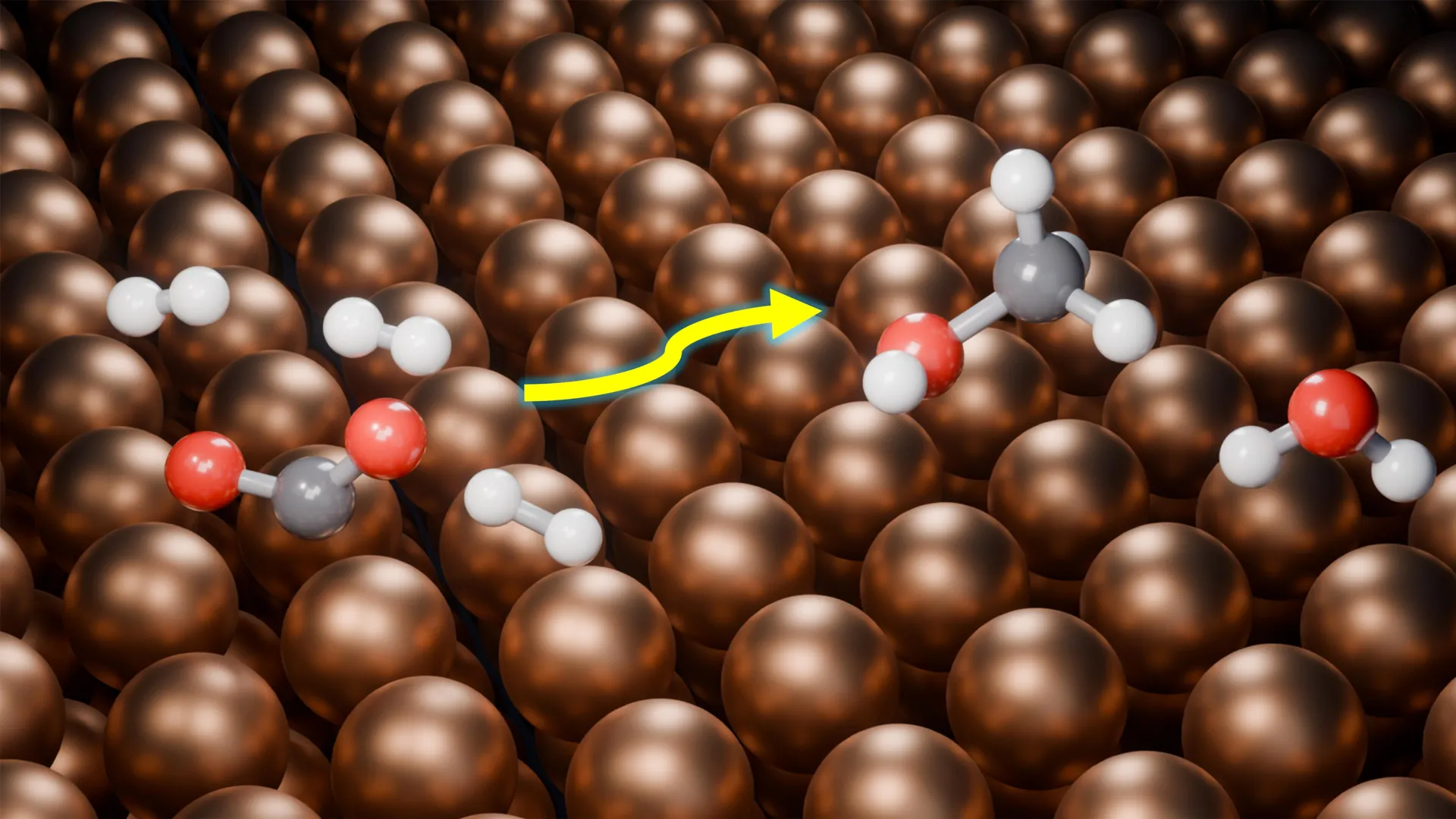
The global imperative to mitigate climate change has accelerated research into carbon capture, utilization, and storage (CCUS) technologies. Among the most promising strategies for recycling captured carbon dioxide is hydrogenation, a catalytic process that forces CO2 to react with hydrogen gas to synthesize commercially viable products, most notably methanol. Methanol serves as a vital building block for the chemical industry, functioning as a precursor for plastics, synthetic fibers, and paints, while also holding immense potential as a clean-burning alternative fuel for maritime and heavy transport. However, optimizing the copper-based catalysts required for this conversion has remained an excruciatingly complex trial-and-error endeavor for scientists worldwide.
The fundamental bottleneck in catalyst design lies in the sheer complexity of surface chemistry. When carbon dioxide and hydrogen interact with a metal catalyst, they undergo a dizzying array of sequential transformations, involving numerous short-lived intermediate chemical species on the catalyst’s microscopic surface. Simulating every conceivable molecular interaction using rigorous quantum mechanical equations demands an extraordinary expenditure of computing power. Consequently, computational chemists have traditionally relied on simplified models, hand-picking a restricted subset of reactions believed to be the most critical while ignoring thousands of ancillary pathways. This reductionist approach, while computationally manageable, has frequently led to severe discrepancies between theoretical predictions and empirical lab results.
The genesis of the IISc study stemmed from this very vulnerability in traditional mechanistic modeling. Anand Mohan Verma, the study’s first author who conducted the research as a CV Raman Postdoctoral Fellow at IISc before transitioning to an Assistant Professorship at the Motilal Nehru National Institute of Technology Allahabad (MNNIT Allahabad), highlighted the core anxiety of computational chemists. The central research question focused on ensuring that a chosen reaction network had not omitted the single step capable of altering the entire thermodynamic and kinetic landscape. To systematically address this blind spot, the multidisciplinary team at IISc constructed a rigorous, automated computational pipeline designed to scale up reaction network generation without compromising on physical accuracy.
The chronological development of the research methodology reflects a sophisticated integration of artificial intelligence and physical chemistry. The research initiative began with the foundational creation of a high-fidelity quantum mechanics database comprising 152 baseline chemical reactions. Rather than manually projecting subsequent steps, the scientists leveraged these quantum calculations to train advanced machine learning models capable of rapidly estimating the energy barriers that additional chemical transformations would need to surmount. Utilizing automated computational algorithms, the team scanned the combinatorial possibilities of 105 distinct chemical species present on the copper catalyst’s surface. By determining which transformations could occur within a single reaction step, the system expanded the modest 152-reaction network into an expansive matrix of 9,389 distinct reactions.
The structural impact of this expansion became immediately apparent when the researchers tested the predictive validity of both models. When restricted to the initial, conservative network of 152 reactions, the mathematical model produced severely flawed conclusions. It incorrectly projected formic acid as the primary reaction product instead of methanol, and it vastly underestimated the overall volume of carbon dioxide conversion compared to established physical benchmarks. It was only after incorporating the full scope of 9,389 reactions into the kinetic model that the theoretical projections aligned with real-world laboratory observations, accurately forecasting methanol and carbon monoxide as the dominant end products and predicting an approximate 40-fold amplification in total CO2 conversion capacity.
To ensure the scientific robustness of these computational breakthroughs, the IISc team collaborated with key industry and international research partners for experimental validation. G Valavarasu and Santhosh Kotni from the Green Research and Development Centre at Hindustan Petroleum Corporation Limited (HPCL), alongside Amol Amrute and colleagues at the Agency for Science, Technology, and Research (A*STAR) in Singapore, subjected the theoretical models to rigorous real-world testing. Additionally, Ambedkar Dukkipati, a Professor in the Department of Computer Science and Automation at IISc, played a pivotal role in refining the machine learning algorithms that underpinned the expansive reaction network.
Beyond successfully matching experimental yields, the massive scale of the newly uncovered reaction network revealed a counterintuitive chemical phenomenon that challenges textbook assumptions regarding hydrogen behavior. Conventional chemical theory dictates that during catalytic hydrogenation, molecular hydrogen (H2) must first dissociate into individual hydrogen atoms before it can chemically bond with intermediate compounds on a catalyst surface. However, the IISc model exposed multiple crucial reaction steps where hydrogen was transferred directly as an intact H2 molecule, bypassing the traditional dissociation phase, particularly when interacting with oxygen-containing intermediates.
This unexpected mechanistic pathway was subsequently verified through targeted quantum mechanics calculations, confirming that direct molecular hydrogen transfer can be energetically favorable under specific surface conditions. Co-author Shivam Chaturvedi, a PhD student in the Department of Chemical Engineering at IISc, noted that the concept of intact molecular hydrogen transfer directly contradicts long-standing pedagogical foundations in chemistry. This revelation only surfaced because the computational network was comprehensive enough to permit such pathways, and the observation withstood rigorous retroactive physical scrutiny. Furthermore, this insight suggests that future catalyst engineering should prioritize materials capable of interacting more strongly with molecular hydrogen to selectively drive the reaction pathways toward high-yield methanol production.
The broader industrial and environmental implications of this computational breakthrough extend well beyond the specific domain of carbon dioxide hydrogenation. The methodological framework established by the IISc researchers—combining quantum mechanical accuracy with machine learning acceleration, automated network generation, and kinetic modeling—provides a powerful new paradigm for chemical engineering. Industrial chemists can now deploy this scalable workflow to investigate a diverse array of complex catalytic systems that have historically resisted accurate modeling due to combinatorial explosion.
Potential future applications of the IISc framework encompass the broad spectrum of heterogeneous catalysis. These include optimizing carbon dioxide reduction reactions across alternative metallic and alloy catalysts, improving nitrogen reduction pathways for green ammonia synthesis, and enhancing water splitting technologies for sustainable hydrogen generation. By illuminating microscopic chemical steps that conventional models inevitably omit, this advanced computational technique offers researchers a holistic, high-resolution understanding of complex catalytic surfaces. As global industries accelerate their transition toward circular carbon economies and sustainable energy vectors, the integration of artificial intelligence and quantum chemistry demonstrated by the IISc team marks a transformative step toward rational, data-driven catalyst design.