The global response to the COVID-19 pandemic, characterized by mass vaccination campaigns and widespread viral exposure, has inadvertently created a vast, durable reservoir of immunological memory within the human population. Researchers at the Cleveland-based biotechnology firm Celloram, in collaboration with Case Western Reserve University and University Hospitals Cleveland Medical Center, are now repurposing this collective immune history to address one of oncology’s most persistent challenges: the limited efficacy of dendritic cell (DC) vaccines. By utilizing the highly immunogenic SARS-CoV-2 Spike protein as an immunological "scaffold," the researchers have developed a novel therapeutic vaccine platform, dubbed Protexi, designed to enhance the body’s ability to recognize and destroy malignant tumors.
The Mechanism of Dendritic Cell Vaccines and the CD4/CD8 Synergy
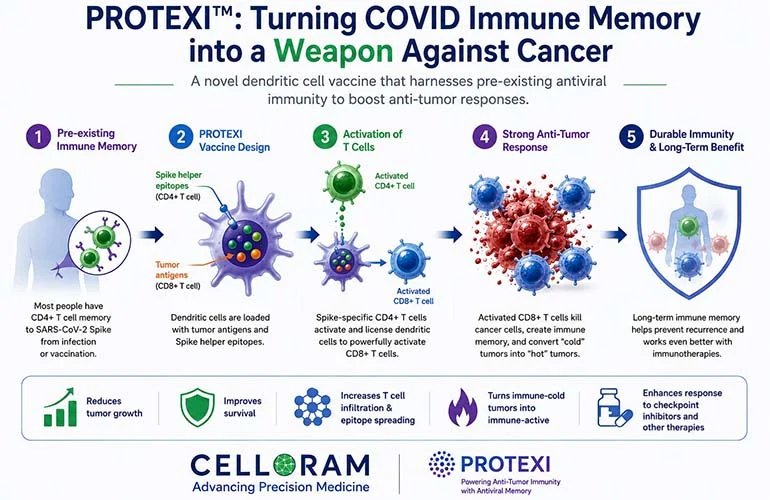
Dendritic cells act as the sentinels of the immune system, responsible for presenting antigens to T cells to initiate an adaptive immune response. In the context of cancer immunotherapy, DC vaccines are engineered to present tumor-specific antigens to CD8+ cytotoxic T cells, which are the primary effectors capable of identifying and killing cancer cells. However, clinical data has historically been underwhelming; studies indicate that only approximately 15% of patients demonstrate an objective clinical response to conventional DC-based therapies.
The fundamental limitation of these vaccines often lies in the "help" required to fully activate the immune response. While CD8+ T cells are the executioners, they frequently require support from CD4+ T helper cells to achieve full activation, proliferation, and durable memory formation. Without this "helper" signal, the CD8+ response can be transient or insufficient to penetrate the tumor microenvironment.
Protexi addresses this deficiency by incorporating specific epitopes from the SARS-CoV-2 Spike protein. Because the majority of the global population has been primed by either vaccination or prior infection, they possess memory CD4+ T cells that recognize the Spike protein. When the vaccine is administered, these pre-existing memory cells are rapidly recruited to the site of the dendritic cells, providing the necessary cytokine signaling to invigorate the CD8+ response against the tumor-specific antigens also carried by the vaccine.
Chronology of Research and Scientific Evolution
The conceptual framework for Protexi emerged from the convergence of two distinct, long-standing threads of immunological research. The first originated in the 1990s, when foundational studies established that CD4+ T helper cells were not merely supportive but essential for the induction of robust CD8+ responses against tumors that lack Major Histocompatibility Complex (MHC) class II expression. Despite this realization, the field struggled with the computational difficulty of identifying tumor-specific CD4+ epitopes, which are highly variable and patient-specific.
The second thread developed rapidly during the COVID-19 pandemic. As clinicians began observing the outcomes of patients on checkpoint inhibitor therapies, it became evident that those with active or recent COVID-19 vaccinations frequently exhibited improved immunological profiles. Researchers began to synthesize these observations, leading to the logical conclusion that rather than waiting to map a patient’s unique tumor-specific CD4+ epitopes—a process that is time-consuming and prone to failure—clinicians could leverage a universal, highly immunogenic epitope that most patients already possess.
In preclinical models, the efficacy of this approach has been pronounced. In experiments involving murine models, mice receiving CD4+ cells engineered to recognize the Spike protein exhibited a 100% survival rate to day 40, compared to a 40% survival rate in cohorts treated with conventional DC vaccines. Furthermore, in a melanoma challenge model, the researchers observed significant tumor regression, with five of seven mice maintaining tumor volumes below 200 cubic millimeters by day 26.
Supporting Data and Durable Immune Memory
The viability of the Protexi platform rests on the longevity of SARS-CoV-2 immune memory. John Letterio, a co-author of the study published in Nature Communications, emphasizes that the durability of Spike-specific CD4+ T-cell memory is robust. Data suggests that these T-cell responses remain elevated for two to four years following vaccination.
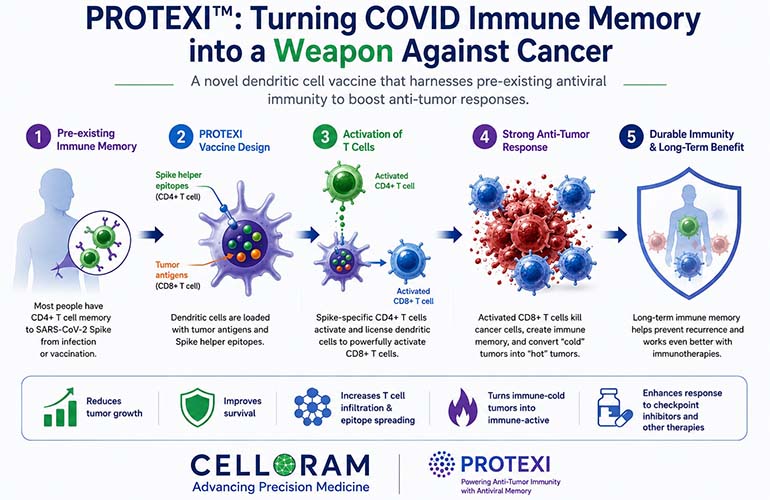
Historical data provides further confidence; studies on SARS-CoV-1, which emerged in 2002, demonstrated that viral CD4+ T-cell memory could persist for as long as 17 years in some individuals. This suggests that the Protexi platform could remain effective for patients long after their initial exposure to the SARS-CoV-2 virus or vaccine.
For the minority of the population lacking this pre-existing immunity, the research team has developed a "priming" protocol. In mice, a preliminary, short-duration dose of dendritic cells loaded with Spike-protein equivalents was sufficient to establish a strong CD4+ T-cell response, effectively creating the necessary "memory" required for the main therapeutic vaccine to function. The developers anticipate that this priming phase will be a standard component of the clinical protocol for patients who are either immunocompromised or have not been exposed to the SARS-CoV-2 antigen.
Official Responses and Clinical Outlook
The scientific community has noted the potential of this platform to solve the "delivery and activation" problem that has long plagued therapeutic cancer vaccines. By bypassing the need for de novo discovery of tumor-specific helper epitopes, Celloram has streamlined the manufacturing process, potentially lowering the barrier to entry for patient-specific immunotherapy.
"The idea builds on two separate threads of research that came together at a good moment," Letterio remarked during a summary of the findings. The ability to use a known, highly immunogenic viral protein as a surrogate helper antigen represents a shift toward more modular vaccine design. While the current iteration of the vaccine utilizes the SARS-CoV-2 Spike protein, the researchers posit that the mechanism is platform-agnostic. In theory, any highly prevalent antigen to which the population has high-affinity memory—such as common seasonal viruses—could be utilized if the Spike-based approach were to lose relevance or efficacy.
Broader Implications for Oncology and Immunotherapy
The implications of the Protexi findings extend beyond the treatment of a single cancer type. The ability to enhance the potency of DC vaccines could revitalize interest in this category of immunotherapy, which has often been overshadowed by the rapid rise of CAR-T cell therapies and bispecific antibodies.
If the preclinical success translates to human clinical trials, the medical community may see a new generation of "bilingual" vaccines. These vaccines would "speak" two languages to the immune system: one representing the malignancy and another—the universal viral epitope—representing a familiar, memory-rich target that the immune system is primed to defend.
The research team is now moving toward an Investigational New Drug (IND) submission with the U.S. Food and Drug Administration (FDA). Pending regulatory approval, the first-in-human clinical trial is slated to take place at the Angie Fowler Adolescent & Young Adult Cancer Institute. The study will specifically target sarcoma, a rare group of cancers that arise in the bones and connective tissues, which have historically shown a high degree of resistance to conventional immunotherapies.
As the industry observes these developments, the focus will remain on the persistence of the CD4+ helper signal and the potential for tumor-induced immunosuppression to dampen the response in a clinical setting. However, the data presented in Nature Communications provides a compelling case for a "piggyback" strategy in vaccine development—using the scars of a global pandemic to build a new, powerful weapon against cancer. The project remains a testament to the unforeseen benefits of rapid, widespread immunological intervention, suggesting that the memory of the COVID-19 era may provide a foundation for future breakthroughs in the ongoing fight against oncological disease.