The field of comparative psychology has long maintained a distinct hierarchy of intelligence, placing large-brained vertebrates like primates, dolphins, and corvids at the apex of cognitive complexity. However, a groundbreaking study published on June 4, 2026, in the journal Science has fundamentally disrupted this paradigm. Researchers from the University of Oulu, the University of Helsinki, and the University of Turku in Finland have provided empirical evidence that bumble bees (Bombus terrestris) are capable of spontaneous problem-solving—a trait previously thought to be the exclusive domain of animals with significantly larger and more complex neural architectures.
The study demonstrates that these insects can solve completely unfamiliar object manipulation tasks without prior training or social learning. By successfully maneuvering a ball to serve as a platform to reach a reward, the bees exhibited what researchers describe as an insect version of the classic "box-and-banana" problem, suggesting that the capacity for insight and goal-directed innovation is not a product of brain size alone, but rather of sophisticated, albeit miniaturized, neural processing.
Historical Context: From Chimpanzees to Hymenoptera
To understand the weight of these findings, one must look back over a century to the work of Gestalt psychologist Wolfgang Köhler. In 1917, while studying chimpanzees at a research station in Tenerife, Köhler observed that the animals did not always solve problems through simple trial-and-error. Instead, they would often experience a moment of "insight," where they suddenly realized that they could stack wooden crates to reach a banana suspended from the ceiling.
For decades, Köhler’s experiments served as the benchmark for higher-order cognition. The ability to recognize that a neutral object (a box) could be repurposed as a tool (a pedestal) to achieve a goal (the banana) was seen as a hallmark of the vertebrate mind. Insects, by contrast, were often dismissed as "biological automatons" governed by rigid instincts and simple associative learning.
The new Finnish study directly challenges this historical bias. By recreating the logic of the box-and-banana experiment with bumble bees, the research team has shown that the "aha!" moment of spontaneous problem-solving is achievable even within the approximately one million neurons of an insect brain—a staggering contrast to the 86 billion neurons found in the human brain.
The Experimental Framework: The Ball and the Ceiling Flower
The methodology employed by the researchers was designed to isolate "spontaneous" problem-solving from "learned" behavior. The experiment was conducted in a transparent arena and involved several distinct phases to ensure the bees were truly innovating rather than merely repeating a conditioned response.
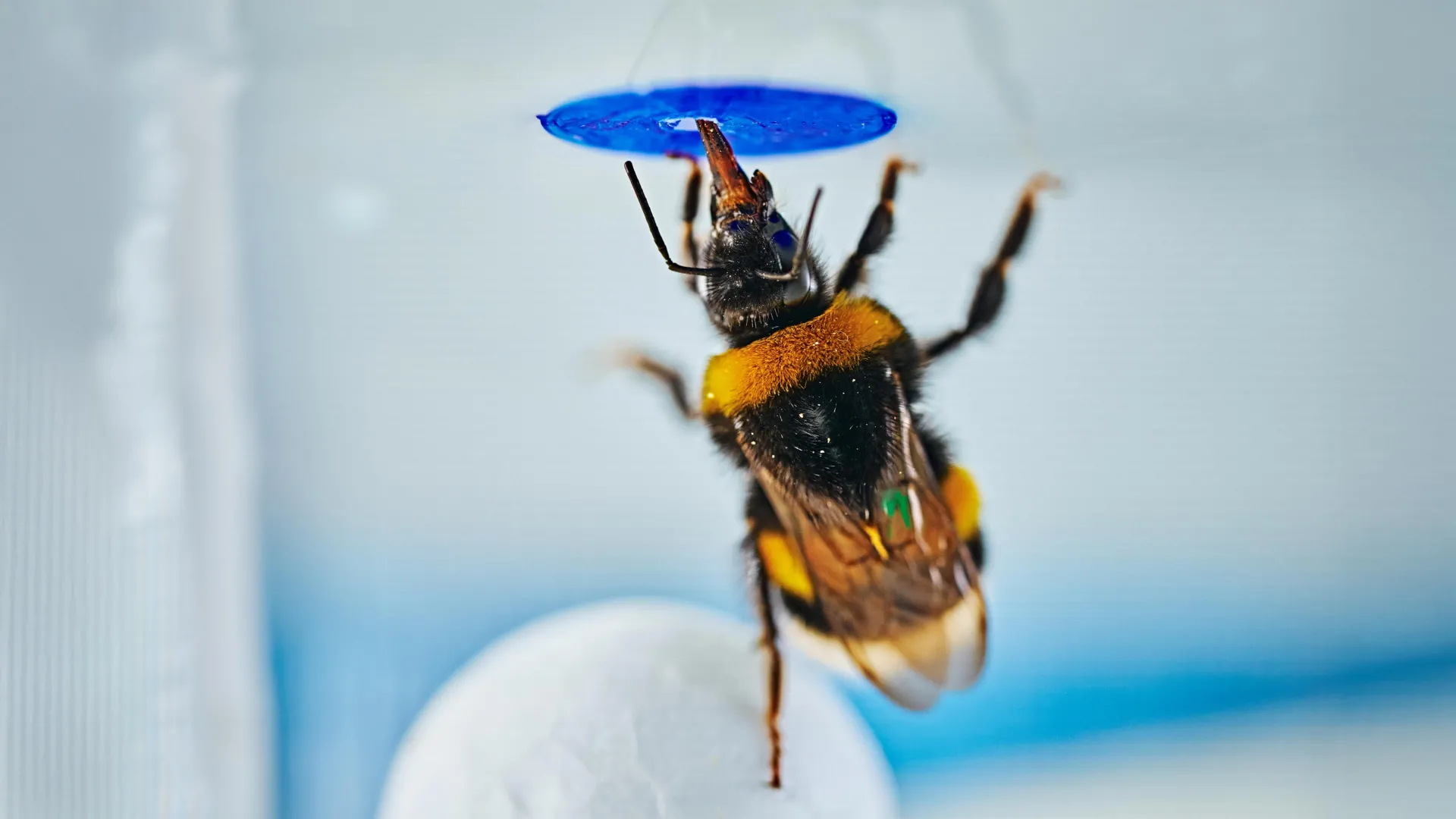
In the initial phase, the subjects were introduced to two separate concepts. First, they learned that a specific blue artificial flower contained a sucrose reward. Second, they were allowed to interact with a small, lightweight ball, learning only that it was a movable, harmless object that did not inherently provide food. Crucially, the bees were never shown the two objects together, nor were they trained to move the ball toward the flower.
The "challenge" phase placed the blue flower on the ceiling of the arena, well out of the bees’ reach. To access the nectar, the bees had to navigate a sequence of actions they had never performed: locating the ball on the floor, rolling it across the arena until it was positioned directly beneath the ceiling-mounted flower, and then climbing the ball to bridge the gap to the reward.
Lead author Akshaye Bhambore from the University of Oulu noted that the behavior of the successful bees was strikingly intentional. "What makes this behavior especially remarkable is that the bees had never been trained to roll the ball," Bhambore stated. "This was a completely new challenge. Their behavior appeared goal-directed, with successful individuals showing more directed movement patterns rather than the random search patterns typical of trial-and-error."
Rigorous Controls and Quantitative Data
To ensure the validity of their findings, the research team implemented a series of stringent control experiments. A common criticism of animal intelligence studies is the "Clever Hans" effect or the possibility of accidental success. The Finnish team sought to rule out these variables through several layers of verification:
- Eliminating Visual Guidance: In one of the most demanding iterations of the test, the researchers obscured the flower from the bee’s view while it was moving the ball. This meant the bee could not simply "steer" toward a visible target. Despite the lack of direct visual stimuli, many bees still rolled the ball to the correct location, suggesting they were working from a mental representation of the goal.
- Rule-Out of Play Behavior: The researchers analyzed the movement of the balls in the absence of a reward to ensure the bees weren’t simply "playing" with the objects. The data showed that ball-rolling was significantly more directed and frequent when the reward was present but inaccessible.
- Naïve Subject Testing: Unlike previous studies where animals had extensive "pre-training" with tools, these bees were "fully naïve." They had no prior experience with using objects to solve problems, ensuring that the solution was a spontaneous innovation.
The data revealed that while not every bee in the colony solved the task, a significant number of individuals did. These "innovator" bees demonstrated a rapid transition from exploratory behavior to a highly efficient sequence of actions. This "step-function" in behavior—where a solution is reached suddenly rather than gradually—is the primary indicator of insight-based learning.
Perspectives from the Research Team
The implications of the study have sparked a broader discussion about the nature of consciousness and intelligence in "miniature" brains. Senior author Olli Loukola, a Docent at the University of Oulu and Senior Researcher at the University of Turku, emphasized that these results necessitate a seat for insects at the table of cognitive science.
"For over a century, spontaneous object-based problem-solving has mostly been studied in vertebrates," Loukola said. "Our study suggests insects may belong in that conversation too. We are not claiming that bees think like humans, but our findings show that miniature brains can generate flexible solutions to novel problems in ways we are only beginning to understand."
Co-author Ece Nur Akmeşe from the University of Helsinki reflected on the visual impact of the experiments. "One moment the animal is exploring seemingly without direction, and the next it performs a highly efficient sequence of actions leading directly to the solution," Akmeşe observed. "Watching the bees solving the task was genuinely fascinating."
Analysis of Broader Implications
The discovery that bumble bees can solve the "insect version" of the box-and-banana problem has far-reaching implications for several fields of study:
Neurobiology and AI
The fact that a brain with a million neurons can perform tasks previously attributed to brains with billions of neurons suggests that cognitive "software" may be more efficient than previously thought. This has significant implications for Artificial Intelligence. If complex problem-solving can be achieved through the simplified neural pathways of an insect, it may provide a blueprint for developing more efficient, low-power AI systems that do not require massive computational resources to exhibit flexible logic.
Evolutionary Biology
The presence of such sophisticated cognition in Hymenoptera suggests that the ability to innovate is a convergent evolutionary trait. It likely evolved as a response to the complex, ever-changing environments in which bees forage. Being able to solve novel problems—such as navigating a new type of flower or overcoming an obstacle—would provide a significant survival advantage to a colony.
Ethics and Conservation
As evidence of insect sentience and cognitive depth grows, the ethical considerations regarding their treatment and conservation become more pressing. Bumble bees are currently facing significant population declines globally due to habitat loss, pesticide use, and climate change. If bees are capable of insight and goal-directed behavior, the argument for their protection gains a new dimension of moral urgency.
Conclusion and Future Research
The study, "Spontaneous problem-solving in bumble bees," authored by Akshaye A. Bhambore, Ece N. Akmeşe, Emma Häkkinen, Milla K. Jussila, Juha-Heikki Kantola, and Olli J. Loukola, marks a pivotal moment in entomology. It effectively closes the door on the era where insects were viewed as simple stimulus-response machines.
Future research is expected to delve deeper into the specific neural mechanisms within the bee’s "mushroom bodies"—the parts of the insect brain associated with learning and memory—to identify exactly how these spontaneous connections are formed. For now, the scientific community must grapple with the fact that the capacity for innovation is not a matter of size, but of the remarkable flexibility of the living mind, regardless of the scale on which it is built.