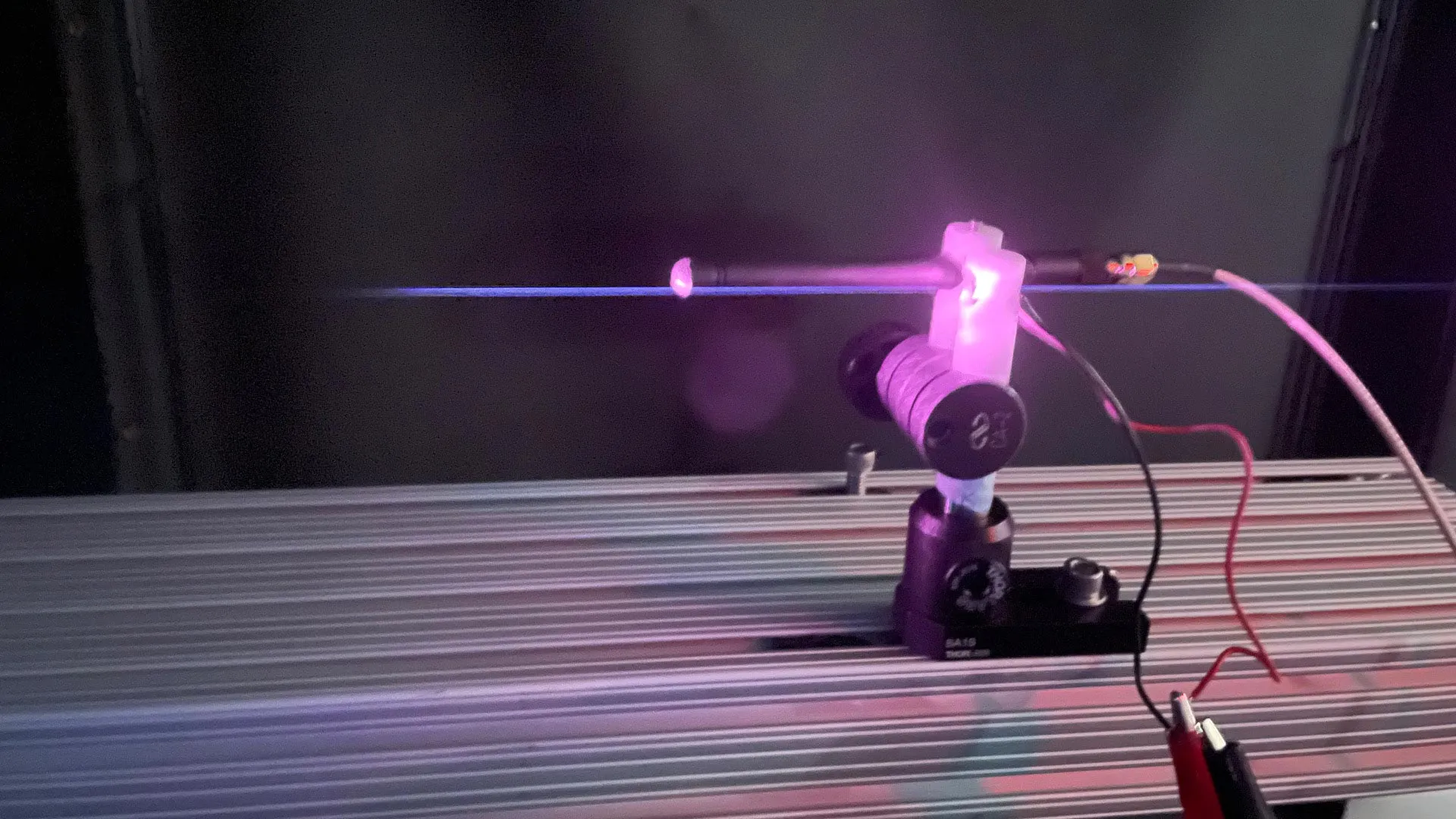
In a breakthrough that challenges traditional thermodynamic intuition, researchers at Kyushu University have announced the development of a novel solid-state molecular material capable of transforming visible sunlight into high-energy ultraviolet (UV) radiation. This process, known as photo upconversion, allows multiple low-energy photons to combine their energy into a single, higher-energy particle, effectively "adding together" the power of visible light to produce UV light under standard outdoor conditions. The study, published on June 23 in the prestigious journal Nature Communications, marks a significant milestone in the field of molecular systems chemistry and solar energy harvesting, achieving a photo upconversion efficiency of 1.9%—a figure that, while seemingly modest, represents a world-class benchmark for materials operating under non-concentrated natural sunlight.
The achievement is the result of a 14-year scientific odyssey led by Professor Emeritus Nobuo Kimizuka and Associate Professor Yoichi Sasaki at Kyushu University’s Faculty of Engineering. By manipulating the molecular architecture of organic semiconductors, the team has solved a long-standing "quenching" problem that has historically prevented solid-state materials from efficiently performing this energy conversion. The implications of this discovery extend far beyond the laboratory, offering potential revolutions in air purification, 3D printing, dental medicine, and solar-powered chemical synthesis.
The Challenge of Harnessing the Solar Spectrum
To understand the significance of the Kyushu University breakthrough, one must first examine the composition of the sunlight reaching Earth. While the sun emits a vast range of electromagnetic radiation, only a small fraction is ultraviolet. Specifically, UV light accounts for approximately 6% of the total solar energy that penetrates the atmosphere. Despite this scarcity, UV light is an essential catalyst for a wide array of industrial and medical processes. It is used to cure resins in 3D printers, harden dental fillings, and power photocatalytic air purifiers that neutralize volatile organic compounds and pathogens.
Historically, generating UV light has required energy-intensive sources, such as mercury lamps or high-powered LEDs, which often rely on electricity generated from fossil fuels. The ability to "upconvert" the much more abundant visible light portion of the solar spectrum into UV light has been a "holy grail" for materials scientists. This process essentially allows for the "recycling" of visible light, turning a common resource into a high-value technological tool. However, achieving this at the quantum level requires overcoming significant physical hurdles, particularly when moving from liquid-based laboratory experiments to practical, solid-state materials.
The Physics of Photo Upconversion: Triplet-Triplet Annihilation
The mechanism behind this transformation is a quantum mechanical process called triplet-triplet annihilation (TTA). In a TTA system, the process begins with a "donor" molecule, also known as a sensitizer. When this molecule absorbs a photon of visible light, it enters an excited state. Through a process called intersystem crossing, the molecule moves into a long-lived "triplet state." This energy is then transferred to a nearby "acceptor" or "emitter" molecule.
The critical phase occurs when two of these excited acceptor molecules, both in their triplet states, encounter one another. Through a complex interaction, they combine their energy. One molecule returns to its ground state, while the other is propelled into an even higher-energy "singlet state." When this high-energy molecule eventually relaxes, it releases its stored energy as a single photon of ultraviolet light.
While TTA has been demonstrated with high efficiency in liquid solutions, liquids are notoriously difficult to integrate into commercial products. They are prone to evaporation, require toxic solvents to keep the molecules in suspension, and are sensitive to oxygen, which can "quench" or kill the excited states before the conversion can occur. Scientists have long sought to replicate this process in solid-state materials, but the transition to solids introduced a new set of problems. In a solid, molecules are often packed so tightly that their electronic clouds—specifically the pi-electron clouds—overlap too much. This proximity causes the energy to dissipate as heat rather than being converted into UV light, a phenomenon known as exciton quenching.
Engineering the "Goldilocks" Molecular Distance
The Kyushu University team, led by Associate Professor Yoichi Sasaki, identified that the key to successful solid-state upconversion lay in precise molecular spacing. "In solids, molecules must be close enough for energy to transfer but separated enough to prevent quenching of excitons," Sasaki explained.
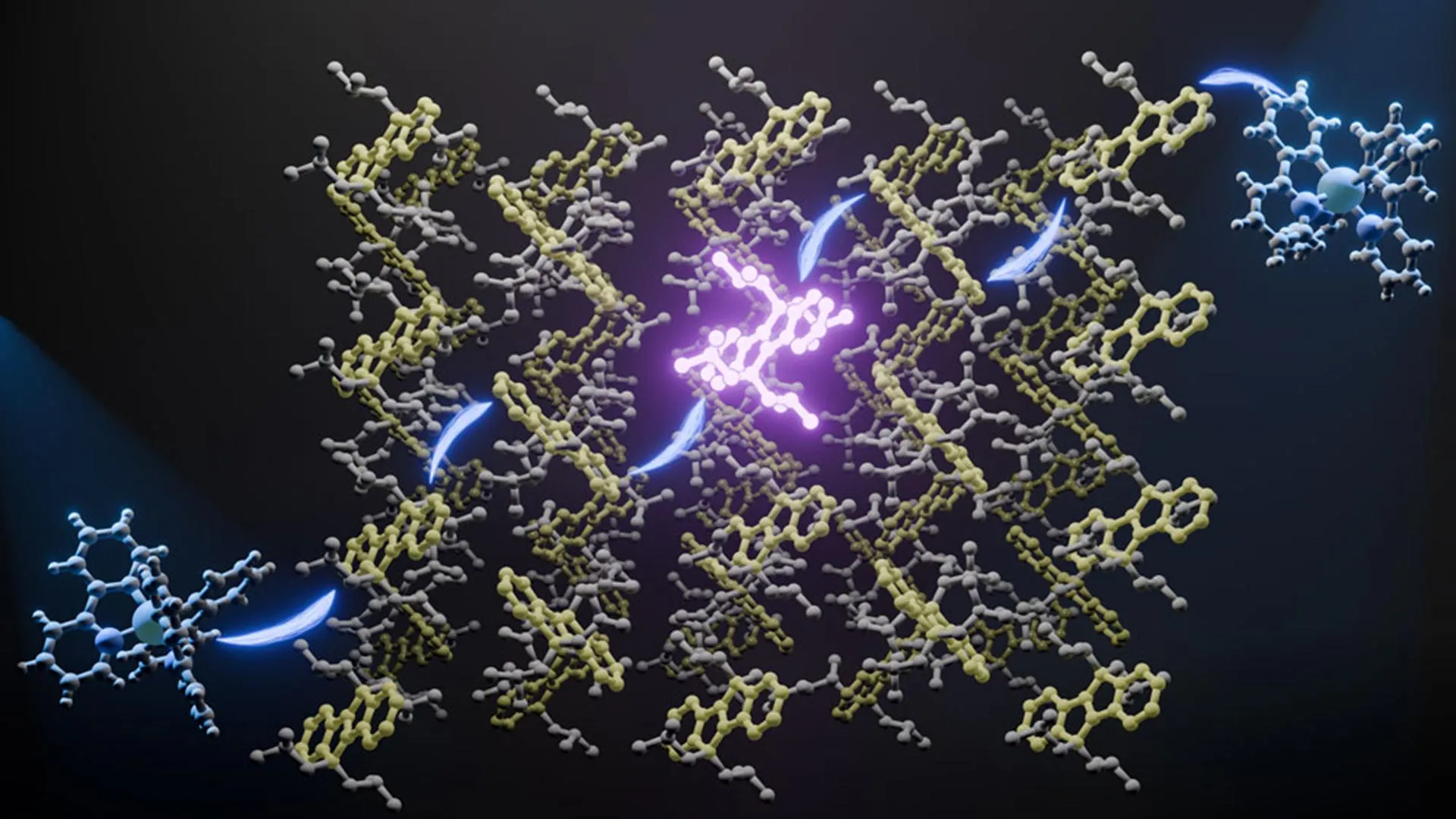
To achieve this balance, the researchers turned to an organic semiconductor called dihydroindenoindenedene (DHI). The breakthrough involved a sophisticated modification of the DHI structure. By attaching specific alkyl chains to the sp³ carbon atoms of the DHI molecule, the team was able to create a rigid, three-dimensional framework. The sp³ carbon atoms are unique because their four chemical bonds point in fixed directions, creating a tetrahedral geometry that acts as a natural spacer.
This molecular engineering ensured that the DHI molecules were held at a "Goldilocks" distance from one another. The spacing was tight enough to allow triplet energy to migrate efficiently through the material—a process known as triplet energy migration (TEM)—but distant enough to prevent the pi-electron clouds from overlapping and quenching the reaction. The resulting material demonstrated remarkable properties, including a solid-state fluorescence quantum yield of over 60%, indicating that the majority of the energy was being converted into light rather than lost to heat.
Performance Under Real-World Conditions
Perhaps the most impressive aspect of the new material is its performance under low-intensity light. Most previous attempts at solid-state upconversion required high-intensity lasers to trigger the TTA process. In contrast, the Kyushu University material functions under natural, non-concentrated sunlight.
The achieved upconversion efficiency of 1.9% is a landmark for solid-state systems. While 1.9% might seem low in isolation, it represents the production of approximately two UV photons for every 100 visible-light photons absorbed. Because visible light is so much more abundant than UV light in the solar spectrum, this conversion rate is sufficient to power various chemical and industrial reactions that would otherwise require artificial UV sources.
"This means the material runs on natural sunlight alone," Sasaki noted. "Most solid-state materials cannot realize this even at much higher light intensity. This efficiency opens the door to using solar energy for tasks that previously required plug-in equipment."
A 14-Year Scientific Journey and a Heartfelt Retirement
The publication of this research marks the culmination of a career-spanning effort by Professor Emeritus Nobuo Kimizuka. Beginning in 2012 at the Kyushu University Research Center for Negative Emissions Technologies, Kimizuka sought to establish a new paradigm in "molecular systems chemistry." His vision was to create self-assembled molecular systems that could perform complex functions, such as light harvesting and energy conversion, mimicking the efficiency of biological systems like photosynthesis.
Over the years, the Kimizuka lab explored various mediums, including gels and liquid crystals, gradually moving closer to the goal of a stable, high-efficiency solid. The final breakthrough with the DHI-based material occurred in May 2024, a timing that carried significant personal weight for the team. Professor Kimizuka was scheduled to retire in early 2025, and the researchers worked with renewed intensity to finalize the data and draft the manuscript.
The core research team included graduate students Naoyuki Harada, Hayato Shoyama, and Nutnicha Boonmong, along with Assistant Professor Kiichi Mizukami. In a poignant moment for the department, the final draft of the study was handed to Professor Kimizuka just 11 days before he officially moved out of his laboratory. "For us, it felt like a heartfelt retirement gift," Sasaki recalled. Kimizuka himself described the discovery as a "major milestone" in the 14-year history of the project, validating the potential of molecular self-assembly in solving global energy challenges.
Broader Implications and Future Applications
The potential applications for this new solid-state material are diverse. The researchers have already filed a patent application, signaling a clear path toward commercialization. Because the material is made from relatively inexpensive organic starting materials and can be synthesized through standard chemical processes, it is a prime candidate for industrial scaling.
One of the most promising applications is in the field of photocatalysis. Many photocatalysts used for water splitting (to produce hydrogen) or carbon dioxide reduction require UV light to function. By coating these catalysts with the new upconversion material, it may be possible to drive these green-energy reactions using the full spectrum of visible sunlight, vastly increasing their efficiency.
In the realm of environmental health, the material could be integrated into indoor air purification systems. These systems currently use UV lamps to activate filters that break down pollutants. A solar-powered or room-light-powered upconversion film could achieve the same results without the need for electricity. Similarly, in the manufacturing sector, low-intensity 3D printing could become more accessible. Currently, resin-based 3D printing (SLA or DLP) relies on UV lasers or projectors. An upconversion layer could potentially allow for the use of safer, cheaper visible-light projectors to cure UV-sensitive resins.
Conclusion and Next Steps
The work at Kyushu University represents a fundamental shift in how we approach solar energy. By viewing the solar spectrum not as a fixed resource but as a flexible one that can be reconfigured through molecular engineering, the researchers have provided a blueprint for next-generation light-harvesting technologies.
As the team moves forward, the next phase of research will likely focus on further increasing the upconversion efficiency and testing the long-term durability of the DHI material under prolonged exposure to environmental elements. Additionally, the researchers aim to explore different molecular combinations that might allow for the upconversion of even lower-energy infrared light into visible light, potentially expanding the usable solar spectrum even further.
The transition from a 14-year theoretical pursuit to a patented, high-performance material serves as a testament to the power of persistent, long-term scientific inquiry. As the world seeks more sustainable ways to power modern technology, the ability to "add together" the energy of the sun may prove to be one of the most vital tools in the green-energy toolkit.