Water is the most abundant and essential substance on Earth, yet it remains one of the most scientifically perplexing liquids in existence. While most substances become denser as they transition from a liquid to a solid state, water famously expands, allowing ice to float. This anomaly is just one of dozens that have puzzled physicists and chemists for centuries. Now, a breakthrough study from the University of Osaka has leveraged the power of artificial intelligence to decode the hidden structural dynamics of supercooled water, providing a unified framework to understand why water behaves so strangely under extreme conditions.
The research, recently published in the prestigious journal Communications Chemistry, marks a significant milestone in computational chemistry. By using neural networks to evaluate and compare various mathematical models of molecular arrangement, the Osaka team has identified the most effective ways to describe the transition between different liquid states of water. This discovery not only advances our fundamental understanding of thermodynamics but also offers a roadmap for future research into the behavior of liquids in biology, meteorology, and materials science.
The Scientific Enigma of Water’s Anomalies
To appreciate the significance of the Osaka study, one must first understand the "anomalous" nature of water. Standard liquid behavior dictates that as temperature decreases, molecular motion slows down, and molecules pack more tightly together, increasing density. Water follows this rule only until it reaches 4 degrees Celsius (39.2 degrees Fahrenheit). Below this point, it begins to expand.
This expansion is the result of water’s unique molecular geometry. Each water molecule (H2O) can form hydrogen bonds with four neighbors, creating a tetrahedral arrangement. At higher temperatures, these bonds are fluid and frequently break, allowing molecules to crowd together in a relatively disorganized, high-density state. As the temperature drops toward the freezing point, the molecules begin to favor a more rigid, open-lattice structure that takes up more space, leading to a decrease in density.
When water is "supercooled"—cooled below its standard freezing point of 0 degrees Celsius without turning into ice—these anomalies become even more extreme. In this metastable state, water exists in a precarious balance, revealing structural secrets that are usually hidden by the process of crystallization.
Understanding Supercooling and the Two-State Hypothesis
Supercooling occurs when liquid water lacks a "nucleation site"—a microscopic impurity, such as dust or a scratch on a container’s surface—around which ice crystals can form. In the absence of these triggers, water can remain liquid at temperatures as low as -48 degrees Celsius.
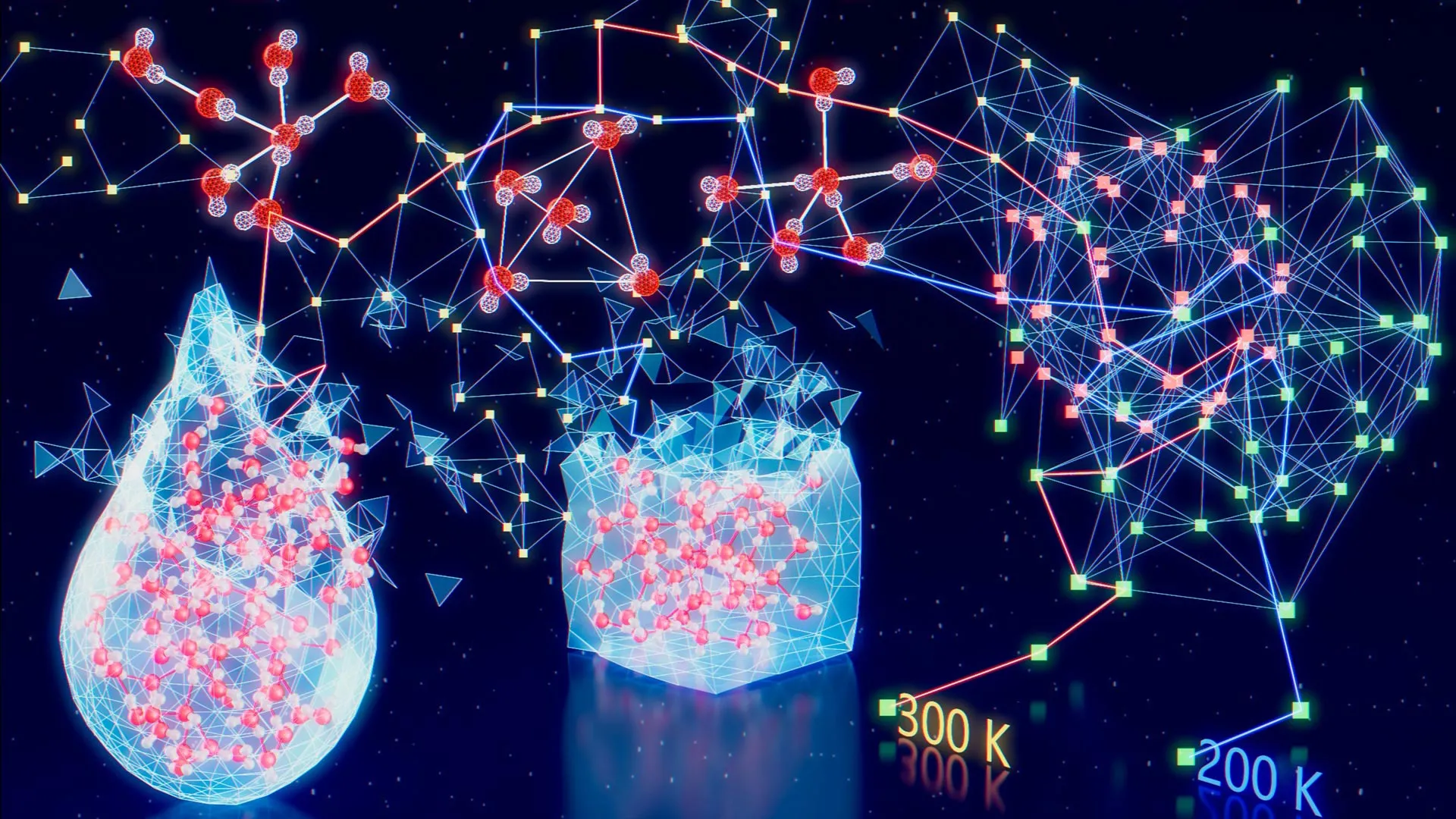
In this supercooled regime, many scientists subscribe to the "two-state hypothesis." This theory suggests that liquid water is actually a fluctuation between two distinct local structures: High-Density Liquid (HDL) and Low-Density Liquid (LDL).
- HDL (High-Density Liquid): A more disordered, compact arrangement where hydrogen bonds are distorted or broken.
- LDL (Low-Density Liquid): A highly ordered, tetrahedral arrangement where molecules are spaced further apart.
The competition between these two states is believed to drive water’s unusual thermodynamic properties, such as its high heat capacity and increasing compressibility at low temperatures. However, because these structures are fleeting and microscopic, researchers have struggled to find a consistent way to measure and describe them.
The Challenge of Structural Descriptors
Over the decades, computational chemists have developed various "structural descriptors"—mathematical formulas used to quantify the arrangement of molecules in a simulation. Some descriptors focus on the angles between bonds (tetrahedral order), while others focus on the distance between nearest neighbors (local density) or the volume of empty space around a molecule.
The problem facing the scientific community was a lack of standardization. Because these 16 or more descriptors were developed independently, they used different scales and captured different types of information. It was nearly impossible to determine which descriptor provided the "truest" representation of water’s molecular reality. This is where the University of Osaka researchers intervened, turning to machine learning to provide an objective arbiter.
Methodology: Neural Networks and Molecular Dynamics
The research team, led by corresponding author Kang Kim and senior author Nobuyuki Matubayasi, utilized a combination of molecular dynamics (MD) simulations and artificial intelligence. First, they performed high-resolution simulations of water at various temperatures and pressures, generating vast amounts of data on the positions and trajectories of thousands of water molecules.
They then fed this data into a neural network. Unlike traditional statistical methods, neural networks are capable of identifying complex, non-linear patterns that resemble human cognition but operate at a much higher level of mathematical complexity.
"Past studies have shown that using machine learning to classify and understand structural data is effective," explained Professor Kang Kim. "We specifically wanted to incorporate a neural network model into this study to evaluate how accurate the descriptors were at capturing key structural information, in a way that is like human cognition."
The AI was tasked with a classification challenge: it had to use the various structural descriptors to distinguish between the HDL-like and LDL-like environments within the supercooled liquid. By observing how well the AI performed using each descriptor, the researchers could rank the descriptors based on their efficiency and accuracy.
Key Findings: Identifying the Most Efficient Descriptors
The AI evaluated 16 different structural descriptors, comparing how they differentiated between the competing liquid structures across a range of temperatures. The results provided a clear hierarchy of information.
The researchers found that while many descriptors could identify the difference between LDL and HDL at very low temperatures, their accuracy varied significantly as the temperature increased toward the ambient range. The AI identified specific descriptors—those that combined information about both bond angles and the distance of the "second shell" of neighboring molecules—as being the most robust.
This finding is crucial because it suggests that the "secret" to water’s behavior isn’t just in the immediate four neighbors a molecule bonds with, but in how those neighbors influence the next layer of molecules. The AI-driven framework proved that a unified description of water’s structure is possible, bridging the gap between different schools of thought in liquid-state physics.
A Timeline of Water Research and the AI Evolution
The quest to understand water’s structure has been a century-long endeavor. To put the Osaka study in context, it is helpful to look at the chronology of the field:
- 1933: Bernal and Fowler propose the first tetrahedral model of water structure.
- 1970s: The first molecular dynamics simulations of water are conducted, allowing scientists to "see" molecular motion for the first time.
- 1992: Researchers at Boston University propose the "Liquid-Liquid Critical Point" theory, suggesting that water could separate into two distinct liquid phases at high pressure and low temperature.
- 2010s: Advances in X-ray lasers allow for the experimental observation of water’s structure at femtosecond timescales.
- 2024: The University of Osaka integrates AI to unify decades of disparate structural models, providing a definitive way to compare molecular descriptors.
This timeline highlights a shift from theoretical modeling to experimental observation, and finally to the current era of "data-driven discovery," where AI is used to synthesize and interpret massive datasets that are too complex for human researchers to analyze manually.
Broader Implications and Future Applications
The implications of the Osaka University study extend far beyond the laboratory. Understanding the structural transitions of supercooled water has direct applications in several critical fields:
1. Cryopreservation and Medicine
In medicine, the ability to freeze biological tissues, organs, or reproductive cells without damaging them is a "holy grail." The primary obstacle to cryopreservation is the formation of ice crystals, which can rupture cell membranes. By understanding the exact structural conditions that keep water in a supercooled liquid state, scientists can develop better cryoprotectants—substances that prevent freezing—potentially revolutionizing organ transplants and long-term tissue storage.
2. Climate Science and Meteorology
Supercooled water is a major component of clouds in the Earth’s atmosphere. The transition from supercooled liquid droplets to ice plays a vital role in cloud formation, precipitation, and the Earth’s radiation balance. More accurate models of water’s molecular structure will lead to more precise climate models and weather forecasts, as researchers can better predict when and how clouds will reflect sunlight or produce rain.
3. Planetary Science
On icy moons like Europa (Jupiter) or Enceladus (Saturn), water exists under extreme pressures and temperatures that are difficult to replicate on Earth. The Osaka framework allows planetary scientists to use AI to predict how water—and potentially the building blocks of life—behaves in the subsurface oceans of these distant worlds.
4. Materials Science
The study of "glassy" states—where liquids become highly viscous and behave like solids without crystallizing—is a major area of materials research. The AI methods used in this study can be applied to other liquids, helping engineers design new types of glass, polymers, and metallic alloys with specific structural properties.
Expert Perspectives and Industry Reaction
While the study is primarily academic, it has resonated with the broader scientific community. Independent researchers in the field of computational physics have noted that the Osaka team’s approach addresses a long-standing "bottleneck" in the industry: the lack of a standardized language for molecular structure.
"What makes this work stand out is the move away from ‘my model vs. your model,’" says one researcher in a related field. "By using AI as a neutral judge, we can finally move toward a consensus on how to describe the most important substance on our planet."
The study’s senior author, Nobuyuki Matubayasi, emphasized the forward-looking nature of their work. "The network used what it had learned to compare how 16 descriptors differentiated between LDL and HDL structures at different temperatures. In this way, we determined the most efficient descriptors." This methodology provides a template for future researchers to test even more complex descriptors as computational power continues to grow.
Conclusion: A New Lens on the Molecular World
The University of Osaka’s research represents a fundamental shift in how we study the natural world. By combining the rigorous principles of thermodynamics with the pattern-recognition capabilities of artificial intelligence, scientists are finally beginning to crack the code of water’s anomalous behavior.
The discovery that certain structural descriptors are superior to others provides more than just a better mathematical tool; it provides a deeper insight into the very fabric of liquid matter. As we continue to face global challenges—from climate change to the need for advanced medical technologies—the ability to understand and manipulate the molecular structure of water will remain one of our most potent scientific assets.
The findings in Communications Chemistry serve as a reminder that even the most common substances can harbor profound mysteries, and that the tools of the future, like AI, are essential for uncovering the secrets of the past. As researchers build upon this framework, the scientific community moves one step closer to a complete, unified theory of water—a goal that has remained elusive since the dawn of modern chemistry.