In a landmark achievement for the field of quantum chemistry and condensed matter physics, a collaborative research team has successfully demonstrated a method to precisely manipulate the rotational dynamics of molecules embedded within liquid helium nanodroplets. This feat, which utilizes a sophisticated optical centrifuge, marks the first instance where scientists have exerted such control inside a superfluid medium—a state of matter that flows without viscosity. The research, led by the University of British Columbia (UBC) in partnership with the University of Freiburg, offers a new window into the microscopic interactions that define quantum fluids and could have far-reaching implications for the development of quantum technologies and the study of molecular dynamics in extreme environments.
The findings, published in the prestigious journal Physical Review Letters, describe a technique that allows researchers to directly adjust both the direction and the angular velocity of a molecule’s rotation while it is submerged in a superfluid. By doing so, the team has provided a "control knob" for investigating the boundary between classical and quantum mechanical behavior. The ability to spin molecules at specific frequencies within these frictionless droplets enables the study of how individual particles interact with their surrounding environment at the quantum scale, a prerequisite for understanding the fundamental nature of superfluidity and its potential applications in high-precision sensing and quantum computing.
The Unique Properties of Superfluid Helium
To understand the significance of this breakthrough, one must first consider the unusual nature of the medium involved. Liquid helium, when cooled to temperatures approaching absolute zero (specifically below 2.17 Kelvin for the isotope Helium-4), undergoes a phase transition into a superfluid state. In this state, the liquid exhibits zero viscosity, meaning it can flow through microscopic capillaries without any loss of kinetic energy. It possesses an extraordinary thermal conductivity and can even climb up the walls of its container in a thin film known as a Rollin film.
Despite these exotic properties, superfluids still act as solvents. Scientists have long used helium nanodroplets—minuscule spheres of liquid helium containing only a few thousand atoms—as "nanolaboratories." Because the internal temperature of these droplets is extremely low (typically around 0.38 Kelvin), they provide an ultra-cold, non-reactive environment for isolating and studying individual molecules. However, the very nature of the superfluid has historically made it difficult to manipulate the rotation of these "solvated" molecules. While the fluid itself is frictionless, the molecules inside are not entirely disconnected from their surroundings; they interact with the helium atoms in a way that alters their effective mass and rotational properties.
The Challenge of Molecular Rotation in Fluids
Controlling the rotation of a molecule dissolved in a liquid is inherently more complex than doing so in a gas. In the gas phase, molecules are relatively isolated, allowing them to spin freely when struck by light. In a fluid, however, the molecule is surrounded by a dense environment of atoms. Dr. Valery Milner, an associate professor at UBC Physics and Astronomy and a lead author of the study, explains the difficulty using a vivid analogy: "Dissolved molecules interact with the atomic or molecular constituents of the fluid, effectively getting bigger and harder to spin up. Imagine making a snowball: It’s very easy to move it when it’s small, but gets harder and harder as more snow gets attached to it."
In the context of helium nanodroplets, this "snowball" effect occurs because the molecule attracts a shell of helium atoms that rotate along with it. This increases the molecule’s moment of inertia, making it sluggish and resistant to external forces. Previous attempts to use standard optical techniques to spin these molecules often failed because the pulses were either too fast for the "heavy" molecule to follow or too weak to overcome the initial resistance of the helium shell.
Innovation: The Modified Optical Centrifuge
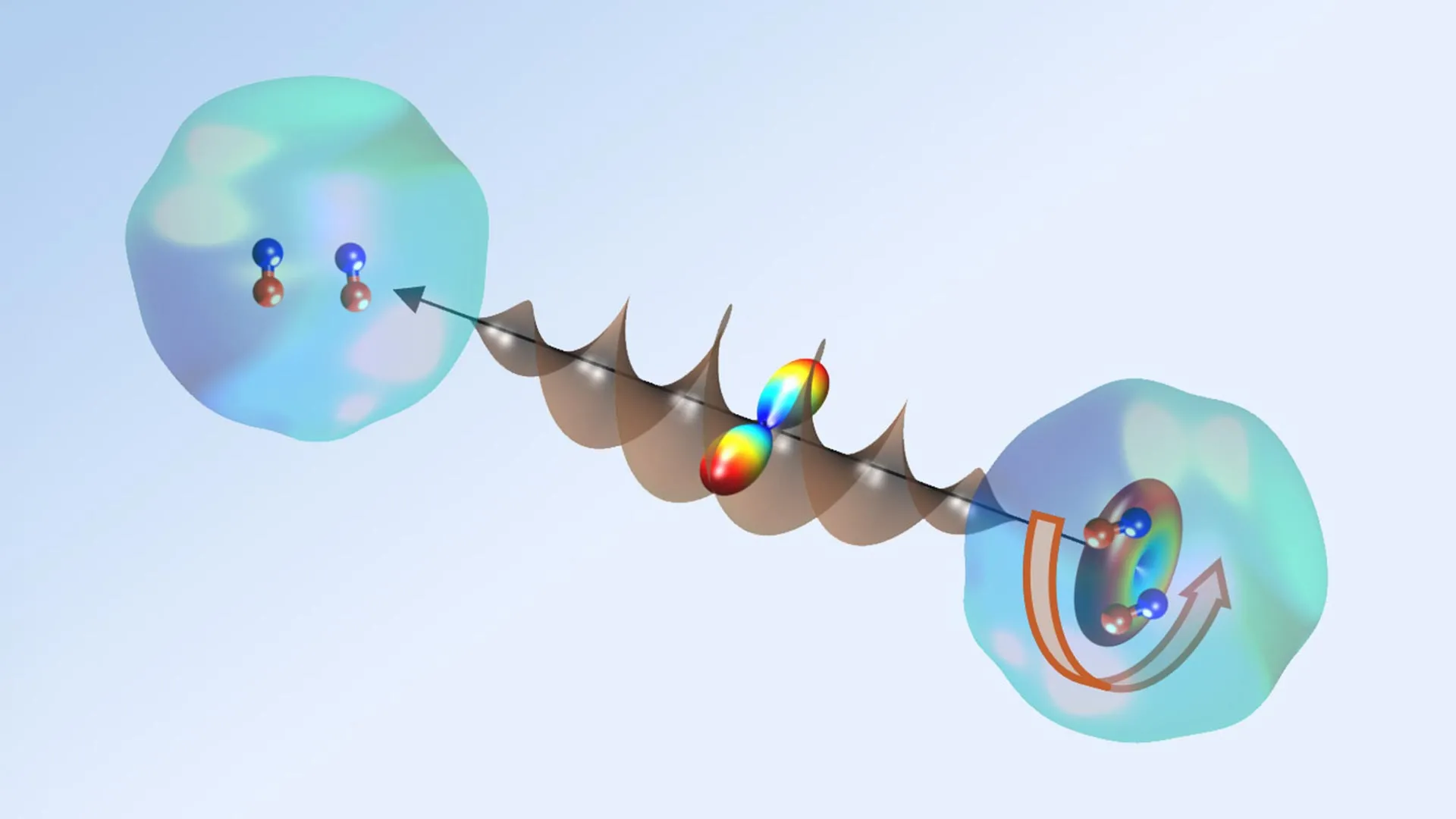
The breakthrough was made possible through the refinement of a tool known as an optical centrifuge. Originally developed to study molecules in the gas phase, an optical centrifuge uses a "chirped" laser pulse whose polarization rotates at an accelerating rate. As the electric field of the laser spins faster and faster, gas-phase molecules with a permanent dipole or polarizability align themselves with the field and are "dragged" into a state of high-speed rotation, reaching frequencies in the terahertz range.
To adapt this technology for the dense environment of a superfluid, the UBC and Freiburg team introduced a critical modification. Instead of a single continuous pulse, they utilized a sequence of laser pulses with a specifically engineered time delay between them. This delay created a form of quantum interference that effectively lowered the starting frequency of the rotation and allowed the molecule to synchronize with the laser more efficiently.
The researchers experimented with helium nanodroplets doped with dimers of nitric oxide (NO)2. By adjusting the timing and phase of the laser pulses, they were able to achieve a steady, controlled rotation rate. This approach significantly increased the "spinnability" of the molecules, allowing the scientists to overcome the drag caused by the surrounding helium atoms. The experiment proved that even within the confines of a quantum fluid, a molecule could be forced into a specific rotational state and maintained there with high precision.
Chronology of the Research and Experimental Data
The path to this discovery involved several years of incremental progress in the field of ultrafast optics. The concept of the optical centrifuge was first proposed in the late 1990s, but its application was largely confined to low-density gases for nearly two decades. In the mid-2010s, researchers began exploring the possibility of using these centrifuges to probe more complex systems, including liquids and solids.
The UBC-Freiburg collaboration began by establishing a baseline for how nitric oxide dimers behave in a vacuum versus a helium environment. Initial data showed that the rotational constant—a value that determines the spacing between rotational energy levels—decreased significantly when the molecules were placed inside the helium droplets. This confirmed the "snowball" theory, indicating that the molecules were indeed dragging helium atoms with them.
In the final series of experiments, the team utilized a "pump-probe" setup. A "pump" pulse (the optical centrifuge) initiated the rotation, while a subsequent "probe" pulse was used to detect the orientation and speed of the molecules via Coulomb explosion imaging. This technique involves stripping electrons from the molecules, causing them to fly apart; by measuring the trajectory of the fragments, the researchers could reconstruct the rotational state of the molecule at the moment of the explosion. The data revealed a clear correlation between the laser’s rotational frequency and the molecule’s angular momentum, confirming successful control.
Official Responses and Scientific Context
The scientific community has reacted with enthusiasm to the publication in Physical Review Letters. Experts in quantum fluids suggest that this technique provides a much-needed tool for testing the limits of the Landau criterion for superfluidity. The Landau criterion states that a superfluid can only remain frictionless if the velocity of an object moving through it (or rotating within it) stays below a certain critical threshold.
"Dr. Milner’s work addresses a fundamental question in quantum matter," noted a colleague in the field of molecular spectroscopy. "By being able to tune the rotation frequency, we can now observe the exact moment when the molecule begins to ‘feel’ the fluid—the point where the superfluidity breaks down and friction returns."
Dr. Milner himself emphasized the broader scientific inquiry driving the project. "The question of interest in the science of quantum matter, and the one this new approach will help us explore, is what changes from the perspective of the solvated—dissolved—molecule when you make the transition from a normal fluid to this type of quantum superfluid," he stated.
The research was supported by several major Canadian funding bodies, including the Natural Sciences and Engineering Research Council of Canada (NSERC), the Canada Foundation for Innovation (CFI), and the BC Knowledge Development Fund. These organizations highlighted the importance of fundamental physics research in maintaining Canada’s position at the forefront of international scientific innovation.
Analysis of Implications and Future Directions
The implications of being able to control molecular rotation in superfluids extend beyond the study of helium. One of the most immediate applications is in the field of "cold chemistry." In ultra-cold environments, chemical reactions are governed by quantum tunneling and long-range interactions rather than thermal collisions. By controlling the rotation of reactants inside a helium droplet, scientists may be able to steer the outcome of chemical reactions with unprecedented precision, potentially creating new materials or molecules that cannot exist at room temperature.
Furthermore, this research provides a pathway to exploring the "critical frequency" of superfluids. The UBC team is already planning follow-up experiments to identify the exact speed at which the superfluid can no longer support frictionless rotation. At very high rotational speeds, it is predicted that the molecule will create "vortices" or excitations within the helium, leading to a dramatic increase in drag. Understanding this transition is crucial for the study of other superfluid systems, such as the interior of neutron stars or the behavior of Cooper pairs in superconductors.
Another potential impact lies in the development of quantum sensors. Superfluid helium is incredibly sensitive to external rotations (a property used in superfluid gyroscopes). By embedding and controlling molecules within these systems, researchers could potentially develop hybrid sensors that combine the sensitivity of superfluids with the addressability of molecular quantum states.
Conclusion
The successful demonstration of controlled molecular rotation in liquid helium nanodroplets represents a triumph of experimental physics. By overcoming the challenges of density and solvation through the innovative use of a modified optical centrifuge, Dr. Valery Milner and his colleagues have opened a new frontier in the study of quantum fluids. As the team moves forward with investigating the breakdown of superfluidity at the atomic scale, their work will likely serve as a cornerstone for future research into the complex and often counterintuitive behavior of matter at the absolute limits of cold and speed. The "control knob" they have developed is not just a tool for spinning molecules; it is a key to unlocking the mysteries of the quantum world.