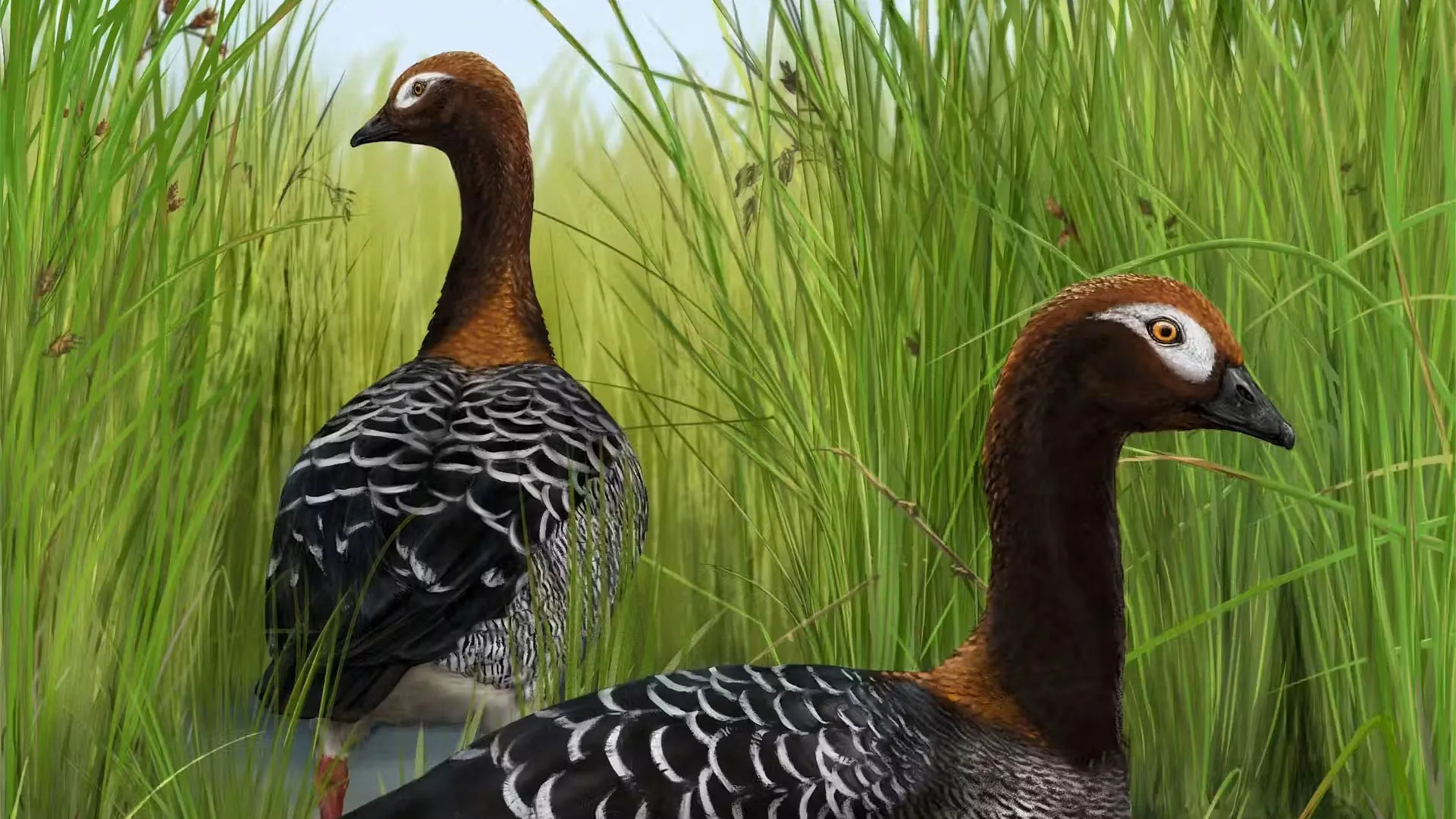
A groundbreaking discovery in the ancient lakebed sediments of Central Otago, New Zealand, has unearthed a fossil goose species previously unknown to science. This remarkable find, meticulously analyzed by researchers from the University of Otago (Te Whare Wānanga o Otāgo) and international collaborators, is fundamentally altering our understanding of how New Zealand’s exceptionally unique bird life evolved. The findings provide compelling evidence that the origins of Aotearoa’s avian fauna were far more dynamic and complex than previously theorized, challenging long-held scientific assumptions.
The research, published in the esteemed journal Historical Biology, is the culmination of extensive work by a multidisciplinary team. Associate Professor Nic Rawlence, Director of the Otago Palaeogenetics Laboratory and a key figure in the study, highlighted the significance of the discovery. His team’s investigation focused on a detailed re-examination of fossil material recovered from the renowned St Bathans fossil deposits, a treasure trove of paleontological evidence in the Otago region. These deposits, dating back to the Miocene epoch (approximately 23 to 5.3 million years ago), have consistently yielded a rich array of ancient bird remains, offering invaluable insights into New Zealand’s prehistoric ecosystems.
Unveiling a New Species from Ancient Sediments
While waterfowl fossils are notably abundant at the St Bathans site, the remains of geese have historically been far less common, making any discovery of this nature particularly noteworthy. To address this rarity, the research team undertook a rigorous re-evaluation of every fossil bone previously classified as belonging to geese. This painstaking process involved detailed comparative analysis, contrasting these specimens not only with other fossil waterfowl found at St Bathans but also with an extensive collection of skeletons from both modern and extinct bird species housed in major natural history institutions.
The meticulous examination led to a startling revelation: among the previously cataloged bones lay the remains of an undescribed species, a bird comparable in size to a small modern goose. This newly identified avian inhabitant of ancient New Zealand has been formally named Meterchen luti. The evocative name draws inspiration from the beloved nursery rhyme, "Old Mother Goose," symbolizing the emergence of an ancient goose from the very mud of the fossil deposit. The genus name, Meterchen, is derived from ancient Greek, translating to "mother goose," while the species epithet, luti, is Latin for "of the mud," directly referencing its paleontological origins.
Crucially, Associate Professor Rawlence clarified that Meterchen luti is not closely related to the recently extinct giant flightless New Zealand geese, scientifically known as Cnemiornis species. Furthermore, it is also distinct from their closest extant relative, the Cape Barren goose of Australia. This phylogenetic distinction is vital, as it separates the newly discovered species from the lineages previously considered the primary candidates for the ancestors of New Zealand’s iconic large geese.
A Paradigm Shift in Understanding Avian Evolution
The discovery of Meterchen luti, when considered in conjunction with recent advancements in avian genetics, paints a picture of New Zealand’s bird history as significantly more complex and dynamic than scientists had previously assumed. For decades, the prevailing scientific narrative suggested a more singular and ancient establishment of avian lineages in New Zealand. However, this new evidence, alongside genetic data from other bird groups, indicates a history of multiple colonization events and evolutionary radiations.
Alan Tennyson, lead author of the study and a paleontologist at the Museum of New Zealand Te Papa Tongarewa, emphasized this evolving understanding. He explained that while New Zealand has indeed been a destination for migrating birds over millions of years, the ancestral lineages of some of its most celebrated large bird species arrived surprisingly recently. These more recent arrivals, with their origins tracing back a mere four to five million years, include iconic species such as the takahē (Porphyrio hochstetteri), Forbes’ harrier (Circus approximans), and the formidable Haast’s eagle (Aquila moorei), the largest eagle known to have ever existed.
The earlier scientific hypothesis proposed that the St Bathans goose represented the direct ancestral lineage of the giant flightless Cnemiornis geese. This theory suggested a remarkably long evolutionary history for this lineage within Zealandia, the ancient continental fragment that includes New Zealand, potentially extending back at least 14 million years. Such a deep history would have implied a very early arrival of these ancestral geese.
However, this hypothesis presented a significant conflict with compelling genetic evidence that indicated the ancestors of Cnemiornis geese actually arrived in New Zealand from Australia only about seven million years ago. Proponents of the earlier theory had largely dismissed this genetic data as being inconsistent with their paleontological interpretations. The current rigorous reassessment of the St Bathans goose fossil material, as detailed in the Historical Biology publication, strongly supports the later arrival theory, aligning the fossil evidence with the genetic findings. This reconciliation of disparate data points is a significant triumph for the research team and a testament to the power of integrated scientific inquiry.
Chronology of Discovery and Analysis
The St Bathans fossil deposits have been a focal point of paleontological research for over a century, with initial discoveries made in the early 20th century. The deposits themselves were formed in a large, ancient lake system that existed in Central Otago during the Miocene epoch. This lacustrine environment provided ideal conditions for the preservation of a wide range of flora and fauna, including numerous bird species.
Early 20th Century Onwards: Initial excavations at St Bathans began, yielding a significant collection of fossil bird bones. These collections formed the basis of early studies into New Zealand’s prehistoric avifauna.
Mid to Late 20th Century: Continued research at St Bathans expanded the known fossil record, with a focus on identifying and classifying the diverse bird species present. However, the scarcity of goose remains remained a notable observation.
Early 21st Century: Advances in palaeogenetics and comparative anatomy provided new tools for re-examining existing fossil collections. The University of Otago, in collaboration with other institutions, intensified research efforts at St Bathans.
Recent Years (leading up to publication): Associate Professor Nic Rawlence and his team at the Otago Palaeogenetics Laboratory, alongside collaborators from Te Papa Tongarewa and the University of Cambridge, undertook a comprehensive re-evaluation of the St Bathans goose fossils. This involved detailed morphological analysis and comparative studies with modern and extinct avian skeletons.
Publication in Historical Biology: The findings, confirming the existence of a new species, Meterchen luti, and its implications for New Zealand bird evolution, are formally presented in this peer-reviewed scientific journal. This publication marks a significant milestone in avian paleontology and evolutionary biology.
Integrated Evidence: DNA, Fossils, and a Dynamic Past
The ancestors of Meterchen luti are estimated to have reached Zealandia over 14 million years ago, indicating a much earlier presence of goose-like birds than previously understood. However, their specific lineage appears to have eventually died out, leaving no direct surviving descendants. This finding underscores the complex tapestry of extinction and diversification that has characterized New Zealand’s evolutionary history.
Associate Professor Rawlence articulated the power of employing a comprehensive, multidisciplinary approach. "Using all the tools in the toolbox, including DNA and fossils, we can reconstruct how the dynamic geological, climatic, and human history of Zealandia has shaped the evolution of Aotearoa fauna in ever more detail," he stated. This integrated methodology, combining ancient DNA analysis with detailed fossil morphology and geological context, provides a more robust and nuanced understanding of evolutionary processes.
The giant flightless Cnemiornis geese themselves serve as another remarkable example of the rapid evolutionary changes that can occur on islands. These birds, which stood up to one meter tall and weighed up to 18 kilograms, were among the largest geese globally. Their relatively recent evolution, occurring within a short geological timeframe on islands, demonstrates the potent selective pressures and adaptive opportunities present in isolated environments. The ability of species to undergo such dramatic morphological transformations in response to island conditions is a key theme in island biogeography and evolutionary biology.
Broader Implications for Understanding Island Biogeography
The implications of this discovery extend far beyond the specific identification of a new goose species. It challenges the notion of a static, ancient avian establishment in New Zealand and highlights a history of repeated colonizations, extinctions, and adaptive radiations. This more dynamic model of evolution is likely applicable to many other endemic New Zealand species, suggesting that our understanding of their origins may also be due for revision.
The study reinforces the concept of "founder effects" and rapid adaptive evolution in isolated island ecosystems. When species colonize new lands with available ecological niches and without significant competition or predation, they can diversify and evolve at an accelerated rate. New Zealand, with its long period of isolation, has provided a unique laboratory for such evolutionary experiments.
Furthermore, the research underscores the importance of re-examining existing fossil collections with new analytical techniques and perspectives. Many long-held assumptions in paleontology are based on the best available evidence at the time of discovery. However, as scientific methodologies advance, these collections can yield new insights, revealing species and evolutionary pathways that were previously overlooked.
The collaboration between the University of Otago, Te Papa Tongarewa, and the University of Cambridge exemplifies the international nature of modern scientific research. By pooling expertise and resources, these institutions have been able to achieve a breakthrough that significantly advances our knowledge of New Zealand’s natural heritage. The discovery of Meterchen luti is not merely the identification of a new fossil; it is a crucial piece of a much larger puzzle, helping scientists to reconstruct the intricate and fascinating evolutionary journey of Aotearoa’s extraordinary bird life. This ongoing research promises to continue reshaping our understanding of life’s history on these isolated shores.