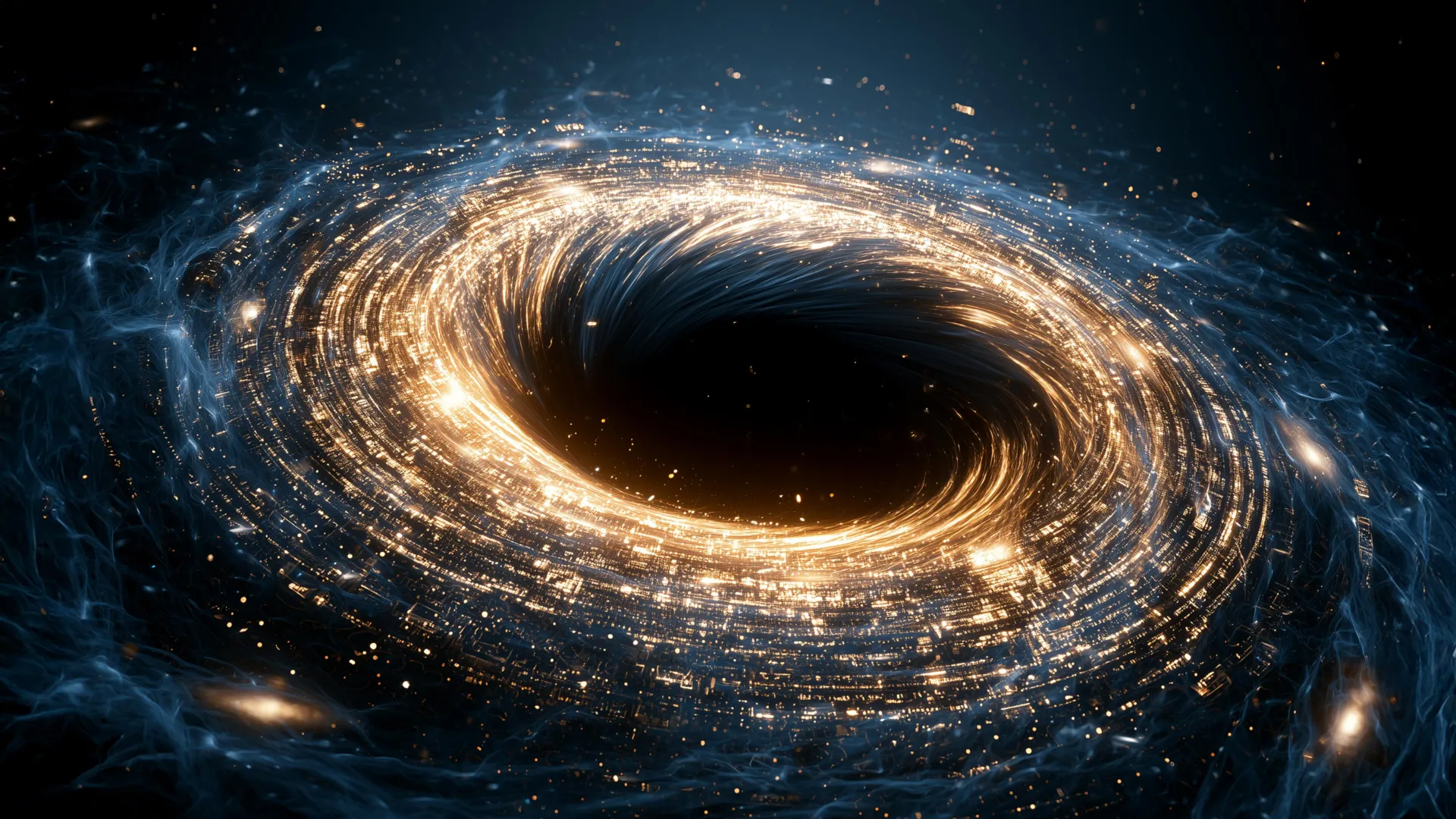
The long-standing conflict between general relativity and quantum mechanics, epitomized by the black hole information paradox, may finally have a geometric solution according to a groundbreaking study published in the journal General Relativity and Gravitation. Led by theoretical physicist Richard Pinčák, the research proposes that black holes do not evaporate into nothingness as previously feared, but instead leave behind stable, high-density remnants that act as permanent repositories for quantum information. By utilizing a sophisticated mathematical framework known as Einstein-Cartan theory within a seven-dimensional universe, the study not only addresses the fate of information in the cosmos but also provides a potential geometric origin for the mass of fundamental particles, bridging a gap between macroscopic gravity and the subatomic world of the Higgs field.
The Historical Context of the Information Paradox
To understand the significance of Pinčák’s findings, one must look back to the mid-1970s, a period that redefined modern astrophysics. In 1974, Stephen Hawking published a transformative paper suggesting that black holes are not perfectly "black" or eternal. Using semi-classical physics—applying quantum field theory to the curved spacetime around a black hole—Hawking demonstrated that black holes should emit thermal radiation, now known as Hawking Radiation.
This radiation originates from quantum fluctuations near the event horizon, where pairs of virtual particles are constantly created and annihilated. Occasionally, one particle falls into the black hole while its partner escapes. To maintain the conservation of energy, the black hole must lose a tiny amount of mass to account for the escaping particle. Over trillions of years, this process would cause a black hole to shrink and eventually vanish in a final, explosive burst of energy.
However, this conclusion triggered a crisis in physics. Quantum mechanics relies on the principle of "unitarity," which dictates that information about the state of a system must be preserved over time. If a black hole evaporates completely, the information regarding the matter that formed it—its spin, charge, and composition—would seemingly be erased from the universe. For decades, this "Black Hole Information Paradox" has forced physicists to choose between the validity of Einstein’s General Relativity or the foundational laws of quantum mechanics.
The Einstein-Cartan Theory and the Role of Torsion
The new study moves beyond the standard model of General Relativity (GR) to resolve this tension. While Einstein’s GR describes spacetime as a fabric that curves in the presence of mass, it assumes that the connection between points in spacetime is "symmetric," meaning space can bend but not twist. The Pinčák team instead employed the Einstein-Cartan theory, an extension of GR developed in the early 20th century that introduces a geometric property called torsion.
In this framework, spacetime possesses both curvature and torsion. Torsion is a "twist" in the geometry of the universe that becomes physically significant only at extreme densities, specifically those approaching the Planck scale (the smallest possible unit of length, approximately 1.6 x 10⁻³⁵ meters). At these scales, the gravitational pull that normally collapses matter into a mathematical point—a singularity—is countered by a repulsive force generated by the torsion field.
The researchers modeled this effect within a seven-dimensional universe, specifically utilizing a mathematical structure known as a G2-manifold. This choice is significant in the context of M-theory and string theory, which often posit that our four-dimensional world is a subset of a higher-dimensional reality. By calculating the interactions of gravity and torsion within this 7D geometry, the team discovered that the repulsive force of torsion halts the evaporation process before the black hole can disappear entirely.
Stable Remnants: The Cosmic Hard Drives
The most striking result of the study is the prediction of "stable remnants." Unlike Hawking’s model, where the black hole vanishes, the Pinčák model suggests that the evaporation process terminates when the black hole reaches a specific, microscopic mass. According to the team’s calculations, this stable remnant would possess a mass of approximately 9 x 10⁻⁴¹ kg.
These remnants serve as the solution to the information paradox. Rather than being destroyed, the quantum information that entered the black hole is encoded within the remnant’s internal structure. Specifically, the researchers found that information is stored in "quasi-normal modes"—essentially stable, long-lived vibrations of the torsion field within the remnant’s geometry.
The capacity of these remnants for information storage is staggering. The study calculates that a remnant resulting from the collapse of a star with the mass of our Sun could store roughly 1.515 x 10⁷⁷ qubits of information. This volume of data is precisely what is required to account for the entropy and information content of the original star, thereby satisfying the requirements of quantum unitarity. Under this model, no information is lost; it is simply "compacted" into a stable, geometric state that persists indefinitely.
A Unified Link to the Higgs Field and Mass Hierarchy
The implications of the study extend far beyond the lifecycle of black holes. One of the greatest mysteries in particle physics is the "mass hierarchy problem"—the question of why the fundamental forces have such vastly different strengths and why the Higgs boson has a mass so much lower than the Planck mass.
The Pinčák study suggests a geometric answer. By performing a process called dimensional reduction—mathematically "shrinking" the seven-dimensional geometry down to the four dimensions of our experienced spacetime—the researchers found that the energy scale of the torsion field naturally aligns with the electroweak scale, which is approximately 246 GeV (gigaelectronvolts).
This value, 246 GeV, is the "vacuum expectation value" (VEV) of the Higgs field, the mechanism that gives mass to elementary particles like quarks and electrons. The study argues that the Higgs field may not be an independent, fundamental field, but rather a manifestation of the underlying torsion of a 7D universe. This provides a direct, dynamic link between the geometry of the cosmos and the mass of every particle in the physical world. If correct, this would unify the physics of the very large (black holes) with the physics of the very small (the Higgs boson) through a single geometric framework.
Timeline of Theoretical Milestones
The resolution of the paradox presented by Pinčák and his colleagues is the culmination of nearly a century of theoretical evolution:
- 1915: Albert Einstein publishes General Relativity, defining gravity as the curvature of 4D spacetime.
- 1922: Elie Cartan proposes the addition of torsion to spacetime geometry, creating Einstein-Cartan theory.
- 1974: Stephen Hawking proposes Hawking Radiation, leading to the Black Hole Information Paradox.
- 1990s: The "Black Hole War" intensifies between Leonard Susskind and Stephen Hawking over the survival of information.
- 2004: Hawking admits that information might be preserved, but a clear mechanism remains elusive.
- 2012: The Higgs Boson is discovered at the Large Hadron Collider, confirming the electroweak scale of 246 GeV.
- 2024: The Pinčák study proposes that 7D torsion preserves information and defines the Higgs scale simultaneously.
Empirical Challenges and Potential for Verification
While the theory is mathematically robust, empirical verification remains a significant challenge. The particles predicted by this 7D model—known as Kaluza-Klein excitations—are estimated to have masses around 8.6 x 10¹⁵ GeV. This is seven orders of magnitude higher than the maximum energy levels achievable by the Large Hadron Collider (LHC), the world’s most powerful particle accelerator.
However, the researchers point toward astronomical and cosmological observations as alternative avenues for proof. One compelling possibility involves the stable remnants themselves. If every black hole formed since the beginning of the universe eventually becomes a stable remnant of 9 x 10⁻⁴¹ kg, these "Planckian relics" could be a significant component of Dark Matter. Because they possess mass but do not emit light, their collective gravitational influence could explain the missing mass in galaxies.
Furthermore, the "vibrational signatures" (quasi-normal modes) of these remnants might be detectable through future gravitational wave observatories. If researchers can identify the specific mathematical signatures predicted by the torsion field in the merger or decay of black holes, it would provide direct evidence for the Einstein-Cartan framework.
Additionally, traces of the 7D geometry might be found in the Cosmic Microwave Background (CMB)—the afterglow of the Big Bang. The extremely high energy scales associated with the torsion field are characteristic of the inflationary period of the early universe. Patterns in the polarization of the CMB or primordial gravitational waves could carry the "fingerprint" of this higher-dimensional structure.
Broader Impact on Modern Physics
The study by Pinčák and his team represents an ambitious attempt to synthesize disparate branches of physics. By moving away from the idea of a "singularity"—a point of infinite density that breaks the laws of physics—toward a model of stable remnants, the research offers a more logically consistent view of the universe’s limits.
If the black hole information paradox is indeed resolved by 7D torsion, it suggests that our current four-dimensional view of the universe is merely a low-energy approximation of a much more complex reality. The connection to the Higgs field further implies that the properties of matter are not arbitrary but are dictated by the "twist" of spacetime itself.
As the scientific community reviews these findings, the focus will likely shift toward finding ways to observe these microscopic remnants. Whether through the study of dark matter or the analysis of the early universe’s echoes, the search for seven-dimensional torsion may define the next era of high-energy physics. For now, the study provides a compelling roadmap toward a unified theory, suggesting that the "lost" information of the universe was never truly gone—it was simply waiting to be found in the geometry of the extra dimensions.