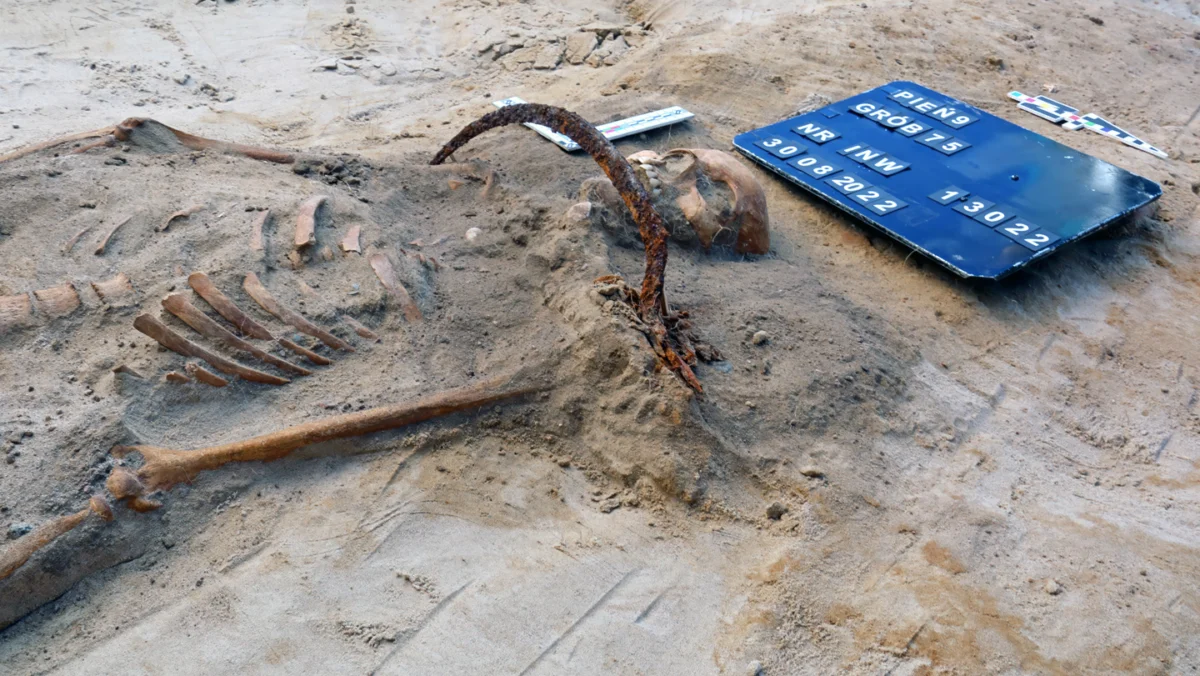
An Unsettling Discovery in Pień
The excavation, led by a team of researchers from the Nicolaus Copernicus University in Toruń, has captured international attention due to the stark, physical evidence of "anti-vampiric" burial practices. In the context of 17th-century Poland, the fear of the "undead"—or individuals perceived as potential revenants—was a deeply ingrained social phenomenon. The site in Pień has previously yielded other burials with similar protective measures, indicating that this specific cemetery served as a focal point for communities grappling with the fear of the supernatural.
The woman, estimated to be in her late teens or early twenties at the time of her death, was buried in a way that suggests she was an object of intense communal anxiety. The placement of the sickle—a curved metal blade traditionally used for harvesting crops—was designed so that any attempt by the deceased to sit up or rise would result in the blade severing her throat or decapitating her. The padlock, meanwhile, represented a symbolic and physical "locking" of the deceased within the grave, ensuring her spirit or body could not wander.
Historical Context and Folklore
To understand why such extreme measures were taken, one must look at the socio-religious landscape of 17th-century Poland. During this era, the border between scientific understanding and folk belief was porous. Epidemics, unexplained deaths, and sudden illnesses were often attributed to malevolent forces, including the influence of the "vampire" or upiór.
While modern pop culture associates the term "vampire" with the aristocratic, blood-drinking figures of Gothic literature, the folk version of the entity was far more grounded in fear of the neighbor. Anyone who died unexpectedly, had physical deformities, or was simply an outsider could be branded a potential revenant. The act of placing iron, such as a sickle, over a body was rooted in the belief that iron possessed apotropaic qualities—the power to ward off evil or restrain spirits.
Chronology of the Excavation
The discovery of this specific grave is part of a multi-year archaeological project aimed at mapping the funerary rites of post-medieval Poland.
- 17th Century: The woman is interred. The specific burial ritual is conducted, reflecting the contemporary belief system regarding death and the afterlife.
- 2022–2023: Archaeological surveys in Pień reveal a cluster of "deviant" burials, highlighting the prevalence of these protective rituals in the region.
- September 2026: The formal findings, documented by Łukasz Czyżewski and D. Poliński, are published in the Journal of Archaeological Science: Reports. The study provides detailed analysis of the burial site, the skeletal remains, and the specific metal artifacts recovered.
The researchers emphasize that these burials were not necessarily instances of ostracization, but rather the result of a community attempting to protect itself from what they perceived as a genuine, existential threat to the living.
Archaeological and Biological Analysis
The skeletal remains underwent rigorous forensic analysis to determine if the individual suffered from conditions that might have led her peers to fear her. Historical records and bioarchaeological studies suggest that conditions such as epilepsy, tuberculosis, or even severe anemia could have caused symptoms—such as seizures, wasting, or pallor—that were misinterpreted as signs of supernatural affliction.
The iron artifacts, while corroded by centuries in the soil, have provided researchers with a wealth of information regarding metallurgical practices of the period. The padlock, in particular, is a high-status object for the time, suggesting that the burial rites were performed with a sense of urgency and importance. The team found that the soil surrounding the burial remained relatively undisturbed, confirming that the implements were placed at the time of the funeral rather than added later.
Scientific Implications and Official Perspectives
Archaeologists involved in the study argue that this find is crucial for moving beyond the sensationalist "vampire" headlines. According to Dr. Dariusz Poliński, the lead investigator, these graves serve as a biological and cultural record of how fear was managed in a pre-modern society.
"The archaeological evidence allows us to map the intersection of theology and superstition," Poliński noted in recent communications. "We are seeing the physical manifestation of a psychological state. These people were not ‘monsters’ to their community; they were family members or neighbors who died in a way that the community could not reconcile with their understanding of the natural order."
The broader implications of this study reach into the field of anthropology. By examining these "deviant" burials, scientists can better understand the social structures that governed 17th-century villages. The act of "locking" a grave was a public ritual—a performative display meant to reassure the survivors that they were safe from the potential transgressions of the deceased.
Broader Societal Impact
The excavation at Pień has prompted a re-evaluation of how museums and historical societies present these findings to the public. There is a growing movement to frame these discoveries not as macabre curiosities, but as evidence of human resilience and the universal human drive to seek control over the uncontrollable.
Data collected from other sites across Central and Eastern Europe confirms that similar burial practices were widespread. From the Balkans to the Baltic, the use of stones, sickles, and heavy locks was a common feature of funeral rites for those suspected of "vampirism." The Pień grave is statistically significant because of the clarity and preservation of the artifacts, offering a rare, near-perfect snapshot of a 17th-century burial ceremony.
Conclusion: A Legacy of Fear
The story of the young woman in Pień is a poignant reminder of the fragility of life in the 17th century. As archaeologists continue to analyze the data from the site, the focus remains on the humanity of the individuals involved. While the sickle and padlock speak to a dark and fearful chapter of history, they also reveal the deep-seated communal bonds of a village trying to find order in the face of the unknown.
The findings published in the Journal of Archaeological Science: Reports in 2026 serve as a permanent record of these events, ensuring that the history of these "deviant" burials is preserved for future generations. Through careful excavation and scientific rigor, the past continues to speak, revealing the anxieties and beliefs that defined a bygone era. The woman in the grave, once feared as a potential threat to the living, is now a subject of academic inquiry, providing a bridge between the superstitions of the past and the analytical methods of the present.