Physicists at the University of Oxford, working in close collaboration with the international ATLAS Collaboration at CERN, have successfully demonstrated that quantum entanglement—one of the most counterintuitive and debated features of quantum mechanics—can persist even among some of the heaviest and most ephemeral elementary particles ever produced. Published in the prestigious journal Physical Review Letters under the formal title "Measurements of Z-boson pair entanglement in decays of Higgs bosons at the ATLAS experiment," this landmark achievement pushes the boundaries of quantum observation from delicate laboratory settings into the chaotic, high-energy environment of particle colliders.
The findings not only validate foundational quantum theories under extreme physical conditions but also bridge two historically distinct scientific disciplines: high-energy particle physics and quantum information science. By demonstrating that entanglement survives the extreme temperatures, pressures, and velocities generated by the Large Hadron Collider (LHC), researchers have opened a novel diagnostic window into the subatomic world. This breakthrough offers unprecedented opportunities to test the limits of the Standard Model of particle physics and potentially uncover physics beyond our current understanding of the universe.
Unraveling the Spooky Connection at Subatomic Scales
Quantum entanglement occurs when a group of particles interact in such a way that the quantum state of each individual particle cannot be described independently of the state of the others, even when the particles are separated by large distances. When a measurement is performed on one entangled particle, the outcome instantaneously dictates or reveals properties of its entangled counterpart. Albert Einstein, deeply troubled by the philosophical implications of this non-local connection, famously dismissed the concept as "spooky action at a distance."
For decades, experimental physicists have rigorously tested and confirmed entanglement across various microscopic systems. Early breakthroughs predominantly utilized photons, electrons, and trapped ions, where systems could be carefully isolated from environmental interference to preserve their fragile quantum states. More recently, these exact principles have transitioned from theoretical physics to practical engineering, serving as the foundational architecture for emerging technologies such as quantum computers, ultra-secure quantum communication networks, and hyper-sensitive quantum sensors. In quantum computing, entanglement enables quantum bits, or qubits, to exist in superposition and be manipulated simultaneously, exponentially increasing computational processing power compared to classical binary computers.
However, a fundamental question persisted within the scientific community: could this delicate quantum property survive the extreme conditions of violent, high-energy particle collisions? Until recently, conventional scientific consensus treated high-energy particle physics and quantum information science as separate domains, assuming that the chaotic kinetic energies and rapid decay rates of heavy particles would instantly destroy any pre-existing quantum correlations.
Chronology of a Breakthrough: From Theory to High-Energy Collisions
The realization that particle colliders could serve as laboratories for quantum entanglement is a relatively recent paradigm shift, spearheaded in large part by theoretical and experimental developments over the past decade.
The conceptual groundwork was laid years prior when theoretical physicists, including Oxford Department of Physics co-author Professor Alan Barr, postulated that the decay products of massive particles generated in colliders might retain quantum correlations. Professor Barr, who was actively involved in the initial construction and commissioning of the Large Hadron Collider near Geneva, Switzerland, recognized that the multi-billion-dollar machine possessed capabilities far exceeding its original mandate of simply discovering new particles. His theoretical frameworks provided the essential roadmap for adapting quantum information metrics to collider data.
These foundational concepts yielded their first major experimental validation in 2023, when the ATLAS Collaboration successfully demonstrated quantum entanglement between pairs of top quarks—the heaviest known elementary particles in the universe. Building directly upon that momentum, the Oxford team and their global collaborators shifted their focus toward an even more rigorous test: evaluating entanglement in pairs of Z bosons produced via the decay of Higgs bosons.
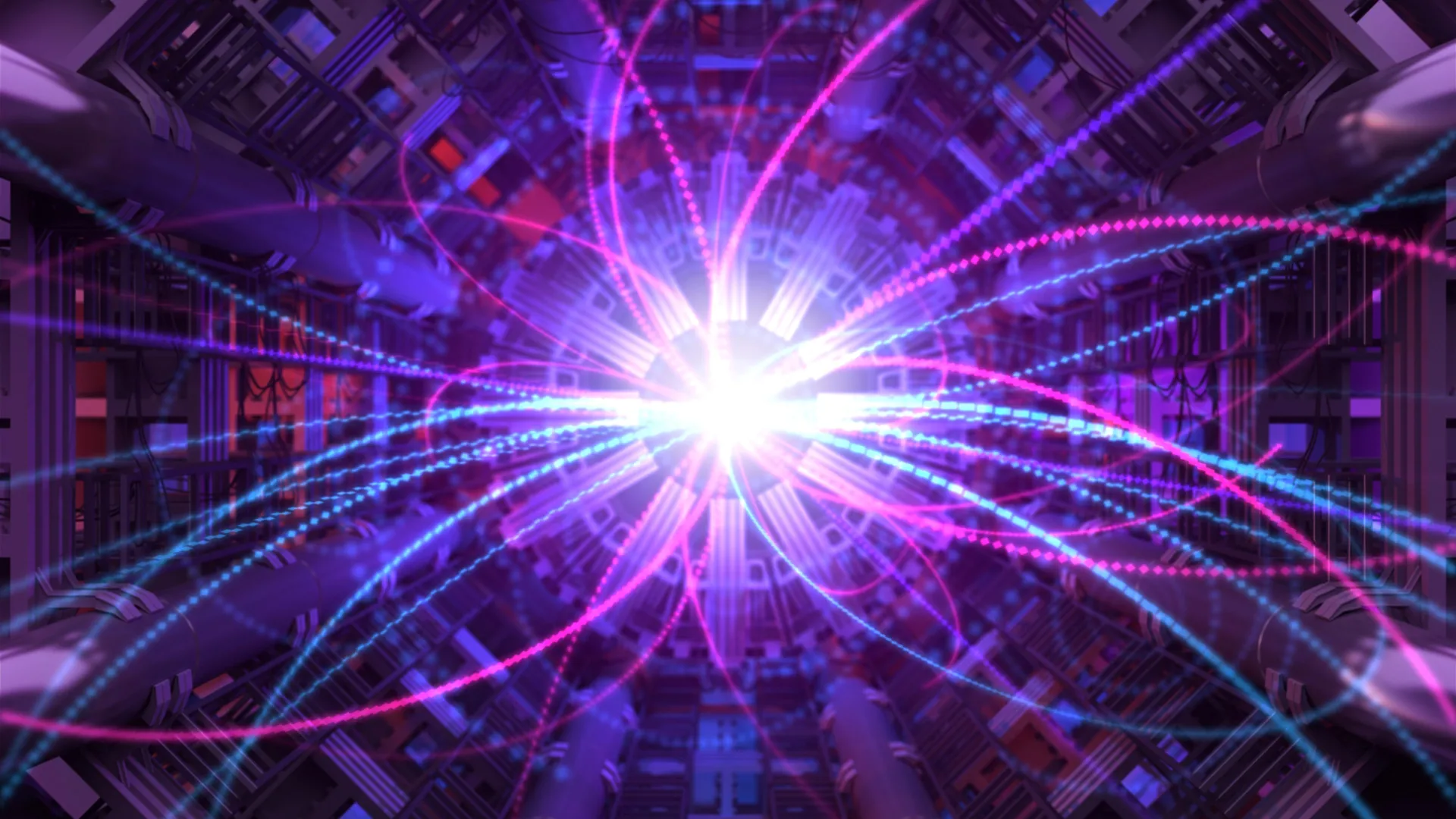
In the most recent experiment, protons were accelerated around the 27-kilometer ring of the LHC to 99.99% the speed of light, generating monumental collision energies reaching thirteen trillion electron volts ($13text TeV$). During these high-energy proton-proton collisions, rare Higgs bosons—the elusive particles famously discovered at CERN in 2012—were occasionally produced. These Higgs bosons survived for only an infinitesimal fraction of a second before decaying into pairs of Z bosons, which themselves are massive, highly unstable particles that exist for mere zeptoseconds before disintegrating into lighter leptons.
Experimental Methodology: Reconstructing Fleeting Quantum Clues
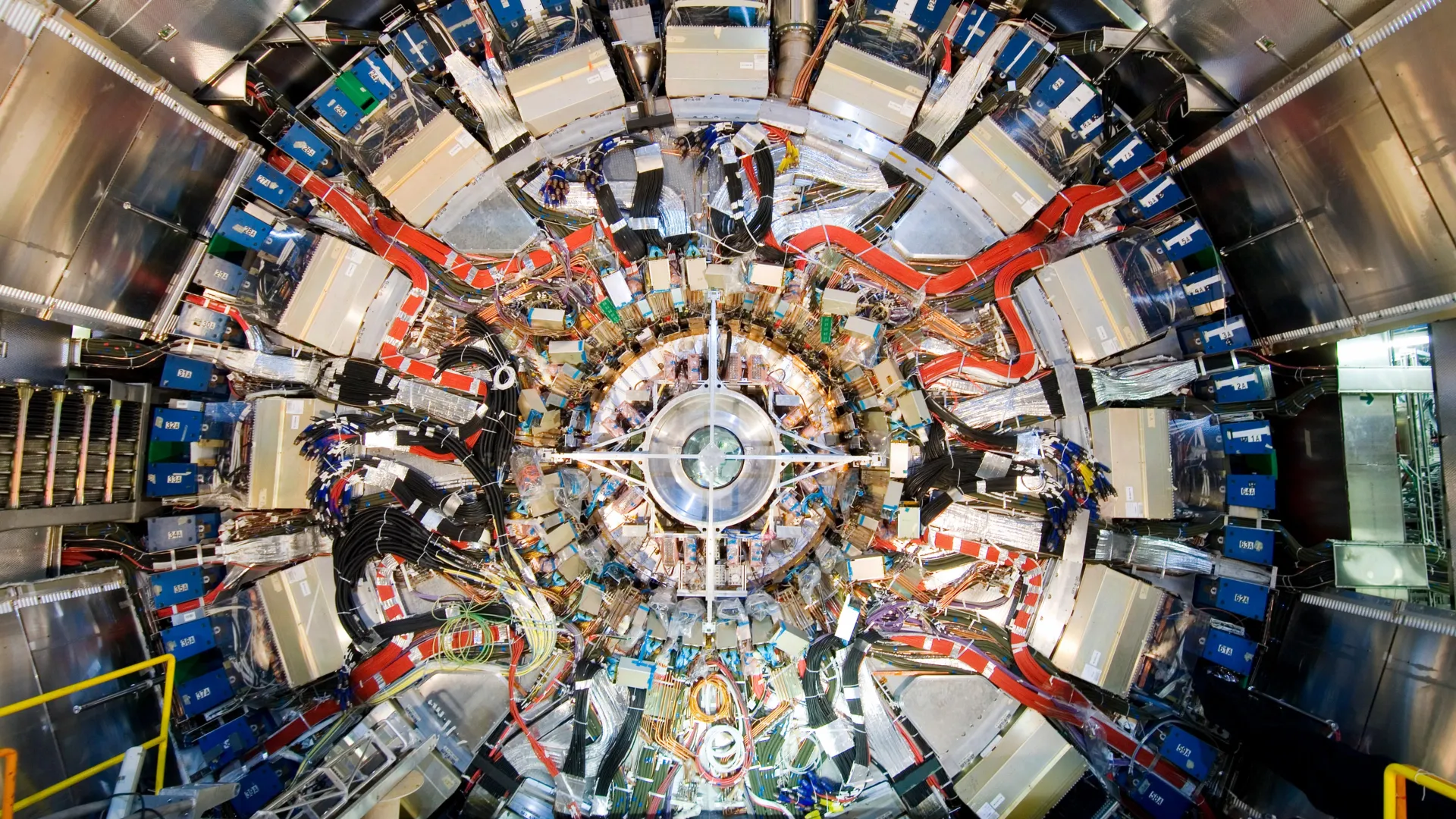
Because Z bosons vanish almost instantaneously after creation, direct observation of their quantum state is impossible. To circumvent this limitation, the international research team utilized the state-of-the-art ATLAS detector—a colossal cylindrical apparatus standing 25 meters high and weighing 7,000 tons—to meticulously track the debris left in the wake of the decay.
Specifically, the detector recorded the precise trajectories, momenta, and angular distributions of electrons and muons produced when the Z bosons decayed. By applying sophisticated statistical and mathematical reconstruction techniques to these measurable decay products, researchers were able to infer the underlying spin states of the parent Z bosons.
The analysis revealed clear, statistically significant correlations between the spins of the Z boson pairs, matching the precise mathematical signatures predicted by quantum entanglement. Because these particles were created at energies orders of magnitude higher than those utilized in conventional atomic or optical physics experiments, this measurement stands as one of the highest-energy confirmations of quantum entanglement ever documented.
Reflecting on the significance of the findings, Professor Alan Barr emphasized the surprising resilience of the phenomenon: "We’re used to thinking of entanglement as something delicate, seen in laboratory experiments with single photons. Finding it alive and well among particles as heavy and short-lived as Z bosons, created in some of the most violent collisions we can produce on Earth, shows just how fundamental and robust this quantum effect really is. It’s a nice reminder that the same strange rules of quantum mechanics that may one day power quantum computers are at work everywhere in nature, even at the extreme energies of the Large Hadron Collider."
Integrating Quantum Information Science with Particle Physics
Beyond confirming the robustness of quantum mechanics, this study marks a critical milestone in an ongoing interdisciplinary movement to merge quantum information science with high-energy particle physics. For decades, particle physicists have sifted through petabytes of collision data searching for anomalous signals using traditional statistical methods. By re-framing collider data through the lens of quantum entanglement and information theory, researchers are unlocking entirely new diagnostic tools.
At the University of Oxford, this cross-disciplinary synergy has materialized as a major research initiative co-led by Professor Barr and Professor Chris Timpson from the Faculty of Philosophy. The interdisciplinary project investigates the foundational physics of quantum mechanics at extreme scales while critically engaging with the philosophical implications of what these measurements reveal about physical reality.
Professor Chris Timpson underscored the philosophical and scientific weight of the research, noting, "Entanglement is both the most promising and the most puzzling aspect of quantum reality; these collider experiments detecting entanglement present a new frontier in investigations of the foundations of quantum mechanics."
By applying quantum entanglement metrics to massive datasets, scientists hope to establish hyper-sensitive detection methods capable of exposing subtle anomalies. These analytical techniques could eventually reveal physical phenomena that lie completely outside the predictive scope of the Standard Model, offering vital signposts toward a unified theory of quantum gravity.
Future Horizons: The High-Luminosity LHC and Beyond
As the scientific community digests these results, preparations are already underway at CERN to push observational limits even further. The European Organization for Nuclear Research is currently executing a major upgrade program to transform the facility into the High-Luminosity Large Hadron Collider (HL-LHC). Scheduled for completion in the late 2020s, this ambitious overhaul will dramatically increase the collision rate of the accelerator, multiplying the volume of collected data by an order of magnitude.
Researchers at the University of Oxford are playing a direct, instrumental role in these hardware upgrades. Oxford physicists are actively contributing to the development and fabrication of advanced silicon pixel detector modules for the upgraded ATLAS tracking system. These technological enhancements will provide vastly superior spatial resolution and data-processing capabilities, allowing physicists to probe quantum phenomena with unprecedented precision.
Professor Daniela Bortoletto, Head of Particle Physics at the University of Oxford and the UK coordinator for the ATLAS pixel system upgrade, highlighted the collaborative nature and future outlook of the initiative: "This measurement demonstrates the scientific power of the ATLAS collaboration and the unique capabilities of CERN’s Large Hadron Collider. Oxford researchers have played a leading role in developing these new approaches to studying quantum phenomena at the highest energies, and we are proud to contribute to an international effort that is opening new ways to explore the fundamental laws of nature."
With larger datasets on the horizon and increasingly sophisticated quantum analytical tools at their disposal, physicists stand on the precipice of a new era in subatomic research. The ability to harness quantum entanglement within high-energy colliders transforms the Large Hadron Collider from a machine designed merely to break particles apart into an extraordinarily precise instrument for mapping the deepest, most fundamental architecture of the universe.