The modern landscape of oncology drug development is characterized by profound scientific breakthroughs, yet it remains perpetually bottlenecked by an unexpected and persistent operational hurdle: patient recruitment and retention. In the United States alone, an estimated 2,041,910 new cancer cases were diagnosed, with 618,120 individuals succumbing to the disease. Despite the immense public health burden and the initiation of 2,717 clinical trials across the nation, only a meager 7.1% of US oncology patients ultimately participate in cancer clinical research. This stark disparity underscores a systemic friction point within clinical operations, where high-level epidemiological assumptions regularly collide with the complex realities of the enrollment funnel.
The consequences of these systemic inefficiencies are severe. According to recent data from GlobalData, 17% of all discontinued oncology studies since January 2023 have failed explicitly due to low patient accrual. For trials that do manage to cross the finish line, the expenditure of time is extraordinary. Single-country oncology trials require an average of 36 months—a full three years—to complete patient enrollment, while multinational investigations take an average of 30.8 months. These delays translate directly into millions of dollars in stalled capital, postponed therapeutic access for vulnerable populations, and heightened financial risks for pharmaceutical sponsors.
Anatomy of the Recruitment-to-Randomization Funnel
To understand why oncology trials frequently miss their recruitment targets, industry analysts examine the multi-step journey a patient takes from initial identification to randomization. The process typically begins when a patient or their primary care physician proactively reaches out to a study team, or when a hospital’s electronic health record system flags a potential match. This triggers a pre-screening phase—often conducted via questionnaires or brief telephone consultations—to evaluate early eligibility based on baseline health history and protocol guidelines.
Once a patient signs an informed consent form, they enter formal screening. This phase requires rigorous diagnostic verification, including complex laboratory testing, medical imaging, biopsies, and tissue sampling to confirm specific biomarker profiles, disease status, and staging. Only after successfully navigating this gauntlet can a patient be officially randomized into a trial.

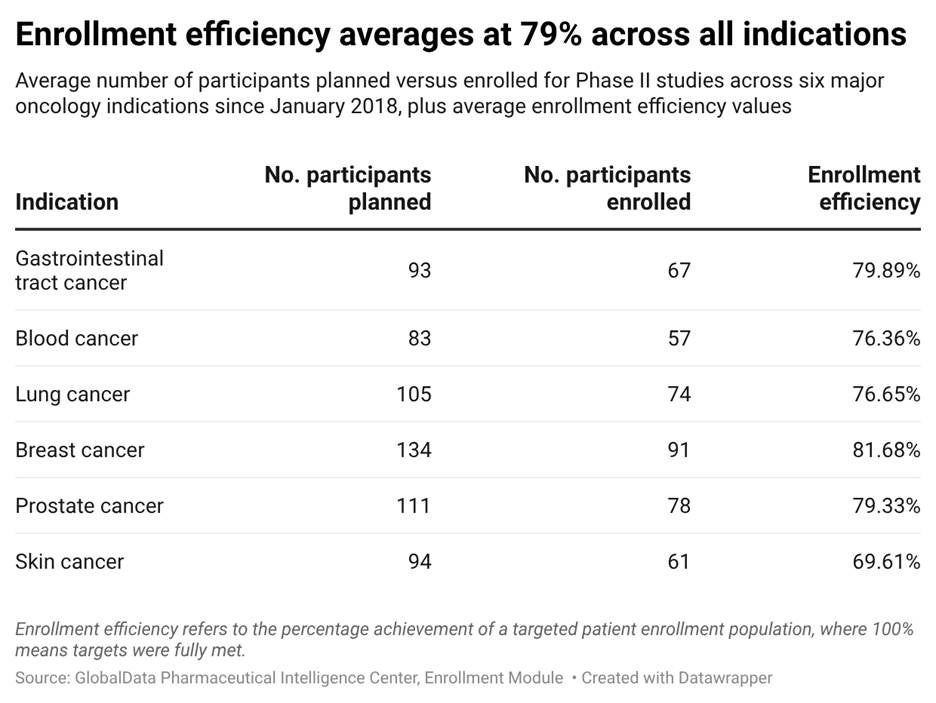
However, attrition occurs at every single junction of this funnel. Metrics from GlobalData reveal that Phase II oncology trials plan to enroll an average of 89 participants, yet the actual cohort size typically lands at just 64—representing an average enrollment efficiency of 79.4%. Regional and pathological discrepancies further exacerbate these shortfalls. For instance, single-country trials in North America enrolling between 100 and 150 participants average an enrollment period of 32.5 months, compared to just 21.7 months for comparable trials in the Asia-Pacific region.
Tumor type also dictates velocity. A standard breast cancer study in the US completes enrollment in roughly 29.8 months, whereas a US-based trial for Ewing sarcoma—a rare pediatric bone cancer representing about 1% of all childhood cancers—demands an average of 42.3 months.
The Paradox of Strict Eligibility and Biomarker Bottlenecks
A primary driver of enrollment failure is the increasing stringency of trial eligibility criteria. Modern oncology protocols routinely feature between 20 and 30 individual inclusion and exclusion criteria, designed meticulously to isolate a targeted patient population, ensure data integrity, and protect patient safety. Yet, broader population studies indicate that only about 48% of real-world cancer patients are clinically eligible for trials under these rigid frameworks.
Paradoxically, while eligibility rules are implemented to refine science, their volume has expanded relentlessly over the decades. Longitudinal analyses of lung cancer trials demonstrate that the median number of eligibility criteria escalated from 17 during the 1986–1995 period to 28 between 2006 and 2016. Furthermore, the average volume of eligibility content within protocols surged from 214 unique words in 2008 to 417 words by 2018.
This upward creep is heavily influenced by the pharmaceutical industry’s pivot toward precision medicine. Since 2020, slightly over half of all company-sponsored Phase II oncology trials have incorporated biomarker screening and stratification. While biomarker-driven trials frequently yield higher response rates and clearer efficacy signals, they introduce severe operational vulnerabilities, including testing delays, tissue availability shortages, and assay variability.

A landmark study conducted by Spiegel and colleagues evaluated the enrollment pathways of patients across 19 non-small cell lung cancer trials, comparing protocols that demanded fresh tissue biopsies with central testing against those that did not. When fresh biopsies were mandatory, the median screening duration doubled to 35 days, compared to just 15 days for trials relying on archival tissue. Consequently, screen failure rates skyrocketed in biopsy-dependent trials, reaching 49.1% versus 26.5%. The researchers identified patient deterioration during the waiting period as the dominant cause of screen failure, accounting for 56.5% of failed cases among biomarker-eligible individuals.
Disease Progression and the Window of Opportunity
The rapid progression of aggressive malignancies creates an unforgiving biological clock for clinical trial operations. While indolent cancers may progress slowly over years, aggressive hematological malignancies—such as acute leukemias—can manifest suddenly and advance to end-of-stage disease within weeks or months.
Because clinical trials generally require participants to be in relatively early or stable stages of disease to properly evaluate therapeutic efficacy, any administrative friction, site workflow delay, or biomarker testing bottleneck can close the therapeutic window entirely. When patients deteriorate during the screening process, clinical investigators are forced to withdraw them due to unavoidable safety concerns and data integrity risks. Historical analyses of solid-tumor trials consistently list disease progression as a leading cause of screen failure, accounting for approximately 16% of all dropouts.
Patient Burden, Consent Withdrawal, and Competitive Dynamics
Beyond biological barriers, the day-to-day burdens of clinical trial participation often overwhelm motivated patients. While the majority of cancer patients receive their ongoing care in community-based practices, clinical trials are predominantly concentrated within major academic medical centers and specialized research hubs. This geographical mismatch imposes severe logistical and financial travel burdens that render frequent site visits unsustainable.
Furthermore, as patients become more educated about the investigational medicinal product (IMP), complex visit schedules, and potential adverse event profiles, enthusiasm can wane. An analysis of 18 clinical trials focusing on advanced pancreatic ductal adenocarcinoma and biliary tract cancer revealed that out of 509 patients who failed screening, withdrawal of consent was the single most common reason, representing 19% of dropouts. When detailed reasons were recorded, patient preference for standard-of-care treatments and travel constraints were the most frequently cited factors, followed by financial limitations, anxiety over side effects, and the availability of competing regional trials.
The hyper-competitive nature of modern oncology drug development means that eligible patients are intensely sought after. Many individuals screen for multiple clinical trials simultaneously to accelerate their access to novel therapies, resulting in frequent switching or dropouts when a more geographically convenient or faster-moving trial presents itself.
Strategic Solutions and Industry Implications
To overcome these pervasive recruitment and retention crises, clinical operations experts argue for a fundamental overhaul of trial design and site selection strategies. Industry stakeholders are increasingly turning to underutilized, research-naive community practices outside of traditional academic centers—such as smaller European research networks or high-density population hubs in Asia-Pacific, particularly China—to tap into fresh patient pools and bypass overcrowded research hotspots.
Moreover, transitioning toward patient-centric protocol designs, streamlining eligibility criteria, deploying decentralized data capture mechanisms, and establishing robust, highly coordinated biomarker testing strategies can drastically minimize operational friction. By optimizing the recruitment funnel through intelligent site selection, proactive biomarker logistics, and empathetic protocol structuring, sponsors can safeguard trial timelines, reduce costly screen failures, and ensure that life-saving therapies reach the right patients before the window of opportunity closes.