Data professionals spend a significant portion of their workdays embedded within web browsers. Whether they are parsing complex technical documentation, reviewing academic research papers, analyzing machine learning model cards, working through GitHub repositories, or synthesizing industry reports, these tasks frequently occur within a single afternoon. In recent years, artificial intelligence assistants have become fixtures in this digital environment, operating alongside human workflows to accelerate information retrieval and task execution.
Mainstream consumer tools—such as Google Chrome integrated with Gemini, Perplexity, and ChatGPT utilized within pinned browser tabs—offer notable capabilities. However, these solutions introduce a privacy overhead that is easily overlooked during high-intensity work sessions. Standard consumer versions of Gemini may utilize user conversations to train and refine Google’s underlying systems, and selected inputs remain subject to manual review by human staff. Similarly, Perplexity routes user queries and active page contents to its cloud infrastructure for evaluation, while standard configurations of ChatGPT permit user inputs to be leveraged for ongoing model training unless manual opt-out procedures are executed.
For casual web browsing or general information gathering, these data-sharing trade-offs are often deemed acceptable. Conversely, for data professionals handling proprietary datasets, sensitive business intelligence, unreleased model architectures, or confidential client research, these practices present substantial security and compliance risks. Enter Brave Leo, an alternative privacy-first AI assistant embedded directly within the Brave browser infrastructure. Rather than functioning as an isolated web tab or a third-party browser extension, Leo operates as a native sidebar tool capable of reading active web pages in real-time. It responds to queries without retaining, logging, or utilizing user inputs for model training. The platform’s free tier operates without requiring a user account or formal registration, offering a model lineup that challenges traditional perceptions of browser-based AI capabilities.
The Structural Privacy Deficit in Mainstream Browser AI
To understand the value proposition of privacy-focused browser tools, it is necessary to examine how major mainstream AI interfaces handle user data. The distinctions are structural rather than cosmetic, governing how information travels from a local machine to remote servers.
When utilizing Google Chrome’s Gemini integration, official corporate documentation explicitly cautions users against entering sensitive details that they would prefer to shield from human reviewers. Background processes may download local lightweight models, such as Gemini Nano, onto user devices, occasionally without explicit authorization. Furthermore, consumer-tier subscriptions default to utilizing user inputs for service improvement and machine learning training.
Perplexity remains a robust research assistant, widely adopted by data professionals due to its citation-backed synthesis and exploratory utility. Nevertheless, it functions on a cloud-centric architecture, meaning that targeted queries and active page texts depart the local machine for remote processing. While Apple’s Safari and Apple Intelligence offer higher standards of on-device processing and data protection, they remain restricted exclusively to Apple hardware ecosystems, locking out data scientists and engineers operating on Windows or Linux workstations.
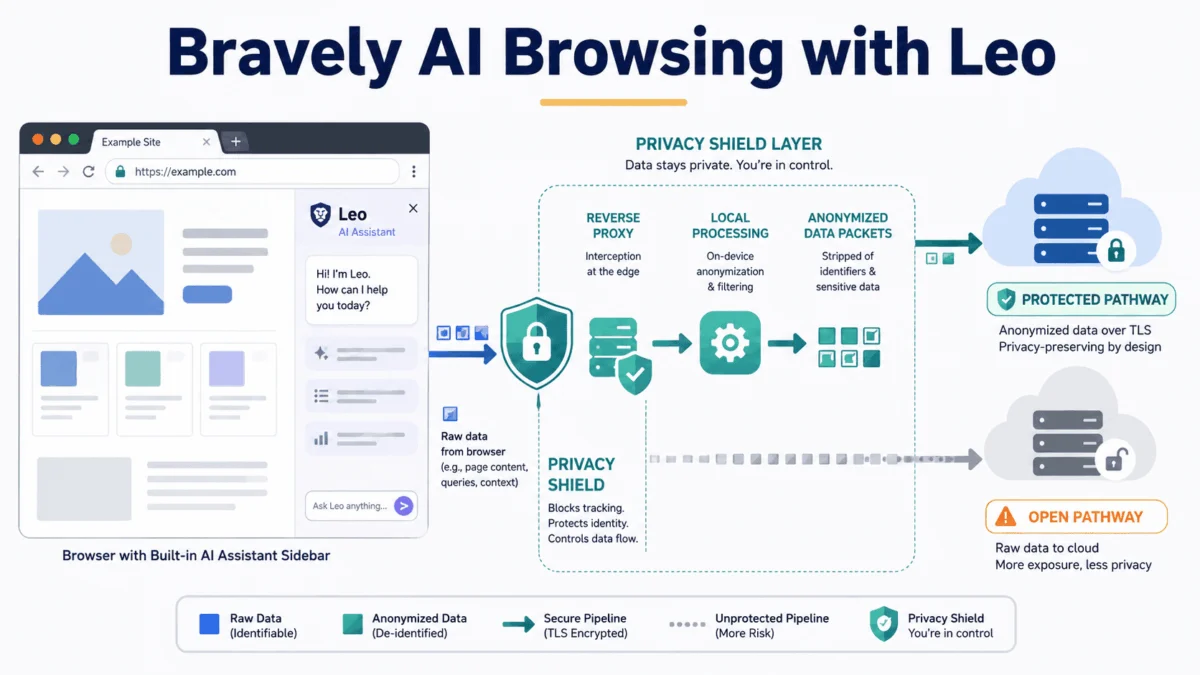
Brave Leo implements a fundamentally different architectural model. User queries pass through a specialized reverse proxy designed to strip originating IP addresses before the traffic reaches the foundational AI models. Conversations are systematically discarded immediately following the generation of a response, ensuring that no permanent records reside on Brave’s servers. No user accounts are linked to functional usage, and input data is excluded from model training by default across all tiers, free and paid alike.
Consequently, data practitioners can paste proprietary documentation, interrogate internal dataset schemas, or evaluate unpublished client research with the assurance that the underlying session data will not persist beyond the active browser window.
Evolution and Deployment Chronology of Brave AI Tools
The integration of privacy-centric artificial intelligence into mainstream browsing environments did not happen overnight; it represents a calculated multi-year engineering trajectory designed to reconcile generative utility with stringent data governance.
In late 2023, Brave Software introduced Leo as an integrated sidebar assistant for its desktop browser, aiming to provide immediate generative capabilities without requiring external API keys or separate application windows. The initial rollout established the core architectural pillars: zero retention of chat logs, proxy-based IP masking, and default exclusion from training datasets.
As the ecosystem matured throughout 2024 and 2025, Brave expanded the platform’s utility by introducing multi-model support, enabling users to transition between open-weights architectures and advanced frontier models depending on task complexity. In December 2025, the platform deployed "Skills"—a feature allowing users to execute saved prompt chains against active page content, effectively converting the browser assistant into a programmable workflow engine.
The architectural evolution accelerated further in early 2026. In April 2026, Brave introduced "Brave Ocelot," a local-first summarization model designed to execute inference directly on local user hardware, ensuring that sensitive text processing never leaves the physical machine. This was followed in May 2026 by the early-access deployment of agentic browsing capabilities. This feature empowered Leo to autonomously execute multi-step routines within an isolated browser infrastructure, maintaining strict adherence to the platform’s foundational privacy guarantees while expanding automated execution parameters.
Feature Architecture and Tier Specifications
Brave Leo is bundled natively with all installations of the Brave browser across Windows, macOS, Linux, Android, and iOS. Because the browser shares the underlying Chromium engine with Google Chrome, migration friction is minimized; bookmarks, stored passwords, and existing extensions import seamlessly.
Accessing the assistant requires no login credentials. Users simply open the browser sidebar or activate the designated toolbar icon. On desktop environments, interactions can also be initiated directly from the address bar.
The platform operates across distinct service tiers:
- Free Tier: Provides access to baseline language models capable of executing standard day-to-day reading tasks, research summarization, code explanation, and documentation reviews without requiring financial commitment or account creation.
- Leo Premium: Priced at $14.99 per month or $149.99 annually (approximately $12.50 monthly) and applicable across up to five distinct devices. This tier unlocks advanced frontier models—including Claude Sonnet variants and deep-reasoning architectures—while granting higher rate limits and priority processing access during periods of peak network traffic.
Crucially, upgrading to Premium does not compromise the platform’s privacy architecture. Brave implements a credential-based token validation system that decouples financial payment information from active chat sessions. Even subscribed users remain structurally unlinkable to their conversational outputs. While Premium subscribers retain the option to enable persistent chat history, this feature remains strictly opt-in, allowing privacy-conscious professionals to disable it for maximum security.
Core Workflows for Data Professionals
Leo’s primary functional differentiator is its native page-awareness. Unlike standalone chatbot applications that require manual copy-pasting of text blocks, the assistant reads active browser tabs in real-time.
Research Paper and Documentation Analysis
Technical documentation, arXiv preprints, and model cards can be analyzed directly within the browser window. Rather than transcribing passages, users can deploy structured prompts to extract vital metrics:
Summarize this page in three sections:
1. What this model was trained on
2. Known limitations
3. Recommended use cases
The assistant generates structured evaluations sourced dynamically from the active document, preventing external data persistence.
Document and Spreadsheet Parsing
PDFs rendered natively in the browser, along with Google Docs and Google Sheets, are accessible for targeted interrogation. Data professionals can query specific dataset documentation files to clarify unfamiliar field names, review data collection methods, or evaluate potential sampling biases within research proposals.
Transcript Evaluation for Technical Media
By reading transcripts of technical presentations and conference talks hosted on video platforms, Leo enables professionals to extract core methodological contributions and experimental configurations without requiring full-length viewing sessions.
Code Synthesis and Interpratation
Users can highlight complex functions within technical documentation and request plain-language explanations or working implementations matching the exact architectural parameters described on the open page.
Comparative Analysis: Privacy-First Assistants vs. Mainstream Cloud Tools
Evaluating AI utility requires recognizing that different tasks demand distinct technical environments. While tools like Perplexity Pro excel at live web searches, citation-heavy literature reviews, and public-domain research synthesis—frequently leveraging models like GPT-4o or Claude Opus—their cloud-first architecture exposes user queries to third-party data collection frameworks.
Conversely, Brave Leo prioritizes data sovereignty. It serves as an optimal environment for internal documentation reviews, client-sensitive code analysis, and proprietary dataset auditing where external data leakage poses compliance vulnerabilities. For comprehensive research spanning the open web, cloud-integrated search engines remain powerful; however, for localized processing of sensitive professional material, privacy-native sidebar assistants provide a defensible operational standard.
Limitations and Practical Boundaries
Transparency demands acknowledging the current constraints of privacy-first browser tools. Leo does not execute autonomous, open-web crawling in the manner of dedicated search engines; queries regarding rapidly evolving external topics rely primarily on the active page context and foundational training data rather than real-time web indexing. Furthermore, the platform lacks native image generation capabilities, extensive voice modalities beyond standard operating system dictation tools, and persistent memory across sessions by default.
Answer quality on the free tier can fluctuate when handling highly complex, multi-variable technical tasks using smaller open-weights models. Advanced tasks—such as parsing nuanced statistical methodologies or debugging intricate neural network architectures—benefit significantly from the reasoning capabilities found in Premium-tier frontier models. Finally, integration is strictly bound to the Brave ecosystem; users committed exclusively to Chrome, Safari, or Firefox without the inclination to transition browsers cannot utilize Leo via external extensions.
Broader Implications for Enterprise Data Governance
The proliferation of integrated AI assistants highlights a growing tension between generative capability and corporate data governance. As regulatory frameworks surrounding data privacy, intellectual property protection, and client confidentiality tighten globally, organizations face mounting scrutiny regarding how employee workflows intersect with cloud-based artificial intelligence providers.
Tools that decouple powerful generative reasoning from data retention policies point toward a sustainable path forward. By leveraging reverse proxies, zero-logging architectures, and local-first inference models, platforms like Brave Leo demonstrate that advanced productivity tools can operate without sacrificing organizational security. For data science teams, engineering departments, and quantitative researchers, adopting privacy-native workflows is no longer merely a matter of personal preference—it is becoming an essential component of modern enterprise risk management.