The deployment of small language models (SLMs) in production environments has increasingly shifted toward narrow automation tasks, where computational efficiency and latency are primary metrics of success. Building upon foundational optimization strategies such as constraining output spaces, modern machine learning engineering has turned its attention to eliminating redundant computations during the prompt evaluation phase. A prominent development in this domain is the strategic reuse of prompt prefixes utilizing key-value (KV) caches. By computing static instruction blocks only once and leveraging pre-filled attention states across multiple inference calls, developers have demonstrated runtime performance improvements exceeding 50 percent without sacrificing output accuracy or model behavior.
Background Context of SLM Optimization in Narrow Automation
In enterprise applications, small language models—such as the 0.5 billion parameter Qwen2.5-0.5B-Instruct architecture—are frequently deployed for high-throughput, repetitive classification tasks, including customer support ticket routing. These workflows typically rely on static instruction sets, rigid taxonomy definitions, and extensive few-shot examples to guide model behavior. In a conventional pipeline, each incoming data point, such as a customer service ticket, is appended to the full system prompt, and the entire sequence is re-encoded from scratch during every inference cycle.
Analysis of typical production prompt compositions reveals that static elements—system instructions, definitions, and examples—frequently account for 80 to 90 percent of the total token count. Conversely, the dynamic content, representing the specific query or record to be processed, comprises a minor fraction of the overall sequence length. Recomputing key and value vectors across all network layers for identical prefix tokens on every individual call introduces a systemic computational bottleneck. This inefficiency has historically limited the throughput of edge devices and standard central processing units (CPUs), making real-time narrow automation economically or operationally burdensome.
Chronology of the Optimization Strategy and Benchmark Implementation
The exploration of prefix caching as a secondary optimization tier follows earlier initiatives focusing on output space constraints. Engineers testing the methodology established a controlled benchmark environment utilizing consumer-grade hardware: an M2 MacBook Air equipped with 24 gigabytes of unified memory and a 16-core Neural Engine running Python 3, PyTorch, and Hugging Face Transformers in float16 precision.
To establish a comparative baseline, researchers processed a synthetic dataset of 600 customer support tickets divided evenly across three distinct categories: billing, technical, and account inquiries. The evaluation utilized a static system prompt consisting of 145 tokens, paired with dynamic suffixes averaging roughly 22 tokens per ticket, resulting in full prompts of 167 tokens where 87 percent of the content remained invariant.
In the baseline execution phase, the model re-encoded the full prompt structure for every record. Running sequentially on CPU threads, the complete processing pipeline required 184.85 seconds, averaging approximately 308.1 milliseconds per ticket.
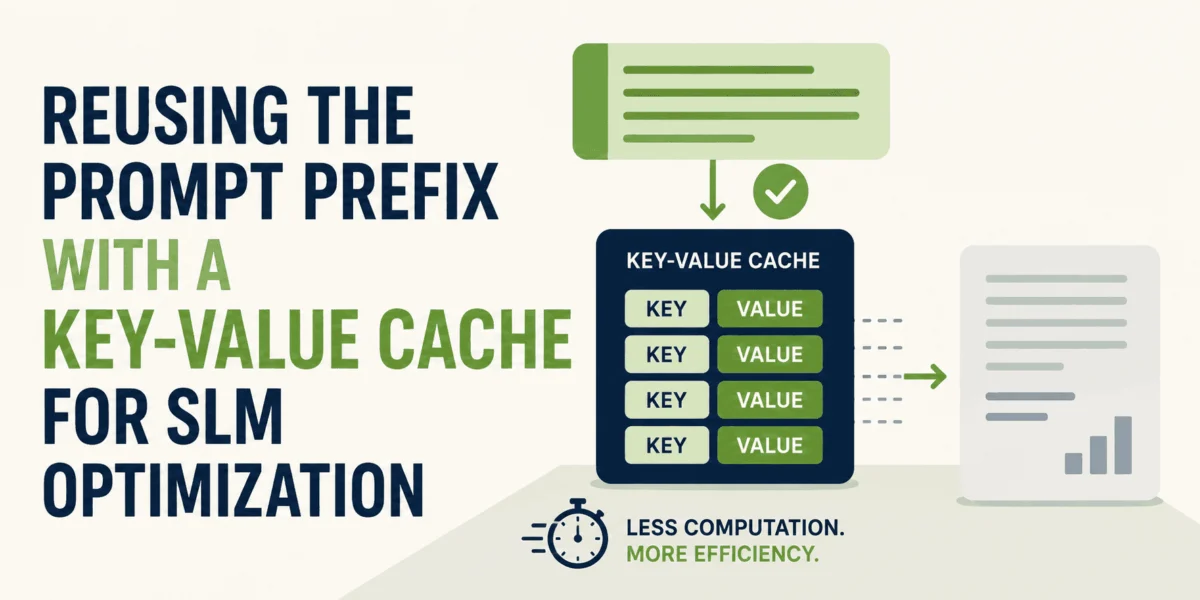
Subsequently, engineers implemented the prefix-caching architecture. In this updated execution flow, the static system prompt was processed through the model precisely once. The resulting key and value tensors were stored within a dynamic caching structure (DynamicCache). For each subsequent ticket, only the dynamic suffix tokens were fed into the model, accompanied by updated attention masks and positional indices mapped to the pre-computed prefix boundary.
Quantitative Findings and Comparative Performance Metrics
The implementation of prompt prefix reuse yielded substantial efficiency gains. Across the identical workload of 600 support tickets, the optimized execution pipeline completed the task in 80.07 seconds. This reduced the average processing time per ticket from 308.1 milliseconds down to 133.5 milliseconds.
Mathematically, this represents an overall runtime reduction of approximately 57 percent. Crucially, validation tests confirmed that the classification outputs generated via the cached prefix path were identical to those produced by the uncached baseline across all records. Because the optimization operates strictly at the level of tensor caching rather than modifying the underlying transformer weights or decoding logic, model accuracy and determinism remained uncompromised.
Industry Implications and Technical Mechanics
The success of KV cache reuse for SLM optimization highlights a broader paradigm shift in how artificial intelligence engineering approaches edge and CPU-bound deployments. By decoupling static instructions from dynamic user inputs, developers can scale the length and descriptive depth of system prompts without incurring proportional performance penalties. In traditional architectures, adding detailed few-shot examples to improve classification accuracy is discouraged due to the linear increase in inference latency. Under a prefix-caching framework, however, larger instruction blocks become advantageous, as the initial pre-fill cost is amortized across thousands of subsequent inference calls.
Technical implementation of this strategy requires strict adherence to token-boundary alignment. If the static prefix and dynamic suffix, when concatenated, fail to match the tokenization of the unified prompt string, the cached key-value states will misalign with the expected vector spaces, leading to runtime errors or silent semantic degradation. Consequently, developers must employ rigorous validation assertions to verify token-clean splits prior to populating the cache. Furthermore, state management requires resetting or cropping the cache appropriately between inference batches to maintain correct temporal sequence modeling.
Broader Impact on Enterprise AI Deployment
As organizations increasingly seek to deploy lightweight models on local infrastructure, minimizing compute overhead is paramount. Running sub-billion parameter models efficiently on standard hardware reduces reliance on costly cloud-based application programming interfaces (APIs), enhances data privacy by keeping sensitive customer communications on-premises, and lowers energy consumption in data centers and edge nodes alike.
Industry analysts note that while large language models capture mainstream attention for broad, open-ended reasoning tasks, narrow automation remains the primary financial driver for enterprise AI adoption. Techniques such as output space constraining and prefix caching bridge the gap between theoretical model capabilities and practical production requirements. By transforming repetitive computational loops into streamlined execution pathways, engineering teams can elevate small language models from constrained alternatives to the preferred architectural choice for dedicated enterprise automation workflows.