The landscape of modern mathematics and computational science experienced a profound paradigm shift following a recent announcement by OpenAI, which revealed that an internal artificial intelligence system had generated a proposed solution to the Navier-Stokes existence and smoothness problem. As one of the legendary Millennium Prize Problems designated by the Clay Mathematics Institute in the year 2000, the Navier-Stokes equations govern the physics of fluid motion, describing everything from ocean currents and weather patterns to airflow over aircraft wings. While the complete resolution of the overarching mathematical framework remains under rigorous peer review, the implications of deploying thousands of concurrent AI agents to tackle intractable theoretical problems signal an unprecedented evolution in how scientific research may be conducted in the future.
Context and the Historical Weight of the Millennium Prize Problems
Established by the Clay Mathematics Institute with a bounty of one million dollars for each correct solution, the seven Millennium Prize Problems represent the most formidable intellectual hurdles in contemporary mathematics. Prior to OpenAI’s announcement, only one of these problems—the Poincaré conjecture—had been officially solved, a feat accomplished by Russian mathematician Grigori Perelman in 2003.
The Navier-Stokes problem specifically asks whether smooth, physically reasonable solutions always exist for the three-dimensional Navier-Stokes equations under arbitrary initial conditions. Proving or disproving this concept has stymied generations of brilliant human mathematicians due to the extreme non-linearity and complexity of the equations. OpenAI’s breakthrough did not resolve the broader question of unforced equations maintaining permanent smoothness; rather, the system successfully constructed a finite-time singularity for the three-dimensional Navier-Stokes equations utilizing a smooth external force. This specific mathematical pathway is formally recognized within the parameters outlined by the Clay Mathematics Institute as a valid route to addressing the core dilemma.
Chronology of the Experiment
The breakthrough was not an isolated incident of an algorithm spontaneously generating mathematical theorems overnight. Instead, it was the culmination of converging human research, strategic computational scaling, and iterative verification protocols.
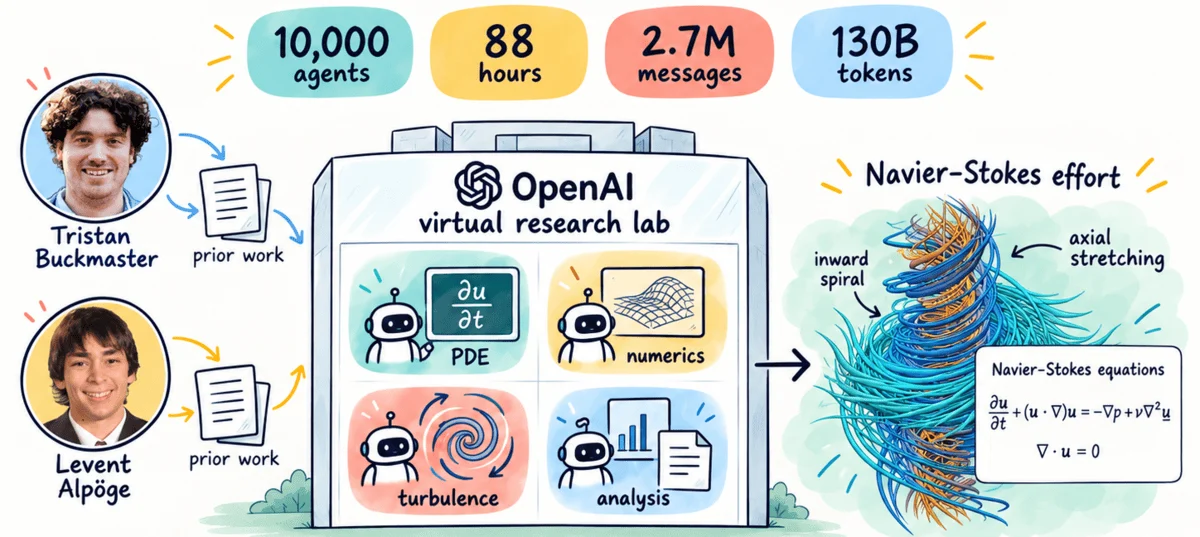
The foundation of the project can be traced back to independent research conducted by human mathematicians Tristan Buckmaster of New York University and Levent Alpöge, an independent researcher formerly associated with Anthropic. Buckmaster and Alpöge had been utilizing advanced AI models, including Claude and OpenAI Codex, to push the boundaries of fluid dynamics, successfully establishing finite-time blowup for the three-dimensional incompressible Euler equations with smooth forcing.
By late August 2026, academic rumors began circulating regarding potential major breakthroughs related to Millennium Prize problems. On September 1, 2026, energized by these rumors and promising internal model performance, OpenAI leadership made the strategic decision to pivot its experimental architecture toward the Navier-Stokes equations.
The execution phase was characterized by a massive deployment of computational resources. Initially, approximately 100 autonomous AI agents spent roughly 50 hours exploring Euler-related problems, yielding highly encouraging intermediate results. Emboldened by this success, OpenAI escalated its operation to deploy approximately 10,000 concurrent AI agents functioning as a coordinated virtual research laboratory. These agents were segmented into specialized groups capable of inter-agent communication, executing code, and querying a cached version of the internet to test disparate mathematical hypotheses.
Quantitative Scope and Verification Protocol
The operational scale of the OpenAI experiment dwarfs traditional academic collaboration. According to official disclosures, the Navier-Stokes research effort required:
- Approximately 10,000 concurrent AI agents exploring diverse theoretical pathways in parallel.
- The exchange of roughly 2.7 million internal messages to facilitate collaboration and critique.
- An aggregate consumption of approximately 130 billion output tokens.
- A total duration of 88 hours from the initialization of the experiment to the delivery of the proposed mathematical solution.
Following the generation of the mathematical proof, the verification process transitioned to formal methods. The system utilized Lean, an interactive theorem prover developed to check mathematical proofs with absolute formal rigor. The Lean formalization and verification process required an additional 17 hours of rigorous computational checking, bringing the total elapsed time from inception to verified formulation to roughly 105 hours.
Attribution Controversies and Academic Friction
As news of the breakthrough circulated through the global scientific community, questions regarding data integrity, authorship, and attribution quickly emerged. The controversy centered primarily on the relationship between OpenAI’s infrastructure and the prior research conducted by Tristan Buckmaster and Levent Alpöge.
Buckmaster raised valid concerns regarding whether OpenAI’s model had been trained on or exposed to unpublished drafts and session prompts from his own collaborative research with Alpöge, given that both researchers had utilized OpenAI Codex during their exploratory phases. In initial discussions, questions regarding training data specificity remained ambiguous, prompting outside scrutiny from journalistic outlets such as ABC News.
OpenAI subsequently conducted an internal investigation to trace data access lineages. The company issued a formal update stating that Buckmaster’s Codex prompts from the preceding two months could not have influenced the system through training or direct observation, and confirmed that its research teams had not accessed Buckmaster and Alpöge’s unpublished manuscripts prior to public disclosure. While these statements cleared the organization of data contamination allegations, a secondary dispute quickly arose regarding academic credit and publishing rights.
According to statements attributed to Buckmaster, OpenAI researcher Sébastien Bubeck proposed potential collaborative avenues, including an option where Buckmaster would act as lead author on a rewritten presentation of OpenAI’s Navier-Stokes proof while explicitly acknowledging the generative role of the AI model. Complications arose when it was indicated that Alpöge—due to his affiliation with rival AI lab Anthropic—might be excluded from the author list. Buckmaster declined the proposal.
Bubeck later clarified the administrative perspective, explaining that he had proposed Buckmaster as lead author to translate OpenAI’s computational findings into a human-readable mathematical paper, noting that co-authoring an OpenAI-driven discovery with an employee of a competing artificial intelligence firm presented organizational and institutional conflicts. Nevertheless, the episode underscored the inadequacy of traditional academic frameworks when applied to hybrid human-machine research ecosystems.
Implications for the Future of Scientific Research
The Clay Mathematics Institute has acknowledged that the Navier-Stokes problem "has apparently been settled" by the OpenAI system, though full institutional evaluation, peer review, and formal acceptance will require considerable time. Regardless of the final academic verdict on the Millennium Prize bounty, the broader implications of the experiment extend far beyond fluid dynamics.
Traditionally, mathematical discovery has relied on the isolated brilliance of individuals or small, specialized research groups capable of exploring a limited number of hypotheses over years or decades. By orchestrating thousands of autonomous agents capable of simultaneous exploration, systematic error-checking, and cross-pollination of intermediate findings, OpenAI has demonstrated the viability of scalable research workflows.
This development suggests that scientific advancement in computationally tractable fields is transitioning from an era of artisanal human contemplation to an era of industrial-scale machine exploration. While human mathematicians remain indispensable for framing problems, allocating computational resources, and interpreting abstract significance, the ability to compress months of trial-and-error hypothesis testing into a matter of days fundamentally alters the speed of innovation.
As research laboratories worldwide begin to adopt similar multi-agent architectures, the scientific community faces a transitional period. The fundamental definition of a "discovery" is being rewritten, forcing institutions to adapt to a reality where artificial intelligence systems serve not merely as passive computational calculators, but as active, highly scalable participants in the expansion of human knowledge.