The optimization of small language models (SLMs) for narrow enterprise automation has entered a new phase of efficiency engineering, focusing heavily on hardware utilization and runtime performance. In recent evaluations utilizing the Qwen2.5-0.5B-Instruct model operating in float16 precision via Hugging Face Transformers on an Apple M2 MacBook Air with 24GB of RAM and a 16-core Neural Engine, engineers have demonstrated that processing pipeline architecture plays a more decisive role in operational speed than raw compute power. Concluding a comprehensive three-part technical series on SLM deployment strategies—which previously examined constrained output spaces and prompt prefix caching with key-value pairs—industry practitioners are turning their attention to the structural inefficiencies of sequential item looping.
Background Context of SLM Pipeline Inefficiencies
Deploying small language models for hyper-specific, narrow automation tasks such as customer support ticket classification, automated tagging, or intent recognition frequently exposes systemic infrastructural bottlenecks. Historically, development teams prototyped these automation pipelines by evaluating incoming textual inputs one by one. In a standard production environment, this translates to processing a single support ticket per forward pass.
Industry benchmarks reveal that operating at a batch size of one forces small language models into a memory-bandwidth bound regime rather than a compute-bound state. Under these conditions, the underlying hardware infrastructure—whether a dedicated graphics processing unit (GPU) or a localized neural engine on a central processing unit (CPU)—must continuously stream every model weight out of memory to evaluate a single sequence. Once that individual sequence is evaluated, the hardware repeats the memory-reading process for the subsequent item. Consequently, the processor’s arithmetic logic units remain largely idle between passes, creating massive computational waste and artificially inflating processing latency.
The Problem with Naive Batching
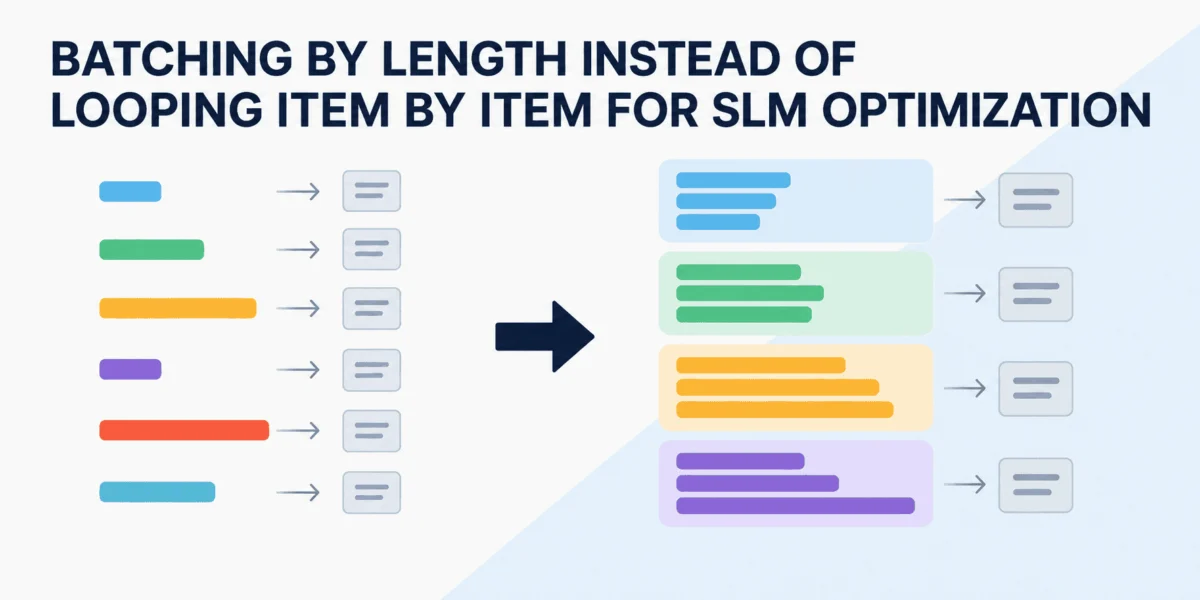
To circumvent the idle hardware states characteristic of single-item loops, software architects traditionally introduce batching. By grouping multiple sequences together, the system amortizes the heavy weight-read operations across numerous items simultaneously, drastically improving hardware saturation. However, standard implementations of batching introduce a secondary form of inefficiency related to token padding.
Real-world datasets, such as incoming customer support queues, naturally exhibit a long-tailed length distribution. While the median ticket length might be well under one hundred tokens, the longest items in the corpus can easily stretch to several hundred tokens. When forming batches without structural ordering, sequences must be padded with placeholder tokens to ensure uniform length across the entire batch matrix. If every batch is padded to match the global maximum length of the entire dataset, a significant majority of the computational effort is squandered processing empty padding tokens rather than meaningful semantic data.
Chronology and Implementation Methodology
To quantify the performance gains of optimized batching, development benchmarks simulate a realistic support ticket classification task containing 600 distinct entries. The test environment utilizes the Qwen2.5-0.5B-Instruct model, establishing a controlled baseline where prompt lengths range from a minimum of 48 tokens to a maximum of 449 tokens, with a median length of 94 tokens.
In the initial baseline phase, the system processes each support ticket through a traditional item-by-item loop combined with constrained output scoring restricted to three categorical labels: billing, technical, and account. Under this unbatched architecture, processing the complete corpus of 600 tickets requires 144.35 seconds, yielding a throughput of approximately 4.2 items per second. Furthermore, computational profiling indicates that naive global padding would force the system to process nearly 3.7 times the necessary token volume.
To resolve this bottleneck, engineers implemented length-bucketed batching. Rather than feeding items into batches arbitrarily, the algorithm sorts the entire dataset by token length prior to execution. Consequently, each batch contains similarly sized text sequences and pads exclusively to its own local maximum rather than the global dataset maximum.
Comparative Performance Data and Benchmarks
The execution of length-bucketed batching with a standardized batch size of 32 demonstrates a dramatic acceleration in inference speed. When subjected to the identical 600-ticket workload on the same hardware configuration, the length-bucketed batching approach completes the entire classification task in 79.60 seconds, nearly doubling throughput to 7.5 items per second.
Crucially, tracking the token budget reveals that padding overhead drops significantly. In the length-sorted configuration, padding accounts for only 7.6 percent of the total processed tokens, compared to the theoretical 3.7x inflation factor associated with naive global padding. To ensure data integrity and model fidelity, random probes across various length distributions are validated against single unpadded reference paths, consistently demonstrating a 100 percent agreement rate with zero predictive mismatches.
Technical Caveats and Composition of Optimizations
As organizations increasingly adopt advanced optimization stacks for edge and localized AI deployments, systems architects emphasize the necessity of rigorous verification. Industry experts caution that combining multiple optimizations—such as merging prompt prefix caching with length-bucketed batching—requires careful engineering oversight. Because standard key-value caches typically operate with a batch dimension of one, extending them across dynamic batches necessitates programmatically expanding every key and value tensor to match the batch dimension, followed by precise cropping upon completion.
Furthermore, data science professionals reiterate a foundational tenet of production engineering: performance optimizations must never alter model predictions. As demonstrated in these benchmark trials, every accelerated execution path is validated against slower baseline loops to confirm identical classification outcomes. An optimization that alters model outputs under the guise of speed is fundamentally a regression.
Broader Industry Implications for Enterprise Automation
The successful deployment of length-bucketed batching for small language models highlights a broader shift toward hardware-aware software design in artificial intelligence engineering. As businesses increasingly deploy sub-billion parameter models directly onto local edge devices, central processing units, and specialized neural hardware, minimizing memory-bandwidth bottlenecks becomes vital for real-time responsiveness.
By systematically eliminating memory starvation through length-sorted batching, enterprises can scale their automated workflows without requiring costly hardware upgrades. This methodology provides a scalable blueprint for organizations seeking to deploy efficient, low-latency, and cost-effective natural language processing pipelines in production environments.