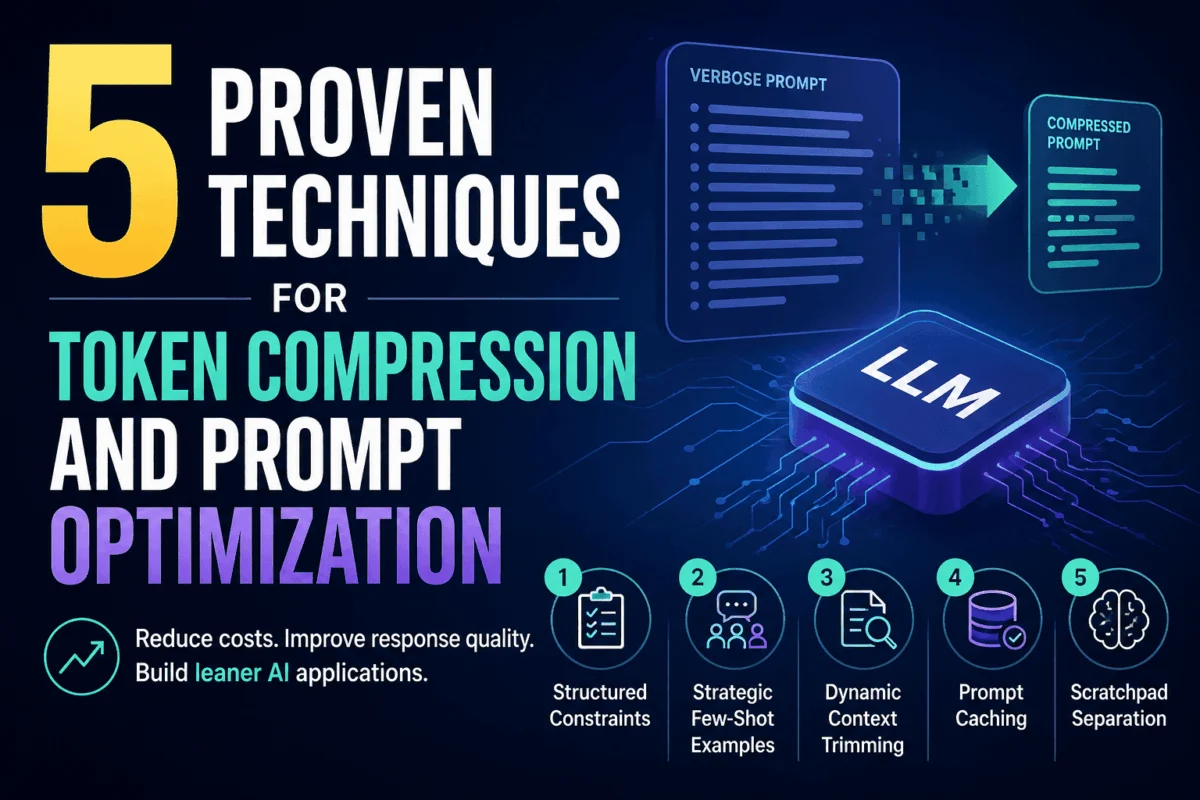
The rapid commercial adoption of Large Language Models (LLMs) across enterprise environments has introduced a critical engineering challenge: the escalating cost and latency associated with token consumption. As organizations transition foundational AI models from experimental notebooks to high-scale production applications, inefficient prompt design has emerged as a primary driver of operational overhead. Every token processed by an LLM incurs a measurable financial cost and adds computational latency. In response to this economic pressure, software engineers and AI architects are increasingly turning to advanced prompt optimization and token compression methodologies to maximize intent transmission while minimizing resource utilization.
To address these inefficiencies, AI practitioners have formalized a series of practical strategies aimed at streamlining inputs and outputs without compromising model accuracy or response fidelity. These techniques focus on eliminating conversational bloat, leveraging semantic retrieval, utilizing server-side caching mechanisms, and managing reasoning traces effectively.
The Economic and Operational Impact of Token Bloat
The financial implications of unoptimized prompts compound rapidly at enterprise scale. Modern LLM pricing models charge per token for both input (prompt) and output (completion). When applications transmit verbose system instructions, redundant few-shot examples, or entire document repositories with every user query, API expenditures scale unnecessarily. Furthermore, processing oversized context windows introduces latency, degrading the user experience in real-time applications such as customer service chatbots and interactive development environments.
Industry analysis indicates that production applications can routinely waste up to 40% of their input tokens on conversational filler, structural redundancies, and irrelevant contextual data. This realization has shifted the paradigm of prompt engineering from an intuitive art form into a rigorous discipline grounded in data compression and computational efficiency.
1. Transitioning from Narrative Instructions to Declarative Constraints
A common inefficiency in early-stage prompt design is the reliance on conversational, natural-language system instructions. While human-like phrasing makes prompts easier for developers to write, LLMs parse structured schemas with significantly higher efficiency. Narrative instructions often consume dozens of tokens to convey simple behavioral parameters.
For example, a traditional instruction set requesting specific formatting and length constraints frequently requires lengthy explanatory sentences. By replacing these narrative paragraphs with pipe-delimited key-value pairs, YAML-style formatting, or JSON schema blocks, developers can drastically reduce token counts. In practice, constraints that previously consumed over thirty tokens can often be compressed into fewer than fifteen tokens while retaining exact behavioral adherence from the model. Across millions of daily API calls, this structural shift yields substantial cost reductions.
2. Calibrating Few-Shot Examples for Optimal Pattern Recognition
Few-shot prompting—the practice of supplying input-output pairs prior to the active query—remains one of the most reliable methods for ensuring consistent output formatting and classification accuracy. However, a widespread misconception among practitioners is that adding a higher volume of examples correlates directly with improved performance.
Empirical research from leading AI laboratories and academic benchmarks demonstrates a clear pattern of diminishing returns. For standard classification and generation tasks, performance typically plateaus between three and five examples. Providing ten or more examples rarely yields measurable gains in accuracy and frequently introduces syntactic contradictions or domain-specific noise that can confuse the model. Furthermore, excessive examples inflate the input token count unnecessarily. Establishing a lean, highly representative set of three examples provides sufficient pattern recognition for the underlying model architecture while conserving computational resources.
3. Implementing Dynamic Context Retrieval for Long-Form Documents
Passing extensive document repositories, legal contracts, or conversational transcripts directly into an LLM prompt is an inefficient use of context windows. In many scenarios, the model requires only a minor fraction of the provided text to formulate an accurate response, yet the application is billed for the entirety of the ingested document.
To mitigate this inefficiency, engineering teams are increasingly deploying dynamic context trimming. By utilizing lightweight embedding models—such as Sentence Transformers—combined with cosine similarity metrics, applications can programmatically parse large text corpuses and isolate only the specific passages relevant to the user query.
This retrieval-augmented approach ensures that only high-utility text segments are appended to the prompt. For instance, when processing a ten-thousand-token knowledge base where only a small fraction contains the requisite information, dynamic filtering can eliminate over ninety percent of extraneous context. This drastically reduces per-request token consumption and accelerates inference times.
4. Leveraging Server-Side Prompt Caching for Static Prefixes
Enterprise applications frequently maintain standardized system instructions, comprehensive persona definitions, and extensive security policy constraints that remain identical across every user interaction. Transmitting these static token sequences with every individual API call represents a significant redundancy.
Major model providers, including Anthropic and OpenAI, have responded to this architectural challenge by introducing server-side prompt caching. These features allow infrastructure providers to store static prefix tokens in memory after the initial request, billing subsequent cache hits at a heavily discounted rate.
To capitalize on prompt caching, developers must structure their API payloads deliberately, placing static content—such as foundational system prompts and baseline knowledge bases—at the beginning of the prompt sequence, followed by semi-static context and dynamic user messages at the end. When implemented correctly, prompt caching lowers operational costs for high-volume enterprise deployments.
5. Managing Reasoning Traces via Scratchpad Separation
Chain-of-thought (CoT) prompting has revolutionized the ability of LLMs to solve complex mathematical, logical, and coding problems by encouraging the model to articulate its reasoning step by step before arriving at a final conclusion. However, these generated reasoning traces can introduce hundreds of output tokens per request, significantly inflating generation costs even when the end user requires only the final answer.
To resolve this economic friction, developers are adopting scratchpad separation techniques. By instructing the model to isolate its internal calculations within dedicated structural tags—such as <thinking> blocks—while restricting the final deliverable to separate <answer> tags, applications can parse and discard the verbose reasoning trace before rendering the output to the end user.
While the application must still pay for the generation of the reasoning tokens, filtering out the intermediate text reduces bandwidth, storage requirements, and downstream rendering costs. Additionally, native reasoning modes offered by various model APIs allow for the direct suppression or differential billing of internal thought processes, providing further financial optimization for complex computational workloads.
Broader Implications and Industry Outlook
The maturation of token compression and prompt optimization techniques signifies a broader maturation within the generative AI industry. As initial enterprise enthusiasm gives way to rigorous financial audits and return-on-investment (ROI) calculations, efficiency has become a paramount metric for AI deployment.
Organizations that fail to optimize their token pipelines face inflated operational expenditures that can undermine the economic viability of their AI initiatives. Conversely, engineering teams that master prompt compression, context retrieval, and caching strategies are better positioned to scale their applications sustainably. As LLM architectures continue to evolve, the integration of automated prompt optimization tools and intelligent context management will likely transition from a specialized engineering practice into a standard component of modern software development life cycles.