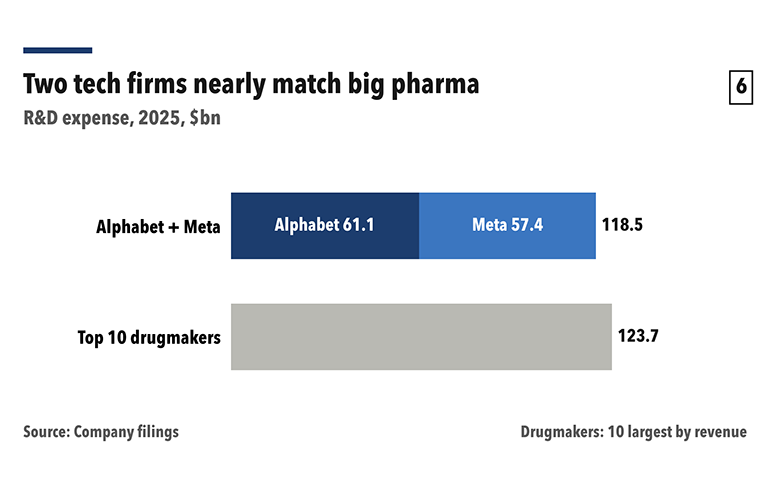
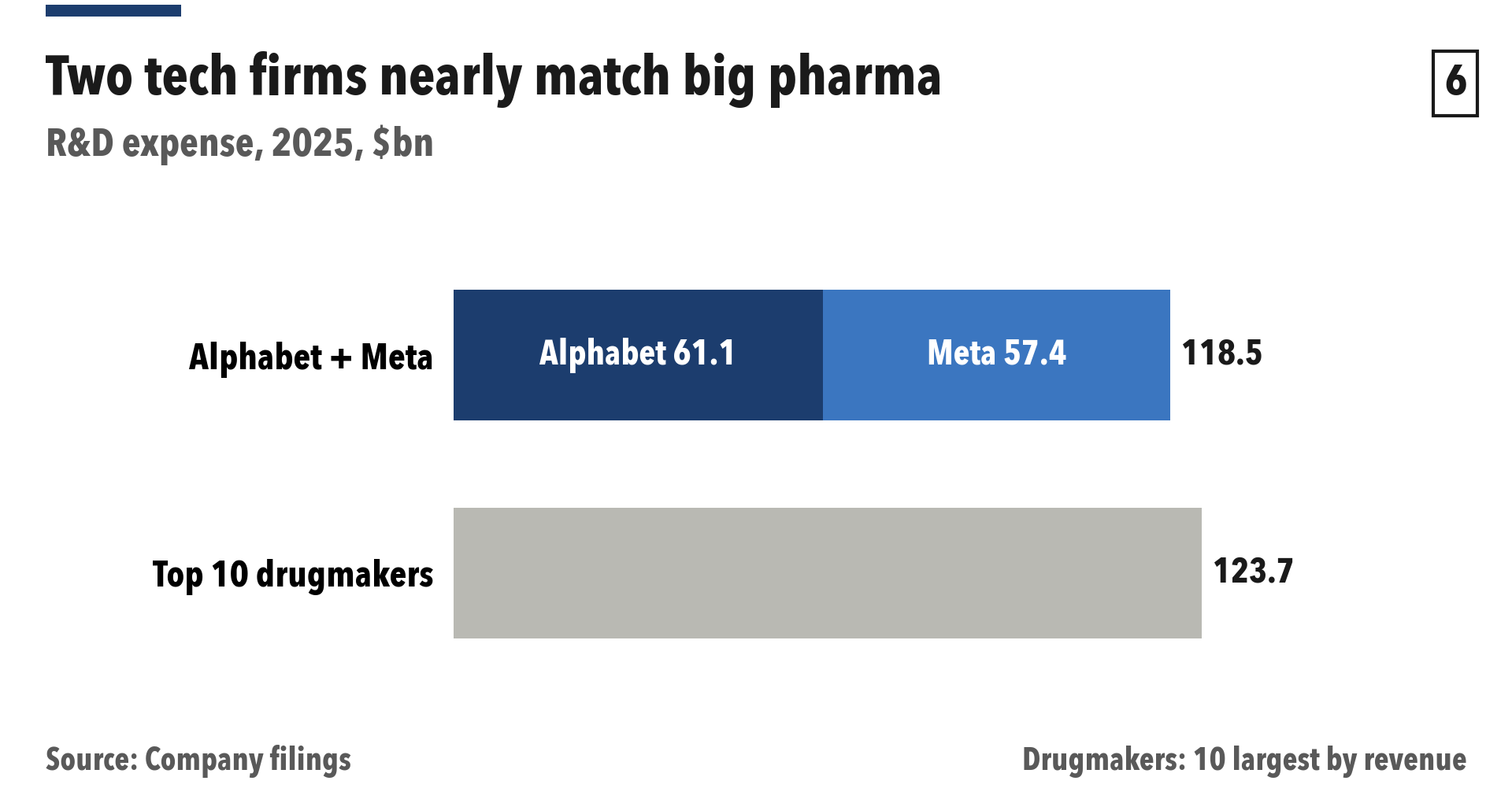
The landscape of global research and development is undergoing a tectonic shift as the financial muscle of Big Tech begins to rival, and in some metrics surpass, the traditional dominance of the pharmaceutical industry. In 2025, Google parent Alphabet and Meta reported a combined $118.5 billion in R&D expenditure. This figure stands in stark contrast to the $123.7 billion collective budget of the world’s ten largest pharmaceutical companies by revenue—a group that includes diversified entities like Johnson & Johnson, with its heavy focus on medtech, and Roche, which maintains significant diagnostics operations.
This convergence of capital signals more than just a battle for talent; it represents a fundamental reordering of the scientific discovery ecosystem. Where pharmaceutical giants once functioned as self-contained research silos, the integration of generative AI, high-performance computing, and massive data architectures has rendered them increasingly dependent on the infrastructure—and the intellectual capital—of Silicon Valley.
The Great Divergence: A Historical Perspective
To understand the gravity of this shift, one must look back to 2013. At that time, Merck & Co. was a titan of research spending, allocating $7.5 billion toward its R&D pipeline, while Google trailed slightly with a $7.1 billion budget. The two entities were then direct peers in terms of financial commitment to innovation.
By 2025, that parity had vanished entirely. Alphabet’s R&D spend ballooned to $61.1 billion, while Merck’s investment, though substantial, grew to $15.8 billion. In little more than a decade, the ratio of spending shifted from near-equality to a four-fold advantage for the tech giant. This expansion is not merely an increase in overhead; it reflects the massive, capital-intensive requirements of building large language models (LLMs), training proprietary AI architectures, and maintaining the global server infrastructure necessary to power the next generation of predictive science.
The Infrastructure Arms Race
The pharmaceutical sector has responded to this disparity by pivoting toward deep integration with tech hardware and cloud providers. The most visible manifestation of this is the race for "AI factories"—dedicated supercomputing clusters designed to handle the complex, high-dimensional data required for modern drug discovery.
Eli Lilly has been at the vanguard of this trend. In February 2025, the company activated its "LillyPod" supercomputer in Indianapolis. Developed in partnership with NVIDIA, the system was assembled in just four months. According to Thomas Fuchs, Chief AI Officer at Eli Lilly, the system utilizes NVIDIA’s 550-billion-parameter Nemotron 3 Ultra model. By running this model on-premises with virtually no budget or token limits, Lilly has transitioned from traditional trial-and-error discovery to a compute-first paradigm. Early results have been promising; a foundation model on the system successfully co-designed a small-molecule candidate featuring a novel chemical fragment, a milestone that underscores the potential for AI to navigate chemical spaces previously inaccessible to human chemists.
This is complemented by a $1 billion, five-year commitment to a co-innovation lab with NVIDIA in the Bay Area, signaling that the relationship is not merely a vendor-client arrangement but a deep, long-term strategic marriage of biology and silicon.
Similarly, Roche has aggressively expanded its computational capacity. In March 2026, the company announced the installation of 2,176 NVIDIA Blackwell GPUs on-premises. When combined with its existing cloud capacity, the company now commands a fleet of more than 3,500 GPUs. Bristol Myers Squibb is following a parallel trajectory, currently constructing its second NVIDIA-based supercomputer utilizing Vera Rubin systems, building upon the operational foundation laid by its first DGX SuperPOD.
The Rise of the "Frontier AI" Scientist
The role of frontier AI labs has evolved from software provider to active participant in the laboratory. Anthropic, a leader in AI safety and development, has taken this a step further by establishing its own wet lab in the San Francisco Bay Area. While the company has clarified that the lab is not exclusively for drug discovery, it is emblematic of a broader trend: AI companies are no longer content to build the tools; they are increasingly building the infrastructure to test their own hypotheses.
Anthropic’s recent strategic moves underscore a multi-pronged approach to the life sciences sector. In June 2026, the firm announced that it would begin running preclinical programs focused on disease areas that have historically been neglected by Big Pharma due to low financial returns. Simultaneously, the company partnered with Basecamp Research to leverage EDEN biological models for antibiotic discovery and vaccine design.
The acquisition of Coefficient Bio—a boutique firm founded by former Genentech computational biologists—for approximately $400 million, further suggests that Anthropic is building an in-house team capable of bridging the gap between digital modeling and biological reality. The appointment of Novartis CEO Vas Narasimhan to Anthropic’s board serves as a final, clear indication that the company intends to influence the highest echelons of global drug development strategy.
Enterprise AI as the New Operating System
Beyond discovery, tech giants are embedding themselves into the operational fabric of pharmaceutical firms through enterprise-wide AI deployment.
- Bristol Myers Squibb: Has deployed Claude Enterprise to over 30,000 employees, embedding the platform across its research, development, manufacturing, and commercial workflows.
- Novo Nordisk: In a year of aggressive technological expansion, the company signed a major enterprise partnership with OpenAI in April, followed by a cloud infrastructure deal with Amazon Web Services in August. In September, it finalized a third partnership with Anthropic to utilize its "Claude Science" workbench, aimed at accelerating its internal R&D workflows.
- Genmab: Announced in early 2026 that it would build custom, agentic AI models powered by Claude to streamline clinical development, a phase of drug development that is notoriously time-consuming and expensive.
The goal for these pharmaceutical leaders is "operational intelligence." By integrating these platforms, companies hope to reduce the cycle time of drug development, which currently takes over a decade and costs billions of dollars per successful molecule.
Analytical Outlook: Implications for the Industry
The current trajectory suggests that the pharmaceutical industry is moving toward a "de-risked" model where the heavy lifting of data synthesis is offloaded to Big Tech providers. While this presents an unprecedented opportunity to accelerate the arrival of life-saving medicines, it also introduces systemic risks.
- Dependency and IP Concentration: As pharma firms become increasingly reliant on a small cohort of tech providers (NVIDIA, Google, Anthropic, OpenAI), they risk losing control over the proprietary data pipelines that form their primary competitive advantage. The question of who owns the "insights" generated by these models remains a contentious legal and strategic frontier.
- The "Black Box" Problem: As AI models like those powering GPT-Rosalind or Claude Science become more complex, the ability for scientists to interpret the reasoning behind a specific drug candidate’s design decreases. This "black box" nature poses challenges for regulatory filings and quality control.
- The Financial Threshold: The cost of entry into top-tier research is rising exponentially. Smaller biotech firms that cannot afford the multi-billion-dollar investments in supercomputing and enterprise AI partnerships may find themselves effectively excluded from the cutting edge of innovation, leading to a further consolidation of the industry under a few dominant, tech-integrated players.
As the industry looks toward the end of 2026, the focus for firms like Isomorphic Labs—which recently secured $2.1 billion in funding—will be to prove that these investments translate into clinical reality. With collaborations now spanning giants like Johnson & Johnson, Lilly, and Novartis, the proof of concept is currently being tested in real-time. The merger of biology and Big Tech is no longer a future-looking forecast; it is the current operating reality of the global healthcare economy.