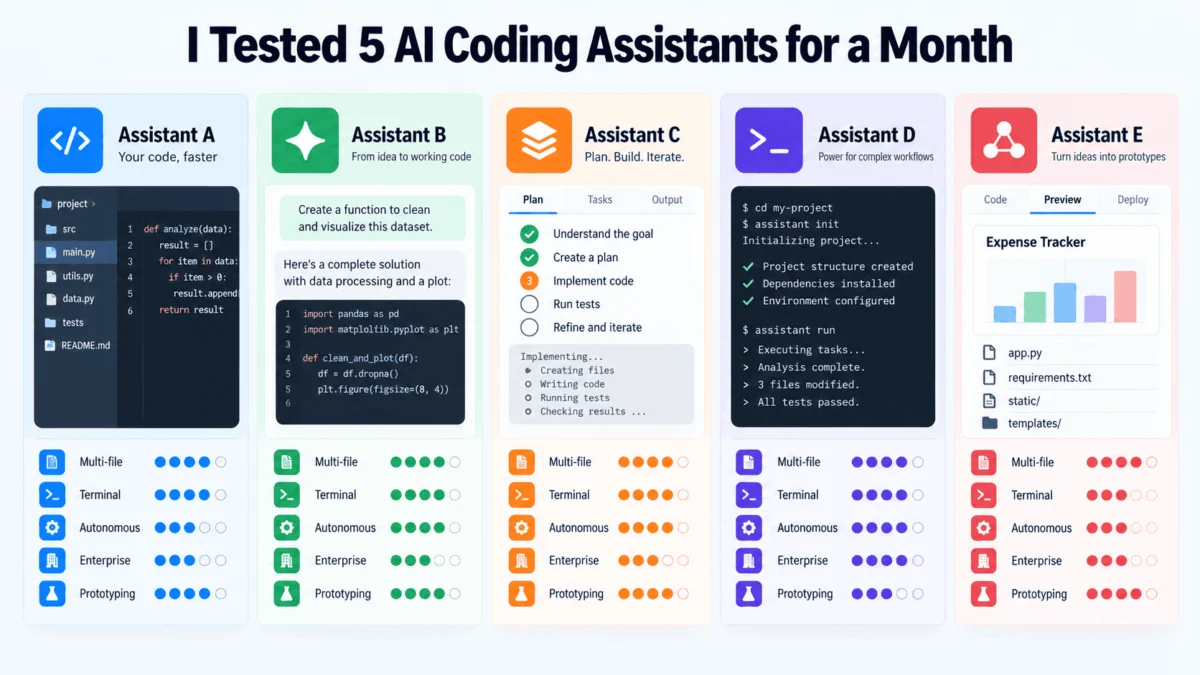
The software development landscape is undergoing a structural transformation as artificial intelligence transitions from experimental autocomplete utilities to autonomous coding agents capable of end-to-end application generation. Over the past several years, the market for AI coding assistants has expanded dramatically, driven by rapid advancements in large language models and reasoning architectures. To evaluate the practical utility, reliability, and architectural trade-offs of these technologies in production environments, a comprehensive one-month empirical assessment was recently conducted across five of the industry’s most prominent developer tools: Cursor, GitHub Copilot, Claude Code, Windsurf (Devin Desktop), and Replit Agent.
Rather than functioning as uniform utilities, these platforms represent fundamentally divergent philosophies on how software engineering should be performed in the modern era. The evaluation spanned complex legacy refactoring tasks, greenfield application builds, multi-file codebase updates, and demanding debugging sessions. The findings indicate that while these tools significantly accelerate specific development workflows, their integration into enterprise and individual pipelines introduces distinct operational challenges, ranging from architectural drift and context loss to cost unpredictability and security compliance considerations.
Background Context and Evolution of AI-Assisted Development
The genesis of AI-assisted coding dates back to the introduction of machine learning models trained on vast repositories of open-source code, primarily designed to predict subsequent lines or functions. Early iterations, while useful for boilerplate reduction, suffered from severe contextual limitations, frequently hallucinating syntax or failing to comprehend broader repository architectures.
The launch of GitHub Copilot in 2021 established inline completions as a standard developer amenity, precipitating widespread industry adoption. However, the subsequent release of generative models with vastly expanded context windows and agentic capabilities—the ability to plan, execute terminal commands, edit multiple files, and verify outputs autonomously—fundamentally altered the paradigm. Developers are no longer merely accepting inline suggestions; they are delegating complex, multi-step engineering tasks to software agents.
This maturation has forced development teams to navigate a crowded market of specialized tools, each optimized for different stages of the software development lifecycle (SDLC). The month-long study provides a granular breakdown of how these tools perform under rigorous, real-world conditions.
Cursor: The AI-Native Integrated Development Environment
Cursor is built upon a definitive premise: that the traditional Integrated Development Environment (IDE) must be fundamentally redesigned around artificial intelligence rather than retrofitted with auxiliary chat panels. Constructed as a fork of Visual Studio Code, Cursor maintains interface familiarity while introducing advanced paradigms such as Composer and Agent modes.
During the evaluation, Cursor’s multi-file awareness was subjected to a moderately complex Django project, requiring the renaming of a data model and the subsequent propagation of those changes across views, serializers, unit tests, and database migrations. The platform managed the operational scope effectively, demonstrating cross-file coherence that simple autocomplete tools cannot replicate.
However, Agent mode—which empowers Cursor to autonomously edit files, execute shell commands, and iterate on its output—revealed operational risks. While highly efficient on well-scoped, deterministic tasks, open-ended requests within sprawling codebases occasionally resulted in code modifications that were locally correct yet globally inconsistent, inadvertently altering unrelated modules. Priced at approximately $20 per month for the Pro tier with consumption-based billing for intensive agentic sessions, Cursor is best suited for experienced developers tackling heavy refactoring who are willing to invest time in mastering its environment.
GitHub Copilot: The Enterprise Incumbent and Ecosystem Integrator
As the pioneer of scalable AI code generation, GitHub Copilot occupies a dominant market position, particularly within enterprise environments. Its primary competitive advantage lies in its seamless integration across established editors such as VS Code and JetBrains, coupled with low latency and deep contextual awareness derived from repository histories, pull requests, and GitHub issues.
Recent architectural updates have introduced conversational and agentic capabilities via Copilot Chat, including Ask, Plan, and Agent modes. In practice, these features perform reliably within clearly bounded parameters. Yet, comparative evaluations note that these capabilities occasionally feel supplemental rather than foundational compared to purpose-built AI editors.
For organizations deeply embedded in the Microsoft and GitHub ecosystems—leveraging GitHub Actions, Codespaces, and enterprise-grade compliance frameworks—Copilot offers friction-reducing integration that standalone tools struggle to match. With individual tiers starting at $10 per month and enterprise packages offering robust auditing and security controls, Copilot remains the premier choice for organizations prioritizing regulatory compliance and workflow continuity over bleeding-edge autonomy.
Claude Code: The Terminal-Centric Reasoning Agent
Diverging completely from graphical user interfaces, Claude Code operates entirely within the command-line interface (CLI). Developed by Anthropic, the tool leverages advanced reasoning models to read local files, execute terminal commands, run test suites, parse compilation failures, and iteratively debug errors in a manner mirroring a methodical human engineer.
During empirical testing involving the extension of a REST API to support a novel resource type alongside comprehensive test coverage, Claude Code demonstrated superior performance in holding multiple complex constraints in simultaneous focus. Notably, it autonomously identified and resolved a dependency conflict introduced during an earlier execution phase without explicit human prompting.
The absence of a graphical UI presents a steeper initial learning curve and requires developers to be proficient in interpreting terminal output streams. Furthermore, because Claude Code operates via Anthropic’s API on a consumption-based pricing model, expenditure scaling can be volatile during intensive development sessions. Despite these hurdles, it remains an optimal solution for engineers who operate primarily within terminal environments and value deterministic reasoning over rapid, unstructured code generation.
Windsurf (Devin Desktop): The Autonomous Workspace with Persistent Context
Developed initially by Codeium and integrated into Cognition’s ecosystem, Windsurf centers its architecture around a core engine named Cascade. Unlike traditional assistants that require context re-establishment with every distinct prompt, Windsurf maintains continuous, real-time awareness of the entire workspace across extended development sessions.
In multi-hour feature implementation tests, Cascade tracked both manual developer edits and autonomous code generation simultaneously, seamlessly synthesizing both into subsequent suggestions without requiring repeated briefing. Nonetheless, extended autonomous operations introduced the risk of architectural drift; over prolonged sessions, the system occasionally made structural decisions that conflicted with earlier design patterns, necessitating vigilant human oversight.
Priced competitively with a functional free tier and paid options starting around $15 per month, Windsurf presents a coherent alternative for developers engaged in prolonged, iterative feature development who require persistent workspace awareness.
Replit Agent: The End-to-End Browser-Based Builder
Replit Agent represents the most ambitious end-to-end automation model evaluated, designed to bridge the entire gap from natural language description to a fully deployed, live URL entirely within a single browser tab. By unifying the editor, runtime environment, AI agent, and cloud hosting into one cohesive web-based interface, it removes traditional environment configuration barriers.
During prototyping trials, the agent successfully constructed a functional expense-tracking application complete with data persistence in under an hour. This capability offers profound utility for rapid product validation, educational settings, and non-technical founders. However, strict technical limitations emerge when scaling toward production environments. The generated applications rely on straightforward architectures that often require substantial refactoring or complete rewrites when subjected to enterprise-grade scalability, security, and custom integration demands. Core tiers begin at approximately $25 per month, positioning the tool as an exceptional rapid-prototyping engine rather than a complete production engineering replacement.
Comparative Analysis and Strategic Implications
The empirical findings from this month-long evaluation underscore that no single AI coding assistant holds universal superiority across all software development tasks. Instead, the efficacy of each tool is profoundly dictated by the specific architectural philosophy it embodies and the nature of the tasks demanded by the engineering team.
| Feature / Metric | Cursor | GitHub Copilot | Claude Code | Windsurf | Replit Agent |
|---|---|---|---|---|---|
| Primary Interface | Forked VS Code GUI | Plugin (VS Code, JetBrains) | Terminal (CLI) | Dedicated Workspace GUI | Browser-Based IDE |
| Context Scope | Multi-file / Repo-wide | File & Repository History | Repository via CLI | Persistent Session Cascade | Full Stack Cloud Runtime |
| Pricing Model | ~$20/mo Pro | ~$10/mo Individual | API Consumption-Based | ~$15/mo Pro | ~$25/mo Core |
| Optimal Use Case | Complex Codebase Refactoring | Enterprise & Workflow Integration | Terminal-Centric Reasoning | Extended Feature Building | Rapid Prototyping & Demos |
| Primary Limitation | Risk of autonomous drift | Less foundational agentic features | Steep CLI learning curve | Long-session architectural drift | Production scalability limits |
From a broader economic and operational perspective, the maturation of these tools carries significant implications for the software engineering industry. Engineering leadership must carefully assess whether their primary bottleneck is code generation speed, architectural refactoring complexity, or compliance and security governance.
Organizations focusing on rapid prototyping benefit immensely from browser-based agents like Replit Agent, whereas legacy modernization efforts require the robust multi-file context tracking offered by Cursor or Windsurf. Conversely, large enterprises with strict security mandates continue to rely on foundational incumbents like GitHub Copilot to maintain compliance while incrementally boosting developer productivity.
Ultimately, the successful deployment of AI coding assistants relies less on marketplace hype and more on precise tool-to-task alignment. As these systems continue to evolve, the distinction between human developer and autonomous agent will increasingly blur, making strategic evaluation and rigorous code review essential competencies for modern engineering organizations.