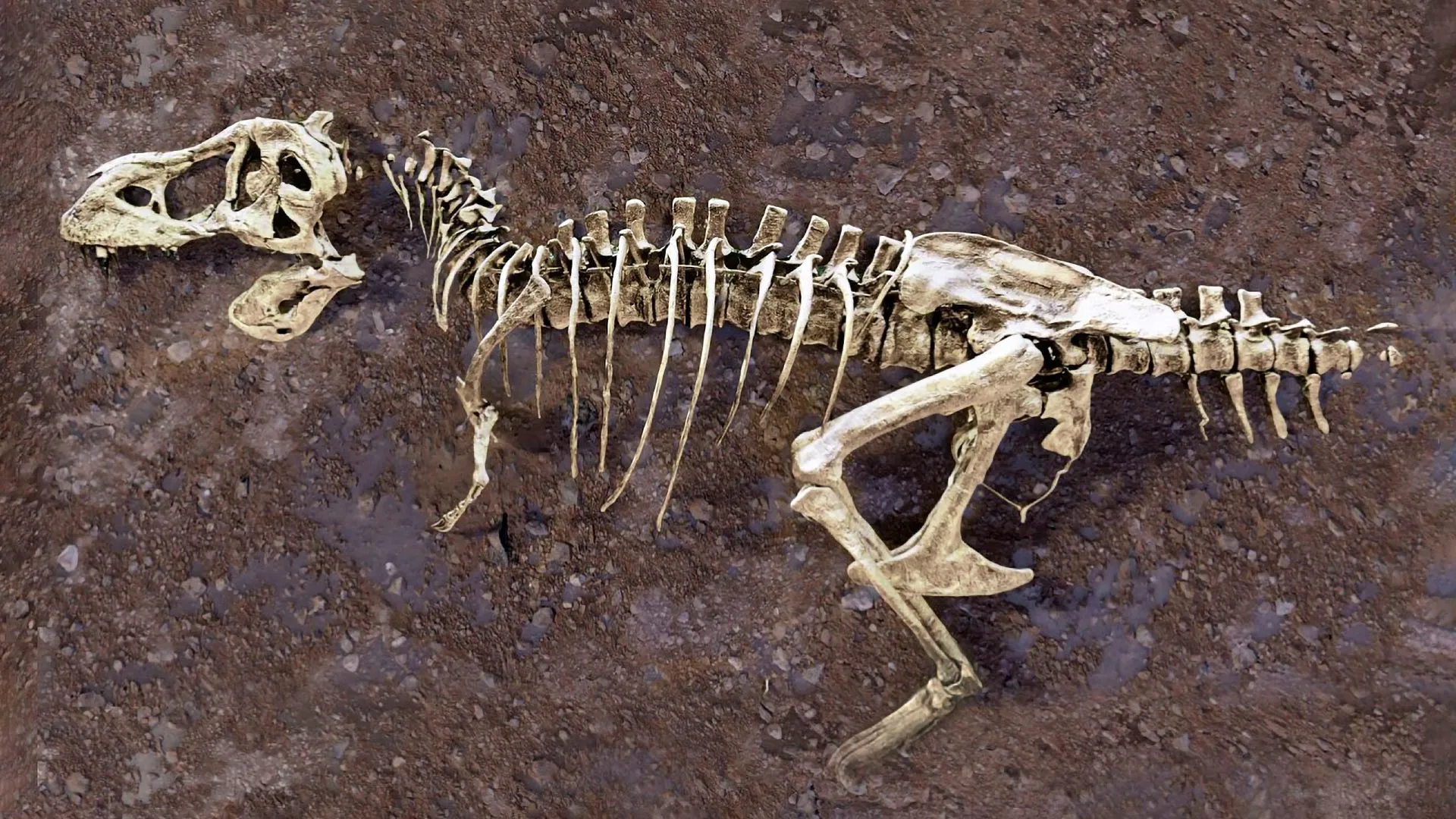
The scientific community has reached a significant milestone in paleontological research as advanced neutron imaging technology reveals the internal biological history of Scotty, the most massive Tyrannosaurus rex skeleton ever unearthed. Discovered in the rugged Frenchman River Valley of Saskatchewan, Canada, by researchers from the Royal Saskatchewan Museum, the specimen has long been a subject of intense academic interest. However, a specific, fractured rib from the skeleton is now providing a rare, high-definition window into the physiology of a creature that roamed the Earth approximately 66 million years ago. By utilizing non-invasive neutron beams at the Department of Energy’s Oak Ridge National Laboratory (ORNL), scientists have uncovered a preserved, mineralized network of blood vessels that were actively healing at the time of the dinosaur’s death—a discovery that challenges long-held assumptions regarding the rapid decomposition of soft tissue in the fossil record.
A Chronology of Discovery and Analysis
The journey to this discovery began in 2020, when Jerit Mitchell, then an undergraduate student at the University of Regina, identified anomalous internal structures within a segment of Scotty’s rib. Utilizing micro-CT scanning at the Canadian Light Source, Mitchell observed signatures that suggested the presence of fossilized soft tissue. This initial observation necessitated a more robust methodological approach. Over the next several years, the research team, led by Professor Mauricio Barbi and Assistant Professor Marcella Berg, integrated synchrotron radiation techniques and advanced microscopy to map the rib’s internal architecture at the cellular level.
The investigation reached a technical crescendo in April 2026, when the team transported the fossils to ORNL. Using the Multimodal Advanced Radiography Station (MARS) and the Virtual Environment for Neutron Sciences (VENUS) instrument, researchers were able to bypass the limitations of traditional X-ray imaging. While X-rays remain the industry standard for visualizing dense bone, their efficacy diminishes when differentiating between subtle mineralized soft tissues and the surrounding matrix. Neutrons, conversely, interact primarily with the nuclei of atoms, demonstrating a profound sensitivity to lighter elements such as hydrogen, which are abundant in biological structures. This duality allowed the team to construct comprehensive 3D models of the injury site without risking the structural integrity of the rare fossil.
The Biological Significance of the Injury
The evidence found within the rib suggests a dramatic moment in the apex predator’s life. Following the fracture of the rib, the dinosaur’s body initiated a standard inflammatory and regenerative response. Iron-rich blood flooded the trauma site, facilitating the formation of a complex vascular network intended to knit the bone back together. The presence of these mineralized vessels indicates that Scotty was in the active stages of recovery when he succumbed to his environment.
The preservation of this biological "medical record" is attributed to the unique taphonomic conditions of the Frenchman River Valley. Upon death, the specimen was interred in a salty, marsh-like environment. The chemical composition of the sediment, coupled with rapid burial, acted as a natural preservative, slowing the typical decomposition process that would otherwise destroy delicate vascular structures. For paleobiologists, this specimen acts as a "Rosetta Stone," providing a concrete link between the mechanical trauma sustained by the animal and its physiological response, effectively bridging the gap between skeletal morphology and soft-tissue biology.
Technical Synergy: Neutrons vs. X-rays
The methodology employed by the ORNL team highlights a sophisticated evolution in paleontological imaging. In clinical medicine, the distinction between MRI and X-ray imaging is well-established; the former excels in soft-tissue contrast, while the latter excels in structural density. Paleontology has historically relied on X-ray-based CT scans, which provide excellent data for skeletal metrics but often fail to capture the nuances of non-osseous preservation.
The integration of the VENUS and MARS instruments at ORNL provided the team with two complementary layers of data. The MARS instrument, utilizing cold neutrons, is specifically calibrated to detect soft-tissue signatures and subtle elemental variations. It proved vital for examining the fossilized scales and amber samples collected from the same geological strata. The VENUS instrument, utilizing high-energy, penetrating neutrons, was employed to probe the depth of the rib. By creating high-resolution, three-dimensional internal reconstructions, the researchers confirmed that the blood vessels identified in 2020 were not an artifact of the scanning process but an authentic, mineralized remnant of the dinosaur’s circulatory system. This capability to peer deep into large, dense objects without destruction marks a paradigm shift in how museums and universities might curate and analyze their most prized specimens.
Broader Implications for Paleontology
The implications of this study extend far beyond the biology of a single T. rex. By demonstrating that soft tissue can be preserved and imaged in 66-million-year-old fossils, the team has provided a new mandate for curators of natural history collections. According to Jerit Mitchell, there are countless fossils currently sitting in storage that have yet to be fully interrogated for their internal biological signatures. The application of neutron imaging could potentially reveal hidden pathologies, growth patterns, and even dietary habits that have been obscured by layers of stone for eons.
Furthermore, the comparison of these ancient injuries with modern vertebrate pathology offers a rare opportunity for evolutionary biologists. By mapping how healing processes have persisted or shifted over 66 million years, researchers can gain a better understanding of the evolutionary pressures that have shaped vertebrate health. As Marcella Berg noted, the synthesis of these clues allows scientists to construct a more cohesive narrative of the past, which is essential for modeling future biological evolution.
Official Responses and Future Directions
The collaboration between the University of Regina, the Royal Saskatchewan Museum, and the Department of Energy’s national laboratories serves as a model for interdisciplinary scientific inquiry. Hassina Bilheux, the lead instrument scientist for the VENUS project, emphasized that while neutrons are typically associated with material science or battery research, their application in the humanities and natural sciences is arguably one of the most innovative frontiers in current research.
The research team has announced plans to expand the scope of their study, aiming to apply this imaging protocol to a wider range of species found in the Frenchman River Valley. The objective is to create a comparative database of injury and healing patterns across different dinosaur lineages. This will enable scientists to determine if the vascular response observed in Scotty is a universal trait among theropods or if it represents a specific biological adaptation unique to the Tyrannosauridae family.
As the data from the 2026 ORNL campaign continues to be analyzed, the scientific community anticipates a series of peer-reviewed publications that will detail the histological findings of the vascular network. The study serves as a potent reminder that the fossil record is not a static list of species, but a dynamic, evolving archive of life. With the continued development of high-resolution, non-destructive imaging technologies, the secrets contained within these ancient bones are finally becoming accessible, allowing us to witness the biological reality of creatures that have been extinct for millions of years. This discovery not only honors the legacy of the largest T. rex ever found but also ensures that Scotty continues to contribute to the advancement of human knowledge, long after his final breath in a prehistoric marsh.