The artificial intelligence landscape has expanded rapidly over the past few years, shifting from isolated conversational chat applications to comprehensive, multi-modal workspaces. Among the platforms emerging in this space is Abacus AI, a unified technical workspace that consolidates multiple language models, autonomous agents, media generation pipelines, and software development environments under a single roof. As organizations and individual developers increasingly seek consolidated solutions to streamline diverse technical workflows, evaluating the platform’s performance, architecture, pricing structure, and user feedback provides critical insight into its viability for modern technological deployment.
Background Context and Platform Evolution
The genesis of platforms like Abacus AI stems from a growing fragmentation in the generative AI ecosystem. Historically, users requiring advanced text generation relied on OpenAI’s ChatGPT or Anthropic’s Claude, while tasks involving image rendering, video synthesis, or heavy data analytics necessitated separate, specialized third-party tools. Juggling multiple subscriptions and navigating disparate interfaces introduced operational inefficiencies for developers, researchers, and enterprise teams alike.
In response to this fragmentation, workspace aggregators were developed to bridge the gap. Abacus AI entered the market by offering unified access to leading large language models through intelligent routing frameworks like RouteLLM. Over successive software iterations, the platform expanded its scope far beyond basic chat functionality, introducing autonomous deep agents, localized desktop coding environments, API deployment tools, and custom agent swarms designed to handle multi-step, asynchronous computing tasks.
Core Ecosystem and Architectural Capabilities
To understand how Abacus AI operates in practice, an examination of its underlying product ecosystem reveals a diverse array of modules tailored for technical and commercial applications. The platform’s offerings can be categorized into foundational model access, agentic workflows, and development environments.
At the entry point of the ecosystem is ChatLLM, which allows users to interface with foundational models from providers such as OpenAI, Anthropic, and Google within a single session. This abstraction layer enables seamless model toggling without requiring separate application windows. Complementing this is the Abacus AI Agent infrastructure, designed to perform multi-step execution tasks including autonomous web research, complex code compilation, and application scaffolding.
For enterprise communication and continuous operations, specialized agents such as Claw integrate directly into messaging architectures like Slack, WhatsApp, and Telegram, preserving contextual memory across extended sessions. Meanwhile, Hermes functions as a learning agent capable of acquiring and retaining reusable skills from previous task executions, reducing redundancy in recurring workflows.
Developers and software engineers utilize Abacus AI Desktop alongside the cloud-based SuperComputer environment. These tools provide dedicated coding spaces, pair-programming utilities, and persistent cloud infrastructure that continues executing tasks even after a user closes their browser session. Furthermore, the introduction of Agent Swarms allows multiple autonomous agents to coordinate simultaneously, dividing complex operations—such as multi-repository code reviews or large-scale data processing—into parallel workstreams.
Evidence-Based Assessment: Strengths, Complexities, and Criticisms
While the breadth of Abacus AI’s product ecosystem offers significant versatility, public reviews, Reddit discussions, and technical evaluations highlight a distinct dichotomy between user praise and operational friction.
Proponents of the platform frequently emphasize its cost-effectiveness and the immense value of accessing a wide variety of high-tier AI models and autonomous agents within a unified workspace. For power users and technical developers who leverage the full spectrum of its capabilities, the platform serves as a powerful productivity multiplier.
Conversely, critical feedback centers on several notable challenges:
Interface Complexity and Learning Curve: Because Abacus AI packs a vast array of tools, models, and administrative controls into a single interface, new users often report difficulty in navigation. Switching rapidly between disparate AI models can obscure tracking provenance, making it challenging to determine which specific model generated a particular output during extended conversational histories. Advanced features, particularly custom agent workflows and multi-step automation, require a steep learning curve that leans heavily toward a developer-focused experience.
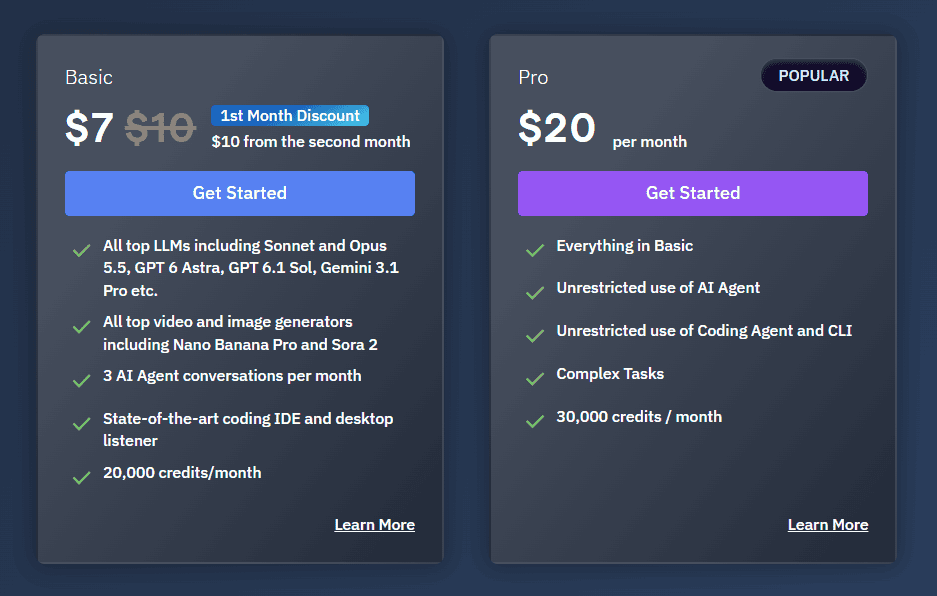
Pricing and Credit Consumption Uncertainty: Abacus AI operates on a credit-based consumption model. While this system permits flexibility across different tool categories—such as standard text queries versus resource-intensive video rendering or multi-step agent research—users frequently note unpredictability in credit depletion. Complex agent loops, unexpected error retries, and extensive web research tasks can exhaust monthly credit allotments faster than anticipated. Additionally, discrepancies between introductory pricing tiers and standard subscription renewals have occasionally led to billing confusion among unwary subscribers.
Workflow Reliability and Performance: Autonomous agents occasionally encounter execution halts or produce incomplete results during multi-step tasks. When a script fails or an agent encounters an error mid-workflow, credits are often consumed regardless of the final outcome, raising concerns regarding error-handling transparency. Furthermore, autonomous agents performing web research have occasionally exhibited information hallucinations, necessitating rigorous human oversight to verify retrieved data.
Business Integrations and Support Metrics: Enterprise adoption studies suggest that organizations must carefully audit whether their existing software stacks and proprietary integrations are natively supported by the platform. While businesses seeking diverse AI functionalities find ample utility, organizations requiring highly specialized, pre-configured workflows for customer support or compliance monitoring may face additional configuration overhead. Customer support response times and billing inquiry resolutions have also received mixed reviews in online forums, underlining the importance of reviewing cancellation terms and credit rollover policies prior to long-term commitment.
Real-World Use Cases and Practical Demonstrations
Demonstration walkthroughs and case studies illustrate how Abacus AI performs across various operational domains:
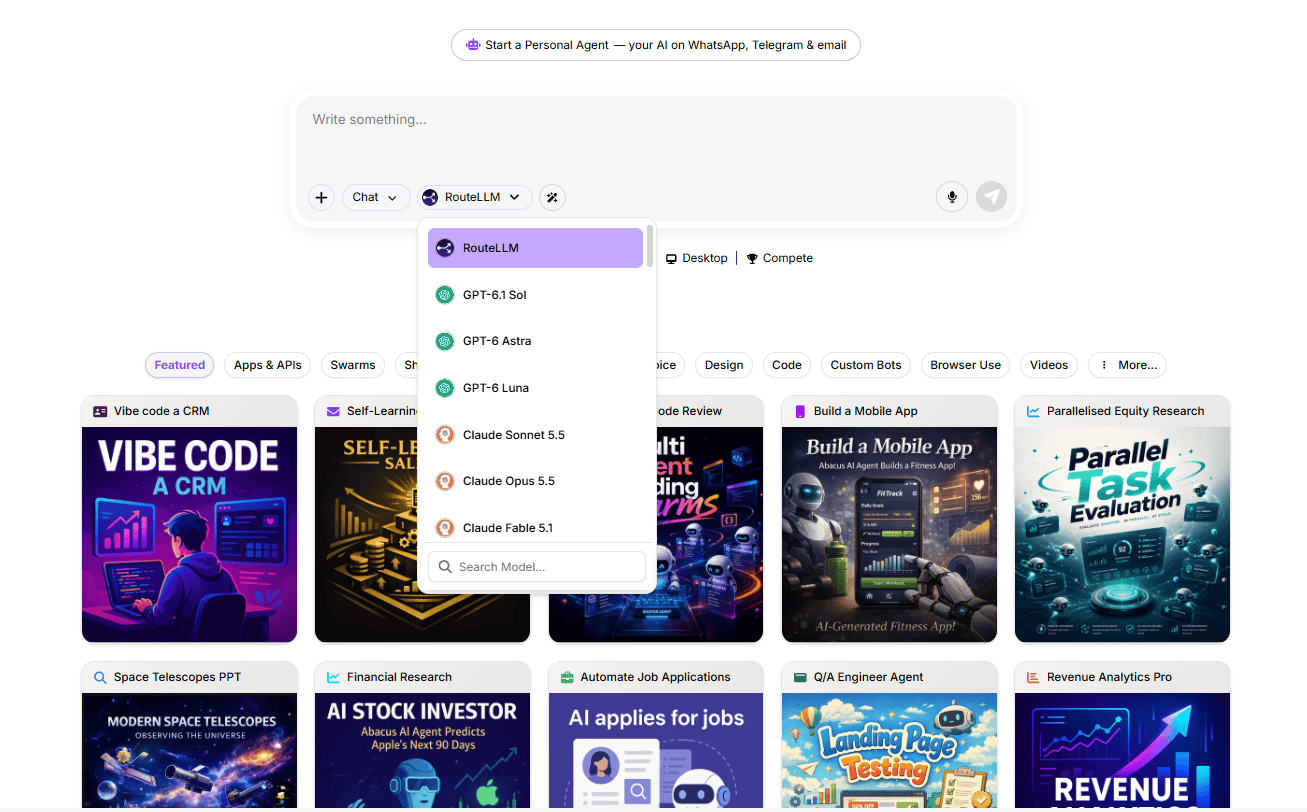
Web Development and E-Commerce Integration: Users can scaffold multi-page websites equipped with integrated payment gateways such as Stripe. While generating front-end interfaces and checkout buttons is streamlined, developers must rigorously test error-handling mechanisms for failed or post-payment states.
Mobile Application Prototyping: The platform supports the rapid development of functional mobile application frameworks, including fitness trackers, running coaches, and expense monitors. Live GPS integration and background execution modes require validation on physical hardware beyond simulated browser environments.
Customer Relationship Management (CRM) Scaffolding: Utilizing natural language prompts, users can deploy custom CRM applications featuring user roles, permission matrices, and employee directories. As business rules and database integrations scale, deeper programmatic testing becomes necessary.
Invoice Processing and Automated Document Extraction: Automated pipelines extract vendor details, line items, and due dates from unstructured PDF invoices, converting them into structured CSV formats suitable for accounting software integration.
Revenue Analytics and Business Intelligence: Automated data processing tools scan financial datasets to identify growth patterns. Analysts emphasize that the integrity of AI-driven financial modeling remains entirely dependent on how baseline metrics—such as invoiced versus collected revenue—are defined by the user.
Automated Code Reviews and Quality Assurance: Multi-agent code review swarms analyze concurrent pull requests to flag security vulnerabilities and syntax inefficiencies. Concurrently, AI QA engineering agents emulate user behavior to test landing page form submissions and report broken workflows directly to issue-tracking software like Jira.
Scheduled Browser Automation: Routine administrative tasks, such as automated multi-site price tracking, competitor data scraping, and nightly report generation, execute via cloud-based browser workflows, provided robust error-alerting mechanisms are established to handle login failures.
Broader Impact and Strategic Implications
The commercial availability of consolidated AI workspaces like Abacus AI marks a significant shift in how organizations procure and deploy artificial intelligence. By democratizing access to multi-agent automation, custom web application deployment (often termed "vibe coding"), and heavy computational resources, platforms of this nature lower the technical barrier for small teams and solo developers.
However, the implications of relying on autonomous agents for mission-critical operations demand careful governance. As organizations delegate research, financial analytics, and software testing to automated swarms, the necessity for human-in-the-loop verification becomes paramount. The distinction between automated data generation and factual validation remains a critical operational bottleneck across the generative AI sector.
Conclusion: Is Abacus AI Worth Implementing?
Abacus AI presents a robust, highly versatile ecosystem for users who require more than basic conversational chat capabilities. Its primary strength lies in its expansive consolidation of models, autonomous agents, and development tools under a unified interface.
For developers, technical researchers, and organizations looking to centralize diverse AI workflows, the platform offers substantial utility. Nevertheless, prospective users must navigate a complex learning curve, carefully monitor credit consumption rates, and maintain rigorous oversight of automated workflows. By thoroughly assessing individual requirements against the platform’s architectural strengths and documented limitations, organizations can determine whether Abacus AI aligns with their long-term technological strategy.
Frequently Asked Questions
What are the core advantages of Abacus AI?
The platform consolidates a wide array of AI tools—including multi-model chat access via ChatLLM, autonomous agents, software development environments, data analytics, and media generation—into a single technical workspace.
How does the credit consumption model work?
Credits are deducted based on the computational complexity of the task performed. Basic text queries consume minimal credits, whereas intensive coding operations, multi-step agent research, and media rendering utilize significantly higher amounts.
Is Abacus AI suitable for beginners?
Novice users can effectively utilize the ChatLLM interface for everyday writing, research, and documentation. However, advanced features such as agent swarms, cloud supercomputers, and automated workflow scripting require technical familiarity and experimentation.
How reliable are the autonomous AI agents?
Agent reliability depends heavily on the complexity of the assigned task, the precision of the initial prompt instructions, and the error-handling mechanisms defined by the user. Intermediate and final outputs require active human verification.
What factors should businesses consider before adoption?
Organizations must evaluate integration compatibility with existing software stacks, monitor monthly credit pacing and budgeting limits, ensure strict data security measures, and review subscription cancellation and billing terms prior to enterprise-wide deployment.