The global race to mitigate climate change and transition toward a circular carbon economy has received a major technological boost. Researchers at the Indian Institute of Science (IISc) have successfully identified 9,389 individual chemical reactions occurring on a copper catalyst, uncovering thousands of previously overlooked pathways that fundamentally alter how scientists understand carbon dioxide (CO2) conversion. Published in the esteemed journal Nature Communications, this landmark study bridges the gap between theoretical chemistry and high-performance computing by merging quantum mechanics simulations with advanced machine learning architectures.
For decades, the chemical upcycling of greenhouse gases into valuable industrial feedstocks and green fuels—such as methanol—has been severely bottlenecked by the immense complexity of catalytic surfaces. Traditional computational methods, constrained by processing limitations, routinely rely on heavily simplified reaction networks. By demonstrating that these conventional models miss crucial chemical steps, the IISc team has laid a new groundwork for the design of next-generation industrial catalysts. The implications of this research extend far beyond carbon dioxide recycling, offering a scalable computational framework for nitrogen reduction, green hydrogen generation, and other vital chemical manufacturing processes.
The Computational Bottleneck: Why Traditional Models Fell Short
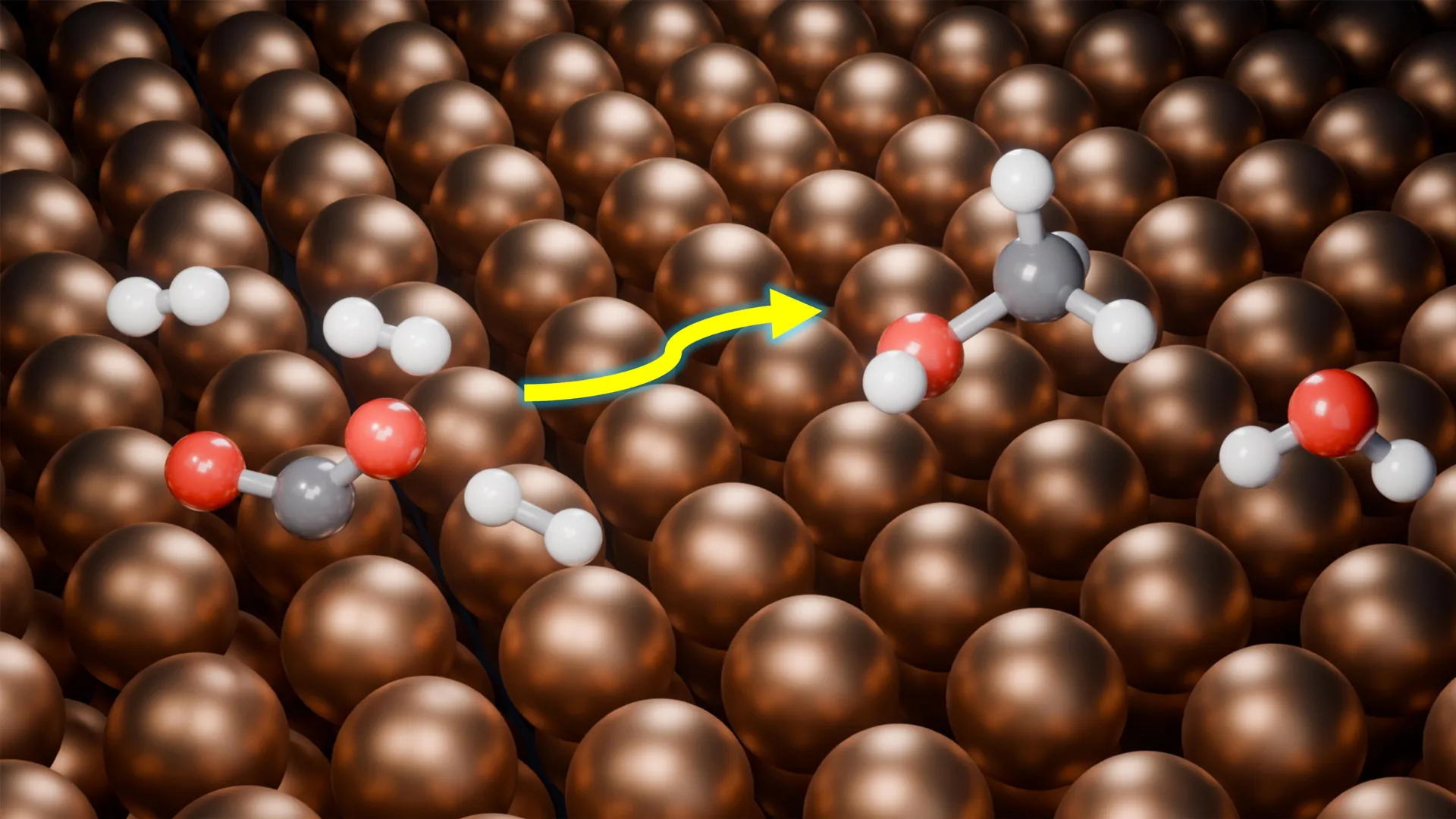
To fully appreciate the magnitude of the IISc breakthrough, one must examine the intricate chemistry of carbon dioxide hydrogenation. Transforming CO2 into methanol—a versatile chemical building block and clean-burning fuel—requires reacting carbon dioxide with hydrogen over a metallic catalyst, most commonly copper. As these molecules interface with the catalyst at an atomic level, an astronomical number of intermediate reactions take place simultaneously across the metallic surface.
Historically, simulating every possible atomic interaction using pure quantum mechanics, such as Density Functional Theory (DFT), demands computational power that exceeds current supercomputing capabilities. Consequently, surface scientists and chemical engineers have traditionally hand-picked a limited subset of reactions deemed most probable based on chemical intuition and historical precedent. Typically, these conventional models track a modest 100 to 200 reaction steps.
This reductionist approach, while computationally manageable, carries a hidden hazard. As Anand Mohan Verma, the study’s first author and currently an Assistant Professor at the Motilal Nehru National Institute of Technology Allahabad (MNNIT Allahabad), points out, researchers in mechanistic modeling live with a persistent anxiety: how to ensure that the chosen reaction network has not omitted the single atomic step that dictates the entire outcome. This methodological blind spot has frequently led to discrepancies between theoretical predictions and empirical laboratory observations, frustrating decades of industrial efforts to optimize catalytic efficiency.
Bridging Quantum Mechanics and Machine Learning
The research initiative began as an ambitious attempt to eliminate these blind spots. Conducting his work as a CV Raman Postdoctoral Fellow at IISc, Verma collaborated with a multidisciplinary team spanning chemical engineering, computer science, and industrial R&D to construct a radically expanded chemical network.
The investigative timeline moved through distinct methodological phases:
- Baseline Database Construction: The team utilized rigorous quantum mechanics simulations to map out a foundational database consisting of 152 fundamental chemical reactions.
- Machine Learning Acceleration: Recognizing that manually calculating thousands of additional reaction pathways via pure quantum mechanics would take decades, the team trained specialized machine learning models. These algorithms were engineered to rapidly and accurately estimate the energy barriers required for auxiliary reactions to proceed.
- Automated Network Expansion: Empowered by automated computational tools, the scientists scanned the landscape of potential interactions involving 105 distinct chemical species present on the copper catalyst surface. They systematically evaluated which transformations could occur within a single reaction step.
- Scale Multiplication: This automated, data-driven exploration radically expanded the initial network of 152 reactions to an unprecedented 9,389 distinct pathways.
The quantitative difference in predictive accuracy between the small and large networks was immediate and dramatic. When the research team ran simulations using the conventional 152-reaction model, the algorithm produced fundamentally flawed outputs. It incorrectly forecasted formic acid as the primary reaction product instead of methanol, and it drastically underestimated the total volume of CO2 converted.
However, when the expanded network comprising nearly 10,000 reactions was integrated into a microkinetic model—which simulates the rates at which chemical transformations occur—the computational output aligned closely with physical experiments. Specifically, the expanded model predicted an approximate 40-fold increase in carbon dioxide conversion efficiency compared to the baseline model, while accurately pinpointing methanol and carbon monoxide as the dominant reaction products.
Validating the Model Through Global Collaboration
To ensure these computational breakthroughs reflected physical reality, the IISc team partnered with prominent industrial and academic institutions for rigorous experimental validation. G Valavarasu and Santhosh Kotni from the Green Research and Development Centre of Hindustan Petroleum Corporation Limited (HPCL), alongside Amol Amrute and colleagues at the Agency for Science, Technology, and Research (A*STAR) in Singapore, subjected the model’s predictions to empirical testing. Furthermore, the development of the underlying machine learning architectures was bolstered by Ambedkar Dukkipati, a Professor in the Department of Computer Science and Automation at IISc.
This synergy between high-throughput computational modeling and empirical industrial testing marks a maturation in chemical engineering methodology. By proving that larger reaction networks eliminate persistent predictive errors, the collaboration validates the use of artificial intelligence as a co-pilot in fundamental chemical discovery rather than merely a supplementary tool for data analysis.
Challenging Orthodox Chemistry: The Molecular Hydrogen Pathway
Perhaps the most startling revelation arising from the expanded 9,389-reaction network was not just the quantitative improvement in conversion rates, but a qualitative discovery that challenges foundational chemical dogma.
For generations, undergraduate and graduate chemistry students have been taught a strict mechanistic rule regarding catalytic hydrogenation: molecular hydrogen (H2) must first dissociate into individual hydrogen atoms on a metal surface before it can participate in subsequent reactions with chemical intermediates. The IISc study upended this established convention.
The expanded model revealed numerous instances where hydrogen is transferred directly to intermediate chemical compounds as an intact H2 molecule, bypassing the dissociation phase entirely. Subsequent targeted quantum mechanics calculations confirmed that this intact molecular transfer pathway is thermodynamically and kinetically favorable, particularly when hydrogen interacts with oxygen-containing reaction intermediates.
Co-author Shivam Chaturvedi, a PhD student in the Department of Chemical Engineering at IISc, highlighted the counterintuitive nature of the discovery. The notion that hydrogen can transfer as an intact molecule without first splitting into atomic components runs directly counter to established textbook chemistry, Chaturvedi noted. He emphasized that this phenomenon only surfaced because the automated network was expansive enough to permit non-traditional mechanistic pathways, and the observation held up when researchers subsequently computed those specific steps explicitly.
This revelation carries profound implications for catalyst design. According to the research team, these findings suggest that engineers should prioritize the development of catalytic materials designed to interact more strongly with molecular hydrogen (H2), which could strategically enhance reaction pathways leading directly to methanol and other high-value chemicals.
Broader Industrial Impacts and Future Applications
The implications of the IISc study extend well beyond the specific chemistry of carbon dioxide hydrogenation into methanol. The underlying computational framework—which successfully harmonizes quantum mechanical accuracy with machine learning speed and automated network generation—provides a blueprint for investigating a wide array of complex catalytic phenomena.
Industrial chemical manufacturing relies heavily on heterogeneous catalysis, where reactions occur at the boundary between solid catalysts and fluid reactants. Many industrial processes suffer from low efficiencies and poor product selectivity simply because the exact reaction pathways remain obscured by computational limitations. By deploying the IISc methodology, researchers can now illuminate previously hidden mechanistic pathways across a diverse spectrum of chemical transformations.
Immediate prospective applications for this expanded framework include:
- Advanced Carbon Dioxide Reduction: Exploring alternative metal catalysts beyond copper to convert greenhouse gases into heavier hydrocarbons, ethylene, or ethanol.
- Nitrogen Reduction Reactions: Optimizing catalysts for the greener production of ammonia, a critical component of global agricultural fertilizers that currently demands immense energy inputs under the Haber-Bosch process.
- Water Splitting and Green Hydrogen Production: Identifying superior electrocatalysts for splitting water molecules to generate clean-burning hydrogen fuel with minimal energy loss.
- Petrochemical Refining: Refining existing catalytic cracking and reforming processes to reduce energy consumption, minimize industrial waste, and lower the carbon footprint of legacy chemical plants.
As regulatory pressures mount and industries worldwide face strict mandates to decarbonize supply chains, the demand for high-efficiency catalysts has never been more urgent. By demonstrating that thousands of overlooked chemical reactions can be systematically identified, quantified, and harnessed through machine learning, the Indian Institute of Science has provided the global scientific community with a powerful new lens through which to engineer a sustainable industrial future.