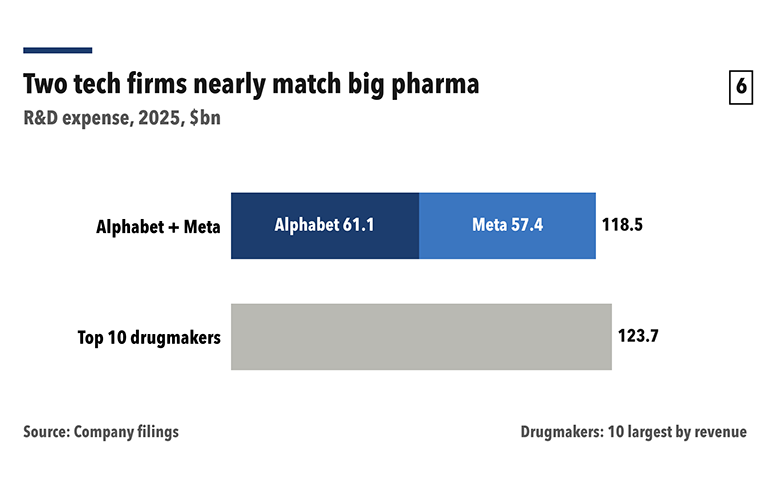
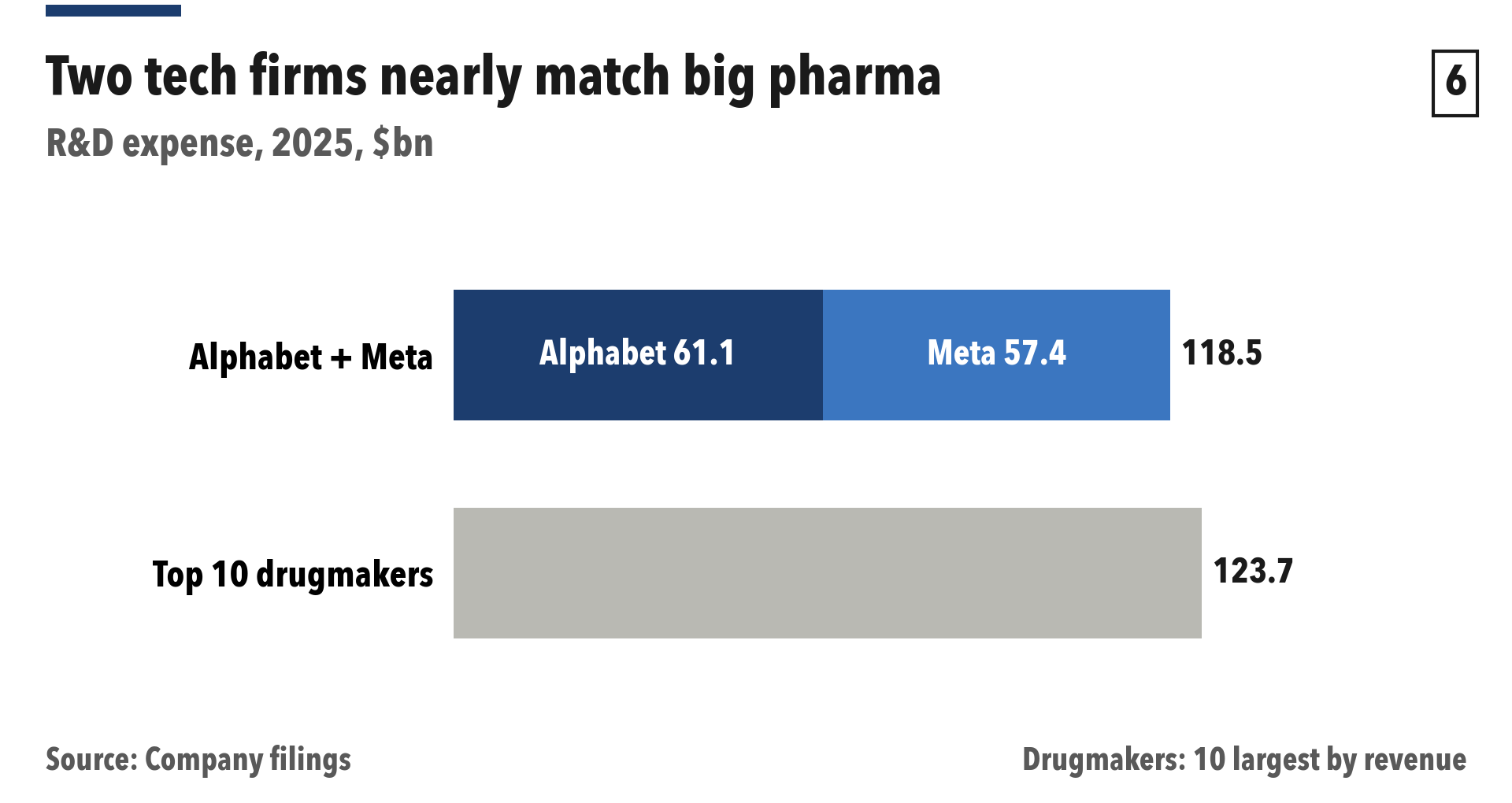
The landscape of global research and development is undergoing a tectonic shift as the lines between Silicon Valley and the pharmaceutical industry blur. In 2025, Alphabet and Meta reported a combined R&D expenditure of $118.5 billion, a staggering figure that nearly matches the $123.7 billion collective budget of the world’s ten largest pharmaceutical companies by revenue. This convergence marks a historical departure from traditional industrial boundaries, signaling that the future of drug discovery is as much about compute power and algorithmic precision as it is about clinical trials and molecular biology.
The Fiscal Divergence: A Decade of Change
To understand the gravity of this shift, one must look back at the trajectory of investment over the last decade. In 2013, the R&D budgets of Big Tech and Big Pharma were operating in fundamentally different financial strata. For instance, Merck & Co. reported an R&D expenditure of $7.5 billion in 2013, slightly outpacing Google’s $7.1 billion investment at the time. By 2025, however, the financial power dynamics had completely reversed. Alphabet’s R&D spend ballooned to $61.1 billion, while Merck’s investment grew to $15.8 billion.
This nearly fourfold increase in Alphabet’s spending relative to Merck illustrates a broader trend: the "Big Tech" giants have transitioned from providing software tools to becoming the primary architects of the digital biological infrastructure. The sheer scale of capital allocated to artificial intelligence, high-performance computing, and massive data centers now provides these technology conglomerates with a structural advantage in computational biology that traditional pharmaceutical firms are struggling to match without deep, strategic partnerships.
Supercomputing and the New Laboratory
The integration of artificial intelligence into drug development is no longer a peripheral strategy; it is a core operational requirement. Pharmaceutical giants are now investing heavily in on-premises supercomputing power to manage the vast data loads required for generative AI in medicine.
Eli Lilly has been at the forefront of this movement. In February 2025, the company brought its "LillyPod" supercomputer online in Indianapolis after a rapid four-month development cycle. The system, developed in partnership with NVIDIA, utilizes the 550-billion-parameter Nemotron 3 Ultra model. According to Chief AI Officer Thomas Fuchs, the system provides "no token or budget limits," allowing researchers to push the boundaries of molecular modeling. A foundation model on this system has already successfully co-designed a small-molecule candidate featuring a novel chemical fragment, a milestone that underscores the practical efficacy of AI-accelerated discovery.
This trend extends to other industry titans. Roche reported in March 2026 that it had installed 2,176 Blackwell GPUs on-premises, pushing its total capacity above 3,500 units when combined with existing cloud infrastructure. Similarly, Bristol Myers Squibb is currently constructing its second NVIDIA-based supercomputer, utilizing Vera Rubin systems, following three years of success with its initial DGX SuperPOD. These infrastructure investments signify a permanent migration toward an "AI-first" model for global pharmaceutical R&D.
The Rise of Frontier AI Labs in Biology
Perhaps the most notable development is the emergence of "Frontier AI" labs—companies like Anthropic, OpenAI, and Alphabet’s Isomorphic Labs—which are moving beyond mere software provision and into the laboratory itself.
Anthropic, in particular, has taken a bold step by establishing a physical wet lab in the San Francisco Bay Area. While the company has clarified that the lab is not dedicated exclusively to drug discovery, it signals a deeper integration into the experimental side of biology. This is further evidenced by Anthropic’s June 2026 announcement that it would conduct internal preclinical programs targeting disease areas often overlooked by traditional pharma due to financial constraints. The company also completed a $400 million acquisition of Coefficient Bio, a startup founded by former Genentech computational biologists, and appointed Novartis CEO Vas Narasimhan to its board of directors.
These AI labs are not acting as competitors to pharma but as strategic enablers. In 2026, the industry saw a flurry of enterprise-level adoption. Bristol Myers Squibb rolled out Claude Enterprise to more than 30,000 employees, while Novo Nordisk entered into its third major AI partnership of the year, focusing on the use of Anthropic’s "Claude Science" workbench to optimize research workflows.
Strategic Alliances and Collaborative Ecosystems
The current climate of cooperation is best illustrated by the $1 billion multi-year alliance announced in April between Merck & Co. and Google Cloud. This partnership aims to accelerate "agentic AI" transformation within the enterprise. Similarly, Isomorphic Labs—Alphabet’s dedicated drug-discovery arm—raised $2.1 billion in May and has successfully integrated its platform into the workflows of Johnson & Johnson, Lilly, and Novartis.
The rise of "purpose-built" models, such as OpenAI’s GPT-Rosalind launched in April, further highlights the specialization occurring in this space. By offering restricted access to these high-fidelity life science models, AI firms are curating a new ecosystem where only the most sophisticated drugmakers can access the bleeding edge of generative discovery tools.
Implications for the Future of Drug Discovery
The implications of this convergence are profound. First, the barrier to entry for drug discovery is being redefined by access to compute. As pharmaceutical companies become dependent on massive, on-premises supercomputers and enterprise-wide AI agents, the competitive advantage will increasingly belong to those who can effectively integrate these tools into the regulatory and clinical trial environments.
Second, the role of the "traditional" researcher is shifting. The emphasis is moving toward interdisciplinary expertise, where a deep understanding of molecular biology is paired with the ability to manage, interpret, and refine large-scale AI models.
Third, there is the question of long-term economic stability. While the current partnerships are highly productive, they create a dependency on Big Tech for the core intellectual property of drug development. As firms like Alphabet and NVIDIA become the backbone of the industry’s R&D efforts, the pharmaceutical sector will need to navigate potential risks related to data privacy, intellectual property ownership, and the concentration of power within the technology sector.
A Look Ahead: 2026 and Beyond
As the industry moves into the latter half of 2026, the focus will shift from building capacity to demonstrating clinical results. Isomorphic Labs, for instance, has set its sights on reaching the clinic by the end of 2026. The success or failure of these AI-designed candidates will serve as a bellwether for the entire industry.
The data suggests that we are witnessing the birth of a new industrial paradigm. The "pharma-tech" hybrid model is no longer a future-looking concept; it is the current reality. With the combined R&D spending of Alphabet and Meta nearing parity with the world’s leading drugmakers, the question is no longer whether AI will transform drug discovery, but how quickly these massive investments will translate into tangible patient outcomes. As global R&D budgets continue to trend upward, the fusion of silicon and science appears poised to accelerate the pace of innovation at a scale previously thought impossible.