Proteolysis Targeting Chimera (PROTAC) technology has officially transitioned from a visionary academic concept to a cornerstone of modern clinical pharmacology. In May 2026, the U.S. Food and Drug Administration (FDA) granted approval to vepdegestrant, marketed under the trade name Veppanu, for the treatment of ER-positive, HER2-negative, ESR1-mutated advanced or metastatic breast cancer. This regulatory milestone represents the first time a targeted protein degrader has navigated the complex pathway from bench to bedside, validating the "chemical knockdown" approach as a viable therapeutic modality. However, the success of vepdegestrant also highlights the daunting developmental hurdles inherent in this class of molecules—specifically, the challenge of achieving effective oral bioavailability.
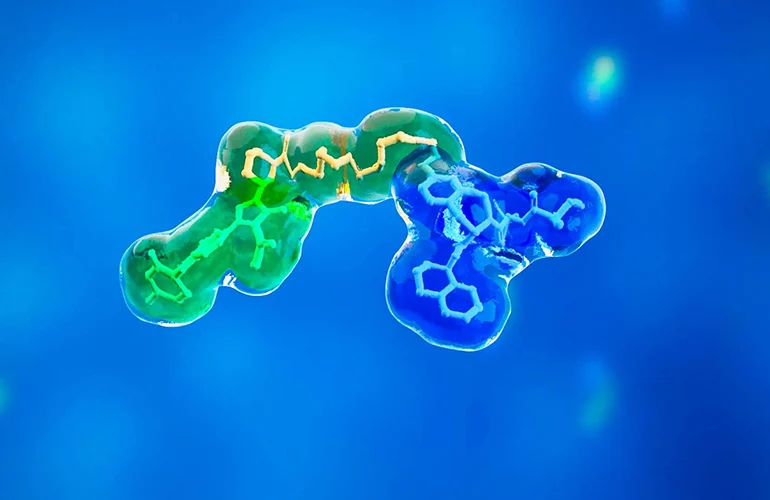
The fundamental mechanism of a PROTAC is elegant in its simplicity but complex in its execution. Unlike traditional small-molecule inhibitors that occupy a protein’s active site, a PROTAC functions as a heterobifunctional molecule. It consists of a target-binding warhead, a ligand to recruit an E3 ubiquitin ligase, and a chemical linker connecting the two. By bringing a target protein into proximity with an E3 ligase, the PROTAC induces polyubiquitination, marking the protein for degradation by the cell’s own proteasome system. Because this process is catalytic rather than stoichiometric, a single PROTAC molecule can degrade multiple copies of a target protein, enabling high efficacy at lower systemic concentrations.
Despite these biological advantages, the structural requirements for a PROTAC—specifically its large molecular size and chemical complexity—frequently push these compounds into the "beyond-Rule-of-Five" (bRo5) chemical space. This trajectory creates significant barriers to oral administration, where solubility, permeability, and metabolic stability are paramount.
Historical Context and the Evolution of Degraders
The journey toward the first approved PROTAC was a decade-long endeavor characterized by rigorous iterative design. The early development of these agents faced skepticism regarding their ability to maintain pharmacological activity in vivo. By the early 2020s, the focus shifted from simple proof-of-concept studies to solving the "druggability" of these molecules. The development of vepdegestrant served as a crucible for the industry, forcing researchers to refine their understanding of how these bulky, polar molecules navigate the gastrointestinal tract.
For drug developers, the 2026 approval serves as both a blueprint and a warning. It demonstrates that oral delivery is possible, but it also confirms that the path requires an unconventional approach to medicinal chemistry. The shift from Lipinski-compliant small molecules to bRo5 degraders necessitates a departure from traditional drug-design paradigms.
The Analytical Challenge of bRo5 Chemical Space
Traditional medicinal chemistry relies heavily on Lipinski’s Rule of Five, which suggests that drugs with a molecular weight under 500 Da, fewer than five hydrogen-bond donors, and a log P under 5 are more likely to be orally active. Most PROTACs, however, routinely exceed these parameters, often reaching molecular weights of 700 to 1,000 Da.
Recent research indicates that the traditional metrics are insufficient for predicting the success of a degrader. Instead, developers are increasingly looking at "solvent-exposed hydrogen-bond donors" (eHBD). Analysis of successful oral PROTAC series suggests that maintaining an eHBD count of two or fewer is a critical predictor of permeability. When these molecules possess high polar surface areas and excessive rotatable bonds, they struggle to cross the intestinal epithelium.
Addressing the "Food Effect" in Clinical Development
One of the most immediate practical observations from the clinical development of vepdegestrant is the significant influence of food intake on bioavailability. In clinical trials, the drug demonstrated superior exposure profiles when administered with food. This phenomenon, known as the "food effect," is common in poorly soluble drugs that benefit from the presence of lipids and surfactants in the gastrointestinal tract, which can facilitate the dissolution of lipophilic compounds.
Industry experts note that early assessment of the food effect is no longer an optional step in preclinical testing; it is a vital component of the development program. By utilizing biorelevant media such as fasted-state simulated intestinal fluid (FaSSIF) and fed-state simulated intestinal fluid (FeSSIF), developers can predict whether a lead candidate will require specific dosing conditions to ensure patient compliance and efficacy.
Engineering the Linker: A Balancing Act
The linker in a PROTAC is far more than a passive bridge; it is a critical determinant of the molecule’s overall physicochemical profile. Optimizing the linker is often the first line of defense against poor permeability. Modern strategies involve transitioning away from standard polyethylene glycol (PEG) linkers—which can be overly polar and flexible—toward more rigid, constrained structures like 1,4-disubstituted phenyl rings or cyclic architectures.
These structural modifications serve two purposes. First, they can reduce the molecule’s conformational flexibility, helping it adopt a "folded" shape that hides polar groups from the surrounding environment. Second, they can improve the metabolic profile by removing handles that are susceptible to enzymatic cleavage in the gut or liver. The challenge, however, is that any alteration to the linker risks disrupting the precise geometry required for the ternary complex (Target-PROTAC-E3 Ligase) to form. Consequently, medicinal chemists must employ high-throughput cell-based assays alongside pharmacokinetic modeling to ensure that improvements in permeability do not come at the cost of degradation potency.
Selecting the Right E3 Ligase
The choice of E3 ligase is perhaps the most significant strategic decision in early-stage PROTAC development. Currently, the industry relies on a small number of well-characterized ligases, including Cereblon (CRBN), Von Hippel-Lindau (VHL), IAP, and MDM2.
Cereblon-recruiting degraders have emerged as the frontrunners for oral administration. The ligands used for CRBN are generally smaller and more chemically tractable than those for other ligases, allowing developers to keep the overall molecular weight closer to the "drug-like" range. Vepdegestrant’s success as a CRBN-based degrader underscores the viability of this strategy. However, the decision must be balanced against target-specific biology; some proteins are better degraded via alternative ligases, requiring teams to invest in more complex, larger molecule designs that necessitate more intensive optimization for oral exposure.
Advanced Strategies: Intramolecular Hydrogen Bonding and Prodrugs
As developers push the limits of molecular design, they are increasingly leveraging intramolecular hydrogen bonding to mask polarity. By designing a molecule that inherently folds to shield its polar donors, chemists can create a "chameleon-like" drug that appears polar enough to be soluble but hides that polarity to traverse the lipid-rich cell membrane.
When these design efforts reach their limit, the prodrug approach offers a secondary pathway. By modifying the PROTAC to include a lipophilic mask, developers can enhance intestinal absorption, relying on in vivo enzymes to cleave the mask and release the active degrader into the systemic circulation. While this adds complexity to the manufacturing and regulatory submission process, it has proven to be a necessary tool in the arsenal for overcoming the most stubborn permeability barriers.
Broader Implications for the Future of Targeted Protein Degradation
The successful approval of vepdegestrant signals a shift in the oncology landscape. We are moving toward an era where the "undruggable" genome—proteins previously thought to lack the pockets required for small-molecule inhibition—can be systematically removed.
However, the field is also observing a diversification of modalities. The emergence of "molecular glues," which are smaller and structurally simpler than PROTACs, provides an alternative for developers who find the size and complexity of bifunctional degraders insurmountable. These glues do not use a linker and thus avoid many of the permeability issues associated with PROTACs.
The Path Forward for Sponsors
For organizations currently navigating the preclinical stages of PROTAC development, the primary lesson is clear: integration is essential. Success in this field requires a cross-functional synergy between structural biology, DMPK (Drug Metabolism and Pharmacokinetics), and medicinal chemistry. Identifying metabolic liabilities, predicting the food effect, and refining the linker-ligase architecture must occur simultaneously.
The 2026 approval of the first oral PROTAC is a testament to the fact that while the challenges are significant, they are not insurmountable. The development community has now established a clear, albeit difficult, road map for future degraders. As the field matures, the focus will likely shift from proving that PROTACs can work to proving they can be optimized for the broadest possible patient populations, ultimately turning these powerful biological tools into standard oral therapies. The early integration of rigorous DMPK profiling and intelligent molecular design remains the difference between a promising lead and a successful, life-changing medicine.