The global landscape of immunology has been irrevocably altered by the COVID-19 pandemic, leaving behind a massive, highly specific reservoir of immune memory within the human population. Leveraging this widespread biological phenomenon, Cleveland-based biotechnology firm Celloram has unveiled a novel therapeutic approach known as Protexi. Developed in collaboration with researchers at Case Western Reserve University and University Hospitals Cleveland Medical Center, this dendritic cell vaccine platform aims to address one of the most persistent hurdles in oncology: the inefficient activation of the immune system’s "killer" T cells. By repurposing the body’s existing memory of the SARS-CoV-2 Spike protein, scientists hope to provide the necessary "help" to enable a more robust and sustained assault on malignant tumors.
The Challenge of Dendritic Cell Vaccines
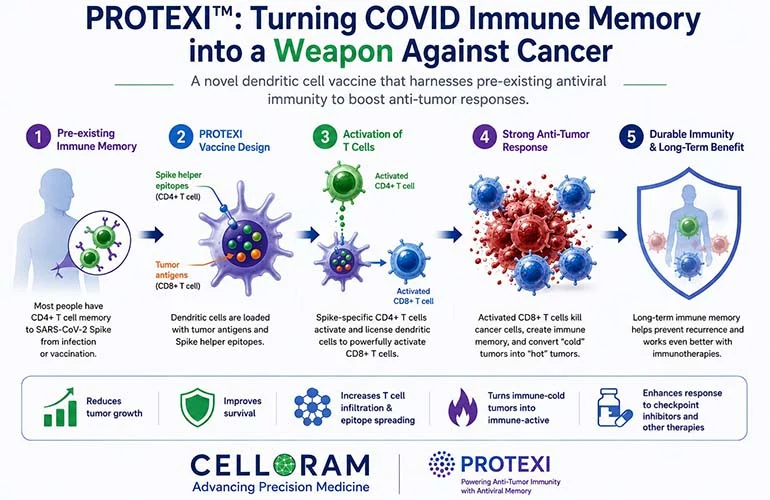
For decades, the promise of cancer immunotherapy has centered on the potential of dendritic cells—the "sentinels" of the immune system that present antigens to T cells to initiate a targeted response. While these vaccines are designed to prime CD8 T cells, which act as the primary executioners of cancer cells, clinical results have historically been underwhelming. Research indicates that only approximately 15% of patients treated with conventional dendritic cell vaccines achieve an objective clinical response.
The shortfall largely stems from the lack of "helper" signals. CD8 T cells require support from CD4 T cells to achieve full activation and effectively infiltrate tumor microenvironments. Without this crucial collaboration, CD8 cells often become exhausted or fail to reach their targets in sufficient numbers. Identifying patient-specific tumor antigens to stimulate these CD4 cells is a labor-intensive, computationally demanding process that has hampered the scalability of personalized cancer vaccines.
Bridging the Gap: The Protexi Mechanism
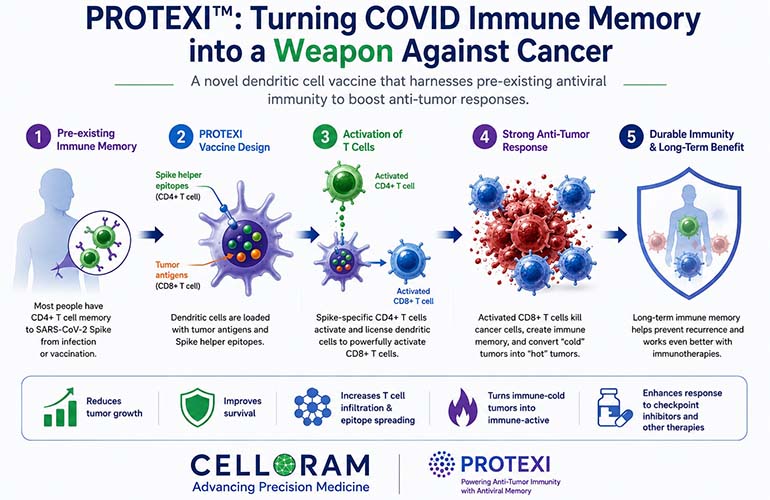
The Protexi platform offers a radical simplification: instead of searching for rare, patient-specific CD4 epitopes, the researchers are using a "universal" helper signal derived from the SARS-CoV-2 Spike protein. Because over 80% of the U.S. population and roughly 65% of the global population possess durable immune memory to COVID-19, this vaccine leverages a pre-existing, highly immunogenic target to "jump-start" the immune response.
When Protexi is administered, it delivers both the tumor antigen and the Spike-protein-derived epitope to dendritic cells. The vaccine activates Spike-specific CD4 T cells, which then act as a localized support system, drawing CD8 T cells to the tumor site and providing the chemical signals required for their full maturation. This dual-pronged activation is intended to transform the tumor microenvironment from an immunosuppressive "cold" state to an inflammatory "hot" state that the immune system can recognize and reject.
Experimental Success and Preclinical Data
The efficacy of this dual-antigen approach was recently detailed in a study published in Nature Communications. In mouse models of cancer, the results were striking. Mice treated with the Protexi vaccine demonstrated 100% survival through day 40, a significant improvement over the 40% survival rate observed in mice receiving a conventional dendritic cell vaccine that lacked the Spike-protein helper signal.
In a melanoma model, the data showed that five out of seven mice maintained tumor sizes under 200 cubic millimeters by day 26, suggesting that the vaccine was not only activating immune cells but successfully curbing tumor growth.
Addressing concerns regarding patients who may lack COVID-19 immunity, the research team developed a "priming" strategy. In laboratory settings, researchers administered a brief preparatory dose of Spike-protein-loaded dendritic cells. This successfully restored a strong CD4 T-cell response in mice, even in those without pre-existing immunity, providing a modular solution that ensures the platform remains effective regardless of an individual’s prior exposure to the virus.
Historical Context and Scientific Rationale
The conceptual framework for Protexi draws upon nearly three decades of immunological research. As early as the 1990s, studies established that CD4 T helper cells are essential for the optimal induction of CD8 responses, particularly against tumors that lack MHC-II expression. However, the inability to easily identify these CD4 targets for every patient created a bottleneck in clinical applications.
The integration of COVID-19 memory into this model was accelerated by observations during the pandemic, where clinical data hinted that patients who had been vaccinated for COVID-19 often experienced better outcomes while on checkpoint inhibitor therapies. This suggested that the systemic activation of the immune system—even through an unrelated pathogen—could sensitize the body to better combat cancer.
John Letterio, a co-author on the study, emphasized the durability of this immune memory. "Spike-specific CD4 T-cell memory is broadly durable across the population that’s been vaccinated or infected," Letterio noted. He pointed to research indicating that CD4 T cell responses to SARS-CoV-1, the virus responsible for the 2003 outbreak, remained detectable for as long as 17 years. By utilizing the SARS-CoV-2 Spike protein, Celloram is betting on the longevity of this memory to provide a long-term, potent therapeutic tool.
Implications for Future Clinical Trials
The implications of the Protexi study extend beyond the treatment of a single cancer type. Because the platform relies on a "plug-and-play" mechanism—where any highly immunogenic epitope could theoretically replace the Spike protein if needed—it provides a versatile framework for future cancer immunotherapies.
Celloram is currently transitioning from preclinical validation to the regulatory phase, with the objective of submitting an Investigational New Drug (IND) application to the FDA. The company plans to initiate first-in-human clinical trials targeting sarcoma, a rare and aggressive type of cancer, at the Angie Fowler Adolescent & Young Adult Cancer Institute.
Industry observers suggest that if the human trials mirror the preclinical outcomes, the platform could disrupt the current paradigm of personalized cancer vaccines. By bypassing the need for complex, time-consuming neoantigen discovery for the helper component of the vaccine, the cost and production time for dendritic cell therapies could be significantly reduced.
Analyzing the Path Ahead
While the preclinical results are promising, the leap from mouse models to human oncology is significant. The human immune system is vastly more complex, and tumor microenvironments in patients often possess sophisticated evasion mechanisms that are not fully replicated in rodent models.
Furthermore, the reliance on a "universal" epitope like the Spike protein raises questions about the potential for "immune distraction," where the immune system might prioritize the Spike antigen over the tumor antigen. However, the researchers argue that the specific delivery method—loading the dendritic cells with both components—ensures that the T cells are "trained" to focus on the tumor while utilizing the Spike memory solely as a helper signal.
The success of these upcoming clinical trials will likely depend on the precision of the dendritic cell delivery and the ability of the Spike-specific CD4 cells to persist in the presence of tumor-derived immunosuppression. If validated, the work by Celloram and Case Western Reserve University could mark a turning point, turning the legacy of the COVID-19 pandemic into a powerful weapon in the ongoing war against cancer. The project serves as a testament to the power of cross-disciplinary science, where infectious disease research and oncology intersect to solve one of medicine’s most stubborn problems. As the team prepares for human trials, the medical community will be watching closely to see if this "borrowed" immunity can indeed translate into life-saving outcomes for patients with solid tumors.