The field of condensed matter physics has reached a significant milestone as researchers at New York University (NYU) successfully engineered a new form of time crystal using acoustic levitation. This development, detailed in a study published in the prestigious journal Physical Review Letters, marks a departure from traditional quantum-scale time crystals by utilizing macro-scale materials visible to the human eye. By suspending tiny styrofoam beads on a cushion of sound waves, the research team—led by Professor David Grier—has demonstrated a system that exhibits self-sustaining oscillations while appearing to bypass one of the most fundamental tenets of classical physics: Newton’s Third Law of Motion.
Time crystals represent a unique phase of matter characterized by a structural repetition not in space, like a diamond or a salt crystal, but in time. While a standard crystal consists of atoms arranged in a repeating pattern across a physical volume, a time crystal consists of particles that move in a repeating cycle, returning to their original state at regular intervals. The NYU experiment utilizes acoustic forces to create these temporal patterns, offering a simplified and accessible model for studying complex dynamical systems that were previously confined to the realm of ultra-cold quantum laboratories.
The Evolution of Time Crystals: From Theory to Laboratory Reality
The concept of a time crystal was first proposed in 2012 by Nobel laureate Frank Wilczek. He hypothesized the existence of a state of matter where the atoms would move in a persistent, repeating loop without consuming energy, effectively breaking "time-translation symmetry." Initially, the idea was met with skepticism, as critics argued it bordered on a perpetual motion machine, which would violate the laws of thermodynamics. However, the scientific community soon refined the definition, distinguishing between isolated systems and "driven" systems where an external energy source maintains the rhythm without dictating its frequency.
In 2016 and 2017, the first experimental validations occurred. Teams at the University of Maryland and Harvard University used trapped ions and nitrogen-vacancy centers in diamonds, respectively, to create discrete time crystals. These systems required extreme conditions, such as near-absolute zero temperatures and high-vacuum environments. The NYU breakthrough is notable because it moves these exotic states of matter into a classical, room-temperature setting. By using a device roughly one foot tall, the researchers have democratized the study of temporal symmetry breaking, moving it from the abstract quantum world into a tangible, mechanical format.
Acoustic Levitation: The Engineering Behind the Breakthrough
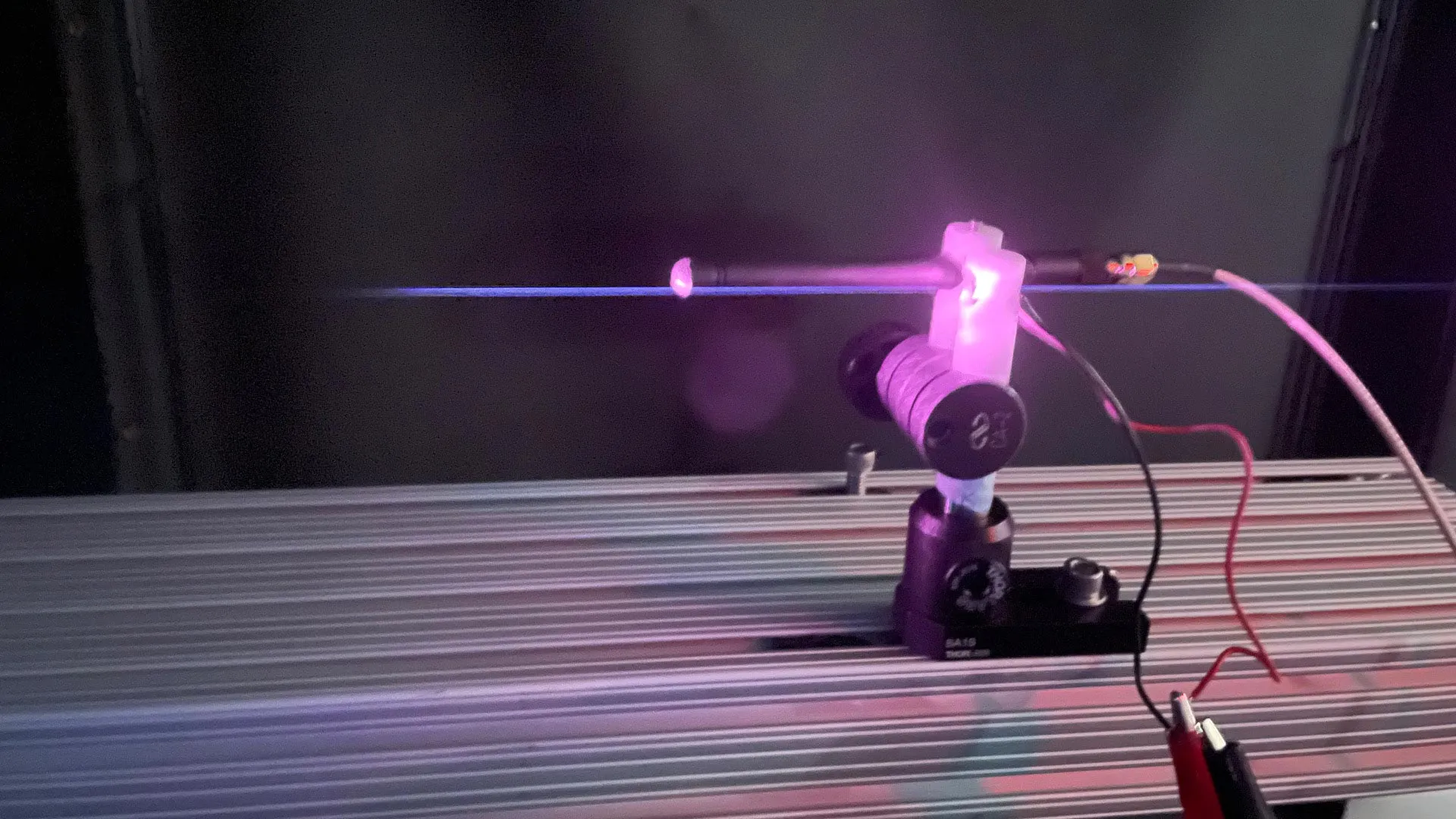
The NYU system relies on the principle of acoustic levitation, a technique that uses sound pressure to counteract the force of gravity. The experimental apparatus, known as an acoustic levitator, generates high-frequency sound waves that reflect off a surface to create "standing waves." Within these standing waves are nodes—points where the sound pressure is zero—and antinodes, where the pressure is at its peak.
In this specific experiment, the researchers utilized small styrofoam beads, commonly used in packaging, as the medium. When placed within the sound field, these beads are trapped at the nodes of the standing waves. "Sound waves exert forces on particles—just like waves on the surface of a pond can exert forces on a floating leaf," explained Mia Morrell, an NYU graduate student and co-author of the study. By immersing the beads in a standing wave field, the team was able to keep the particles suspended and stationary in mid-air.
The transition from a stationary state to a "time crystal" state occurs through the interaction of the beads. As the beads sit in the sound field, they scatter the sound waves toward one another. This scattering creates a secondary set of forces that act between the particles. Because the beads are of different sizes, the forces they exert on each other are not equal, leading to a phenomenon known as nonreciprocity.
Challenging Newtonian Mechanics: The Physics of Nonreciprocal Forces
The most striking aspect of the NYU experiment is the observation of nonreciprocal interactions. In classical mechanics, Newton’s Third Law states that for every action, there is an equal and opposite reaction. If Object A exerts a force on Object B, Object B must exert an equal force back on Object A in the opposite direction. This balance is what maintains equilibrium in most mechanical systems.
However, in the NYU acoustic levitator, this symmetry is broken. Larger styrofoam beads scatter a greater volume of sound waves than smaller beads. Consequently, a large bead exerts a significant force on a smaller neighbor, but the smaller bead lacks the surface area to exert an equivalent force back on the larger one. This creates an "unbalanced" force pair.
"Think of two ferries of different sizes approaching a dock," Morrell noted to illustrate the concept. "Each one makes water waves that push the other one around—but to different degrees, depending on their size."
In the context of the experiment, this nonreciprocity prevents the beads from reaching a state of rest. Instead of settling into a static position, the beads begin to oscillate spontaneously. They move back and forth in a steady, repeating rhythm that is independent of the frequency of the sound waves driving the system. This self-organized, periodic motion is the defining characteristic of a time crystal. Because the interactions are carried by the surrounding sound field rather than direct contact, the system can bypass the constraints of Newton’s Third Law, categorizing it as "active matter."
Supporting Data and Experimental Observations
The research team monitored the movement of the beads using high-speed cameras and precision tracking software. The data revealed that the oscillations were remarkably stable over long periods, a hallmark of a robust phase of matter. Unlike a simple pendulum, which eventually loses energy to friction and comes to a halt, the time crystal beads maintained their "tick" as long as the acoustic field was active.
Key metrics from the study include:
- System Scale: The apparatus stands approximately 30 centimeters (12 inches) tall.
- Particle Dynamics: The styrofoam beads ranged in diameter, with the disparity in size directly correlating to the strength of the nonreciprocal force.
- Frequency Stability: The beads exhibited a collective oscillation frequency that remained consistent even when minor perturbations were introduced to the sound field, suggesting a "self-correcting" mechanism inherent to the time crystal phase.
- Operational Environment: The experiment was conducted at standard room temperature and atmospheric pressure, proving that time crystal properties are not exclusive to cryogenic or vacuum environments.
Bridging the Gap Between Physics and Biology
Beyond the implications for pure physics, the NYU study offers a new lens through which to view biological systems. The researchers suggest that the nonreciprocal interactions observed in the acoustic levitator may mirror the biochemical processes that govern internal biological clocks, such as circadian rhythms.
Circadian rhythms are the 24-hour cycles that tell our bodies when to sleep, eat, and perform vital metabolic functions. These rhythms are maintained by complex feedback loops within cells, where various proteins and enzymes interact in nonreciprocal ways. For instance, the production of one protein may trigger the suppression of another, but the relationship is often asymmetrical.
Professor David Grier, director of NYU’s Center for Soft Matter Research, emphasized the importance of simplicity in understanding these complex phenomena. "Time crystals are fascinating not only because of the possibilities, but also because they seem so exotic and complicated," Grier stated. "Our system is remarkable because it’s incredibly simple."
By studying how styrofoam beads self-organize into a temporal rhythm, biologists may gain insights into how metabolic processes break down food or how the heart maintains a steady beat despite fluctuating external conditions. The experiment provides a mechanical analog for "active matter" in biology, where individual components use energy to move and interact in ways that defy traditional equilibrium physics.
Broader Impact and Future Technological Implications
The successful creation of a macro-scale, sound-driven time crystal has significant implications for future technology, particularly in the fields of quantum computing and data storage. One of the primary hurdles in quantum computing is "decoherence"—the tendency of quantum bits (qubits) to lose their state due to environmental interference. Time crystals are inherently resistant to such interference because their repeating patterns are "locked" by the interactions of their constituent parts.
While the NYU experiment is classical, the principles of nonreciprocal interactions can be scaled down to the micro and nano levels. This could lead to:
- Robust Quantum Memories: Utilizing the stable periodicity of time crystals to store information in a way that is shielded from external noise.
- Advanced Sensors: Creating highly sensitive detectors that rely on the precise "ticking" of acoustic or photonic time crystals to measure minute changes in pressure, temperature, or gravity.
- Signal Processing: Developing new types of filters and oscillators for telecommunications that operate with higher efficiency and lower energy consumption.
The research was supported by grants from the National Science Foundation (NSF), specifically awards DMR-21043837 and DMR-2428983. These grants reflect a growing federal interest in "soft matter" and the foundational physics of out-of-equilibrium systems.
Conclusion: A New Frontier in Condensed Matter
The work of Professor Grier, Mia Morrell, and undergraduate researcher Leela Elliott represents a shift in how physicists approach the study of matter. By demonstrating that time crystals can be built from simple materials like styrofoam and sound waves, the NYU team has stripped away the "exotic" veil surrounding the concept.
As the scientific community continues to explore the boundaries of Newton’s laws and the possibilities of nonreciprocal forces, this hand-held device may serve as a blueprint for a new generation of technologies. Whether it is improving the stability of quantum computers or unraveling the mysteries of the human biological clock, the "ticking" of these sound-levitated beads marks the beginning of a new chapter in the study of time and motion. The ability to observe a fundamental breakthrough in physics with the naked eye is a rare occurrence, making this experiment not just a scientific success, but a powerful educational tool for the next generation of physicists.