An international scientific collaboration, prominently featuring researchers from the Southwest Research Institute (SwRI), has unveiled compelling evidence suggesting that complex organic molecules (COMs), widely regarded as fundamental chemical precursors to life as we know it, were incorporated into Jupiter’s four largest moons during their formation. This groundbreaking research, detailed in a series of companion papers published in The Planetary Science Journal and Monthly Notices of the Royal Astronomical Society, offers a significant advancement in our understanding of how the essential ingredients for life could have been delivered to the vast Jovian system billions of years ago.
Unraveling the Origins of Organic Molecules in the Early Solar System
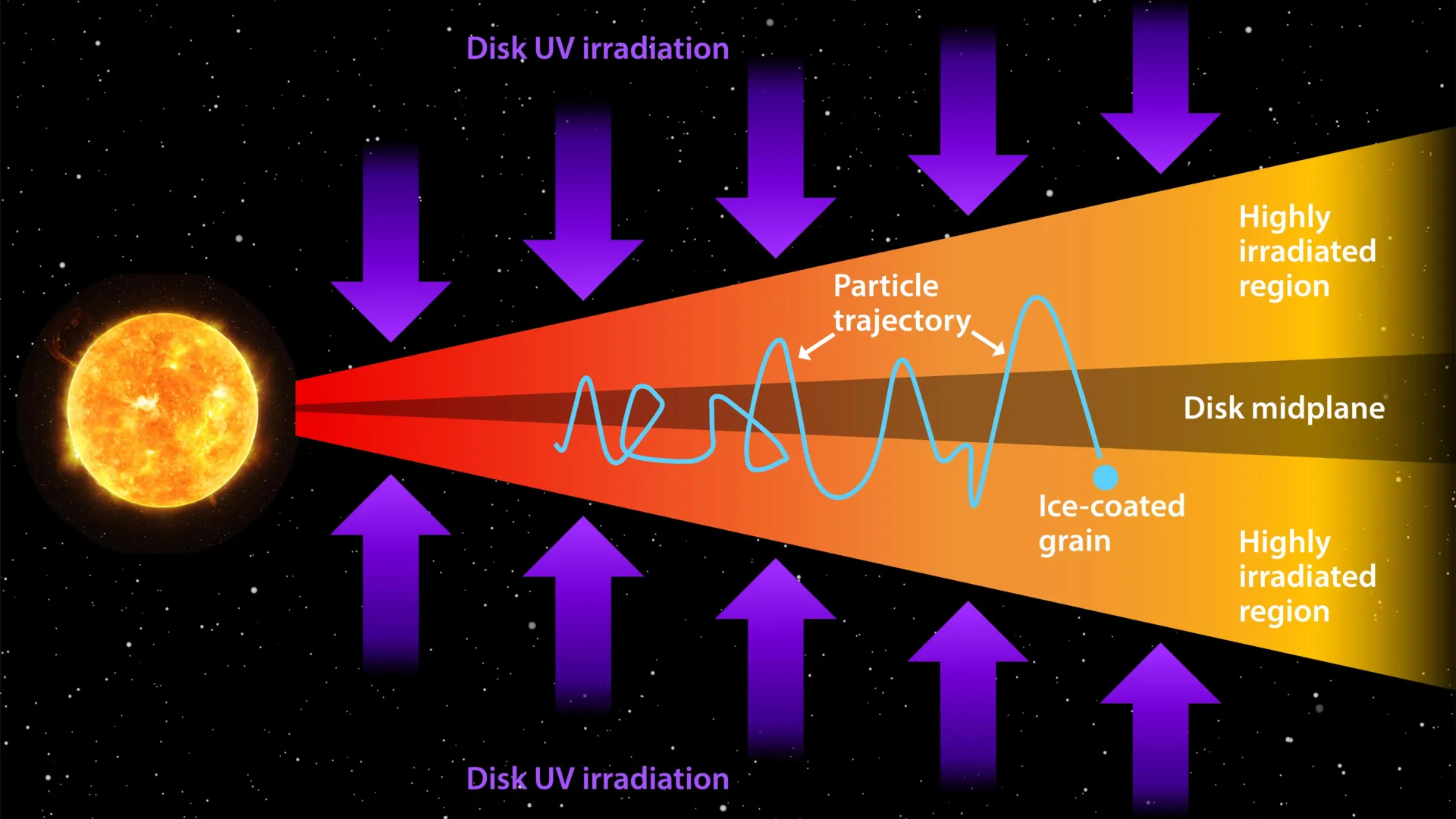
Complex organic molecules are carbon-based compounds that also contain elements crucial for biological systems, such as oxygen and nitrogen. Laboratory experiments have consistently demonstrated that these molecules can spontaneously form under conditions prevalent in protoplanetary disks – the swirling clouds of gas and dust that surround young stars and are the nurseries for planetary formation. Specifically, when icy dust grains, rich in methanol or blends of carbon dioxide and ammonia, are exposed to ultraviolet radiation or gentle heating, the intricate chemical reactions that yield COMs can occur. These conditions are not only found in the general protoplanetary disk but also within the specialized environments surrounding nascent gas giants like Jupiter.
The research team employed sophisticated modeling techniques to reconstruct the journey of these vital molecules. By integrating models of disk evolution with simulations that meticulously track the movement of icy particles, scientists were able to accurately quantify the specific radiation levels and temperatures that these grains would have encountered. This dual approach provided an unprecedented level of detail in assessing the conditions conducive to COM formation.
"By combining disk evolution with particle transport models, we could precisely quantify the radiation and thermal conditions the icy grains experienced," stated Dr. Olivier Mousis of SwRI’s Solar System Science and Exploration Division, who served as the lead author on one of the pivotal studies. "Then we directly compared our simulations with other laboratory experiments that produce COMs under realistic astrophysical conditions. The results showed that COM formation is possible in both the protosolar nebula environment and Jupiter’s circumplanetary disk."
The collaborative effort brought together expertise from SwRI, Aix-Marseille University in France, and the Institute for Advanced Studies in Ireland. Their work involved the creation of detailed simulations for two critical environments: the protosolar nebula, the immense cloud from which the Sun and all the planets of our solar system eventually coalesced, and Jupiter’s circumplanetary disk. This latter disk was a localized structure of gas and dust that encircled the young, massive Jupiter and served as the birthplace for its extensive collection of moons. By incorporating a component that tracked the transport of dust grains, the researchers were able to meticulously trace the migratory paths of icy particles. This enabled them to reconstruct a comprehensive physical and chemical history of the material that ultimately accreted to form Europa, Ganymede, Callisto, and Io – Jupiter’s four largest, or Galilean, moons.
Delivering Life’s Essential Components to the Jovian Moons
The simulations produced by the team indicate a significant finding: a substantial proportion of the icy grains present in the early solar system likely underwent chemical transformation, forming COMs. These newly synthesized organic molecules were then efficiently transported into the region where Jupiter’s moons were in the process of assembly. In certain simulated scenarios, as much as half of the modeled particles effectively carried these freshly created organic molecules from the broader protosolar nebula directly into Jupiter’s circumplanetary disk. Crucially, these molecules were then incorporated into the growing moons with minimal further chemical alteration, preserving their complex structures.
Adding another layer of complexity and potential for organic enrichment, the research also suggests that some COMs may have originated much closer to Jupiter itself. The simulations indicate that specific regions within Jupiter’s circumplanetary disk reached temperatures sufficiently high to drive the chemical reactions necessary for the formation of these complex molecules. This implies that the Galilean moons may have received organic material from a dual source: the vast, primordial material of the wider solar nebula, and also from localized chemical processes occurring within Jupiter’s own immediate orbital environment billions of years ago.
Implications for Ocean Worlds and the Search for Extraterrestrial Life
The implications of these findings for the habitability of Jupiter’s moons are profound. Europa, Ganymede, and Callisto are all believed to harbor vast subsurface oceans of liquid water, concealed beneath their formidable icy crusts. The presence of liquid water, coupled with inferred internal energy sources – potentially generated by tidal heating from Jupiter’s immense gravitational pull – makes these moons prime targets in the ongoing search for extraterrestrial life.
If these moons incorporated a significant inventory of COMs into their fundamental building materials from their very inception, then they may not only possess liquid water but also the essential molecular ingredients required for prebiotic chemistry. This prebiotic chemistry is the complex series of chemical reactions that are believed to have preceded the emergence of life, ultimately leading to the formation of fundamental biomolecules such as amino acids and nucleotides.
"Our findings suggest that Jupiter’s moons did not form as chemically pristine worlds," Dr. Mousis elaborated. "Instead, they may have accreted, or accumulated, a significant inventory of COMs at birth, providing a chemical foundation that could later interact with the liquid water in their interiors." This suggests that the potential for life on these distant worlds might have been seeded from the very earliest stages of their planetary evolution.
The scientific community is keenly awaiting further data from ongoing and upcoming missions that will provide unprecedented insights into these enigmatic moons. NASA’s Europa Clipper mission and the European Space Agency’s Jupiter Icy Moons Explorer (JUICE) spacecraft are currently en route to the Jovian system. Their primary objectives include a comprehensive investigation into the structure, composition, and, most importantly, the habitability of these potentially life-supporting moons.
The success of these missions will be greatly enhanced by the foundational work presented in these new studies. "Establishing credible pathways for COMs formation and delivery provides scientists with a critical framework for interpreting upcoming measurements of Jupiter’s surface and subsurface chemistry," Dr. Mousis concluded. "By linking laboratory chemistry, disk physics and particle transport models, our work may highlight how habitable conditions are rooted in the earliest stages of planetary formation." This integrated approach, combining theoretical modeling with empirical data from laboratory experiments and future space missions, promises to unlock deeper secrets about the origins of life not only within our solar system but potentially throughout the cosmos.
A Timeline of Discovery and Future Exploration
The understanding of complex organic molecules and their potential role in the origin of life has evolved significantly over the past century. Early astronomical observations hinted at the presence of carbon-based compounds in interstellar space. The development of laboratory astrophysics in the mid-20th century allowed scientists to recreate conditions found in space and synthesize COMs, confirming their potential ubiquity.
The exploration of Jupiter’s moons, beginning with the Voyager missions in the late 1970s and early 1980s, provided the first close-up views of these worlds, revealing icy surfaces and hinting at subsurface activity. The Galileo mission, which orbited Jupiter from 1995 to 2003, provided compelling evidence for subsurface oceans on Europa, Ganymede, and Callisto, igniting renewed interest in their habitability.
The current research builds upon this legacy of exploration and laboratory work. The publication of these companion papers in 2024 marks a significant milestone in bridging the gap between our understanding of early solar system chemistry and the potential for life on the Jovian moons. The ongoing missions, Europa Clipper and JUICE, represent the next crucial step, aiming to directly probe the environments of these moons and test the hypotheses presented in these new studies. Their anticipated arrival in the Jovian system in the early 2030s will usher in a new era of discovery regarding the potential for life beyond Earth.
Broader Impact: Connecting Planetary Formation to Habitability
The implications of this research extend far beyond the Jovian system. The mechanisms identified for COM formation and delivery are likely applicable to the formation of other planetary systems. Understanding how the building blocks of life are distributed during the earliest stages of planetary system assembly is crucial for assessing the prevalence of habitable worlds throughout the galaxy.
This work underscores a fundamental principle in astrobiology: habitability is not solely dependent on the presence of liquid water, but also on the availability of essential chemical ingredients. By demonstrating that COMs could have been readily incorporated into the nascent moons of Jupiter, the study provides a compelling argument for their potential to host prebiotic chemistry. This strengthens the scientific rationale for focusing exploration efforts on ocean worlds, both within our solar system and on exoplanets. The ability to link theoretical models of planetary formation with empirical data from laboratory experiments and observational missions represents a powerful paradigm for future scientific inquiry. It offers a roadmap for identifying potentially life-bearing worlds and understanding the universal processes that govern the emergence of life.