The global imperative to mitigate climate change has centered on the reduction of atmospheric carbon dioxide (CO2), a primary driver of the greenhouse effect. While various strategies exist to transition toward renewable energy, the immediate challenge remains the mitigation of emissions from existing industrial infrastructure. Carbon capture and storage (CCS) technologies have long been proposed as a bridge to a net-zero future, yet their implementation has been hampered by significant economic and energetic hurdles. In a transformative development, a research team at Chiba University in Japan has announced the creation of "viciazites," a new class of nitrogen-doped carbon materials that allow for the capture and release of CO2 at significantly lower temperatures than current industrial standards. This breakthrough, led by Associate Professor Yasuhiro Yamada and Associate Professor Tomonori Ohba, promises to revolutionize the efficiency of carbon sequestration by leveraging industrial waste heat, potentially slashing the operational costs that have previously stalled large-scale adoption.
The Energy Penalty of Conventional Carbon Capture
To understand the significance of the Chiba University discovery, one must examine the limitations of the current gold standard in industrial carbon capture: aqueous amine scrubbing. This process, which has been utilized in various forms since the 1930s, involves passing flue gas through a liquid solution containing amines—organic compounds derived from ammonia. The amines chemically bond with the CO2, stripping it from the gas stream. However, the "energy penalty" occurs during the regeneration phase. To release the captured CO2 so the amine solution can be reused, the liquid must be heated to temperatures often exceeding 100 to 120 degrees Celsius.
This heating process is incredibly energy-intensive, primarily because the water in the solution has a high latent heat of vaporization. In a typical power plant setting, the energy required for carbon capture can consume up to 30% of the facility’s total power output. This high overhead makes the technology economically unviable for many operators and prevents its widespread deployment in developing economies where energy costs are a critical factor. Consequently, the search for solid-state adsorbents—which do not require the heating of large volumes of water—has become a focal point of materials science research.
The Rise of Solid Carbon Adsorbents and the Nitrogen Challenge
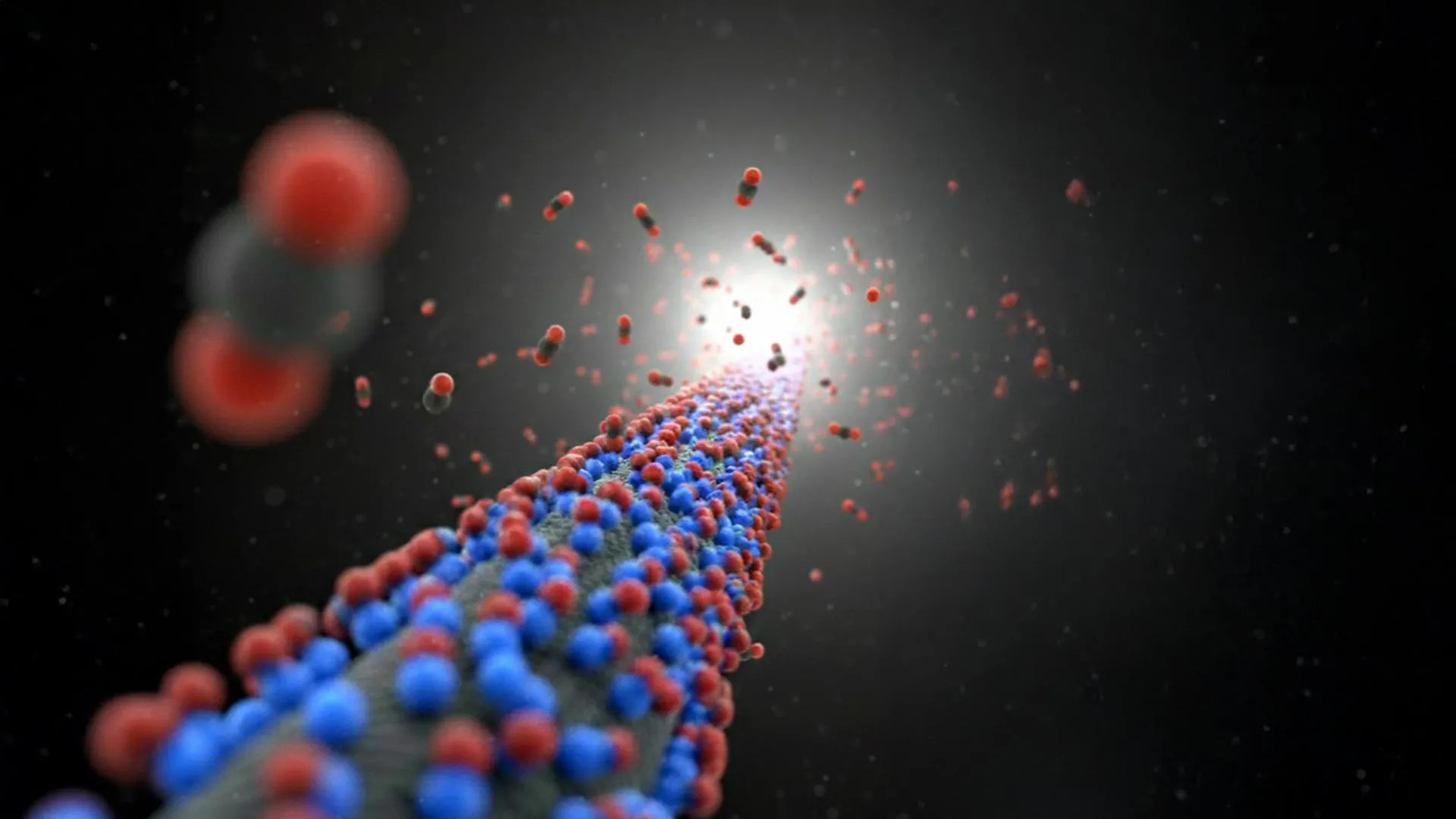
Solid carbon materials, such as activated carbon and carbon nanotubes, offer a promising alternative to liquid amines. These materials possess high surface areas and are relatively inexpensive to produce. By incorporating nitrogen atoms into the carbon lattice—a process known as "doping"—researchers can create localized areas of positive and negative charge that attract CO2 molecules. However, a persistent problem in the manufacturing of these materials has been the lack of precision.
In traditional synthesis methods, nitrogen atoms are distributed randomly across the carbon surface. This "stochastic" doping creates a heterogeneous environment where some sites bind CO2 too weakly to be effective, while others bind it so strongly that they require excessive heat to release it. Without the ability to control the specific arrangement of nitrogen groups, researchers have struggled to optimize the balance between capture efficiency and energy consumption during regeneration.
Engineering Viciazites: Precision at the Molecular Level
The Chiba University team addressed this lack of control by developing a synthesis pathway for viciazites, named for their unique structural configurations. Unlike traditional doped carbons, viciazites feature nitrogen functional groups positioned in specific, adjacent pairs. This controlled arrangement is achieved through a meticulous multi-step chemical process.
The research, published in the prestigious journal Carbon, details how the team produced three distinct variations of these materials. To create adjacent primary amine groups (-NH2), the researchers began with coronene, a polycyclic aromatic hydrocarbon consisting of seven peripheral benzene rings. This precursor was subjected to controlled heating, followed by treatment with bromine and then ammonia gas. This specific sequence allowed the team to achieve a 76% selectivity rate, meaning the vast majority of the nitrogen atoms were placed in the intended adjacent positions rather than being scattered across the material.
Furthermore, the team successfully synthesized two other variants: one featuring adjacent pyrrolic nitrogen (five-membered rings) with 82% selectivity, and another with adjacent pyridinic nitrogen (six-membered rings) with 60% selectivity. By using nuclear magnetic resonance (NMR) spectroscopy and X-ray photoelectron spectroscopy (XPS), the researchers were able to "map" the atomic structure of the materials, confirming that the nitrogen atoms were indeed side-by-side.
Performance Analysis: The 60-Degree Breakthrough
The true test of the viciazites lay in their CO2 adsorption and desorption profiles. The materials were applied to activated carbon fibers to create a high-surface-area medium for testing. The results revealed a stark contrast between the different nitrogen configurations. While the pyridinic nitrogen variant showed minimal improvement over untreated carbon, the materials containing adjacent primary amines (-NH2) and pyrrolic nitrogen demonstrated superior capture capabilities.
Most significantly, the adjacent -NH2 configuration exhibited a unique thermodynamic property: it could release the captured CO2 at temperatures below 60 degrees Celsius. This is a critical threshold in industrial engineering. "Performance evaluation revealed that in carbon materials where NH2 groups are introduced adjacently, most of the adsorbed CO2 desorbs at temperatures below 60 °C," explained Dr. Yamada. "By combining this property with industrial waste heat, it may be possible to achieve efficient CO2 capture processes with substantially reduced operating costs."
Industrial waste heat—low-grade thermal energy generated as a byproduct of manufacturing, refining, and power generation—is often discarded because it is not hot enough to drive steam turbines or traditional amine regeneration. However, if a carbon capture system can operate at 60 degrees Celsius, it can be powered entirely by this "free" energy, effectively eliminating the primary operational cost of the CCS process.
Historical Context and the Evolution of Carbon Capture
The development of viciazites represents the latest chapter in a century-long effort to manage industrial gases. The timeline of carbon capture technology reflects the shifting priorities of the global economy:
- 1930s: The first patents for amine scrubbing are filed, primarily for the purpose of removing CO2 and hydrogen sulfide from natural gas to prevent pipeline corrosion.
- 1970s: Following the oil crisis, enhanced oil recovery (EOR) gains traction. CO2 is injected into oil fields to increase pressure and extract more crude, leading to the first large-scale carbon transport systems.
- 1990s: The focus shifts toward environmental protection. The Sleipner project in the North Sea becomes the first major offshore CCS operation, capturing CO2 from natural gas production and storing it in a saline aquifer.
- 2010s: Research intensifies into Metal-Organic Frameworks (MOFs) and solid-state adsorbents as the "energy penalty" of amines is identified as the primary barrier to the Paris Agreement goals.
- 2024: The Chiba University team introduces viciazites, providing a pathway for molecular-level control over carbon-nitrogen interactions.
This evolution highlights a move from blunt-force chemical engineering toward precision molecular design, where the focus is no longer just on if a material can capture CO2, but how efficiently it can let it go.
Supporting Data and Comparative Efficiency
The data provided by the Chiba University study offers a compelling case for the transition to designer carbon materials. In comparative tests, the viciazite samples with adjacent primary amines showed a significantly higher "working capacity"—the amount of CO2 captured and successfully released per cycle—than standard activated carbons.
While the pyrrolic nitrogen variant required slightly higher temperatures for desorption, it displayed greater chemical stability. This suggests a "toolbox" approach for industrial designers: the -NH2 viciazites could be used in settings with abundant low-grade waste heat, while the pyrrolic versions might be better suited for more aggressive industrial environments where material longevity is the priority.
Computational modeling performed by the team further supported these findings, showing that the adjacent placement of nitrogen groups creates a synergistic electronic environment. The proximity of the two nitrogen atoms alters the electron density of the carbon surface, creating a "sweet spot" for CO2 molecules to dock without forming a bond so strong that it becomes permanent.
Broader Implications for the Global Carbon Market
The economic implications of this research are substantial. The global carbon capture and sequestration market is projected to reach several billion dollars by 2030, but these projections rely on the assumption that technology will become more affordable. Current CCS projects often require government subsidies or carbon credits to remain solvent. By reducing the regeneration temperature to 60 degrees Celsius, the Chiba University team has effectively lowered the "levelized cost of capture."
Beyond the environmental benefits, viciazites hold potential for the burgeoning field of carbon utilization. If CO2 can be captured cheaply and efficiently, it can be repurposed as a feedstock for synthetic fuels, plastics, and building materials. This transforms CO2 from a waste product into a valuable industrial commodity, fostering a circular carbon economy.
Furthermore, the researchers noted that the customizable nature of viciazites extends beyond carbon capture. The ability to place functional groups with such precision makes these materials ideal candidates for removing heavy metal ions from wastewater or serving as high-performance catalysts in chemical synthesis.
Conclusion and Future Outlook
The work of Dr. Yamada, Dr. Ohba, and Mr. Kondo represents a pivotal shift in materials science. By moving away from random doping and toward "designer" carbon structures, they have addressed one of the most persistent bottlenecks in climate technology.
"Our motivation is to contribute to the future society and to utilize our recently developed carbon materials with controlled structures," Dr. Yamada concluded. "This work provides validated pathways to synthesize designer nitrogen-doped carbon materials, offering the molecular-level control essential for developing next-generation, cost-effective, and advanced CO2 capture technologies."
As the world seeks to meet the stringent targets of the IPCC and various national net-zero pledges, the transition from laboratory innovation to industrial application will be the next critical step. With the support of the Japan Society for the Promotion of Science and the Ministry of Education, Culture, Sports, Science and Technology (MEXT), the Chiba University team is now looking toward scaling their synthesis methods. If viciazites can be produced at an industrial scale, the goal of cost-effective, waste-heat-driven carbon capture may finally move from a scientific ambition to a global reality.