The landscape of Artificial Intelligence (AI) is rapidly evolving, moving beyond rudimentary prompt-and-response interactions to sophisticated, production-grade Large Language Model (LLM) applications. While early explorations of LLMs often focused solely on crafting the perfect prompt, the reality of building reliable, scalable, and intelligent AI systems today necessitates a deeper understanding of underlying engineering principles. Modern LLM applications are not monolithic black boxes; they are intricate systems designed to manage context, interact with external tools, retrieve vast amounts of data, and execute multi-step workflows with precision. This shift from mere "prompt engineering" to comprehensive "LLM system engineering" represents a significant maturation in the field, demanding expertise in a suite of advanced concepts.
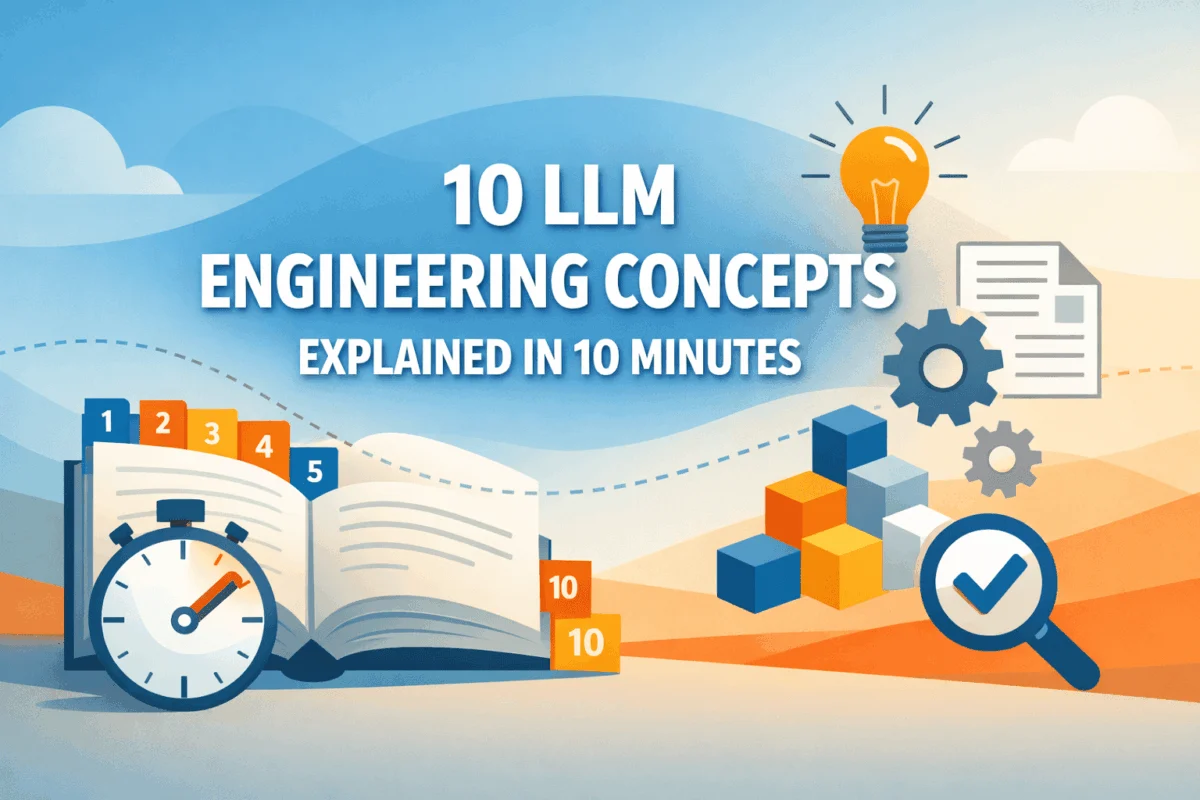
The contemporary approach to LLM development emphasizes architectural design over isolated prompts. Industry experts widely acknowledge that the efficacy and robustness of an LLM application hinge less on clever phrasing and more on the intelligent orchestration of its various components. Failures in AI systems are frequently attributed not to the core LLM’s inability to comprehend but to shortcomings in how information is managed, accessed, and processed around the model. Understanding these building blocks is crucial for anyone aiming to develop or deploy reliable AI solutions in real-world scenarios. The following 10 engineering concepts illustrate the complexity and ingenuity involved in constructing today’s advanced LLM systems.
The Foundation of Intelligence: Context Engineering
At its core, an LLM’s performance is inextricably linked to the information it perceives. Context engineering goes far beyond merely writing a good prompt; it is the meticulous process of curating the precise information presented to the model at any given moment. This encompasses a broad spectrum of inputs, including system-level instructions that define the model’s persona or task, the entire conversation history, dynamically retrieved documents from external knowledge bases, definitions of available tools, an agent’s working memory, intermediate reasoning steps, and even execution traces for debugging.
The strategic selection, ordering, and formatting of this context are paramount. For instance, placing critical instructions at the beginning of the context window, followed by relevant retrieved documents, and then the user’s query, can dramatically influence the model’s output quality. Many researchers and practitioners now argue that context engineering has superseded prompt engineering as the primary lever for influencing LLM behavior. A significant number of LLM failures, such as generating irrelevant or incorrect information, stem not from the model itself but from a context that is incomplete, redundant, poorly structured, or saturated with noise. Effective context engineering ensures the model operates with the most relevant and clean data, thereby enhancing accuracy and reducing instances of "hallucination." Its evolution underscores a move towards more controlled and predictable LLM interactions, moving away from ad-hoc prompting towards systematic data presentation.
Expanding Capabilities: Implementing Tool Calling
The inherent limitation of an LLM is that its knowledge is confined to its training data. To bridge this gap and enable real-world utility, tool calling emerges as a transformative concept. This mechanism allows an LLM to invoke external functions or APIs instead of solely relying on its internal knowledge to generate a response. By integrating tools, an LLM gains the ability to perform actions beyond text generation, such as searching the internet for up-to-date information, querying a proprietary database, executing code, sending an email, or interacting with a customer relationship management (CRM) system.
The advent of tool calling has fundamentally changed how developers conceive of LLM applications. It transforms a passive text generator into an active "agent" capable of thinking, reasoning, and acting. For example, a travel planning agent might use a flight booking API, a hotel reservation tool, and a weather forecasting service. This capability is now a cornerstone of almost all production-grade LLM applications, enabling them to engage with dynamic, real-world data and services. The seamless integration of tool calling is critical for building AI agents that can automate complex tasks, provide real-time information, and interact meaningfully with digital environments, marking a significant step towards truly intelligent automation.
Standardizing Interoperability: Adopting the Model Context Protocol (MCP)
As the ecosystem of AI models and tools proliferates, the challenge of seamless integration becomes increasingly complex. The Model Context Protocol (MCP) addresses this by establishing a universal standard for sharing and reusing tools, data, and workflows across disparate AI systems. Before MCP, integrating ‘N’ different models with ‘M’ different tools often required ‘N x M’ custom integrations, each prone to unique errors and maintenance overheads. This bespoke integration approach was unsustainable for scaling enterprise AI.
MCP acts as a universal connector, providing a consistent framework for exposing capabilities and data. It standardizes how AI clients can discover, understand, and utilize these resources, much like how HTTP standardized web communication. This protocol is rapidly gaining traction as an industry-wide standard because it significantly reduces development time, enhances reliability, and fosters a more modular and interoperable AI landscape. By abstracting away the specifics of individual tool interfaces, MCP allows developers to build more robust and scalable AI systems, facilitating easier collaboration between different models and services and accelerating the adoption of complex AI workflows across organizations.
Orchestrating Collaboration: Enabling Agent-to-Agent Communication (A2A)
While MCP focuses on the standardized exposure of tools and data, Agent-to-Agent (A2A) communication addresses the equally critical challenge of how multiple AI agents coordinate and collaborate to achieve complex objectives. This concept signals a move beyond single-agent applications towards distributed AI systems capable of handling multifaceted tasks that exceed the scope of any one agent. Major technology companies, including Google, have championed A2A as a protocol for agents to securely communicate, share information, and coordinate actions across enterprise systems.
The core premise of A2A is that many complex workflows no longer fit within the capabilities of a single assistant. Instead, a research agent might gather information, a planning agent might formulate a strategy, and an execution agent might carry out the necessary steps, all communicating and collaborating in a structured manner. A2A provides a standardized framework for these interactions, preventing teams from having to invent ad-hoc messaging systems for every multi-agent scenario. This structured communication is vital for building robust AI teams capable of tackling sophisticated problems, improving efficiency, and ensuring secure data exchange between specialized AI entities. Its emergence reflects the growing ambition to build AI systems that mirror human teams in their collaborative problem-solving abilities.
Optimizing Performance and Cost: Leveraging Semantic Caching
In high-traffic LLM applications, efficiency is paramount. Repeatedly sending identical or semantically similar prompts to an LLM incurs unnecessary costs and latency. Semantic caching offers a sophisticated solution to this problem, building upon the simpler concept of prompt caching. Prompt caching involves reusing stable parts of a prompt (like system instructions or tool definitions) to reduce token count and processing. Semantic caching takes this a step further by storing previous LLM responses and retrieving them for new queries that are semantically similar, even if the exact wording differs.
For example, if a user asks "What is the capital of France?" and then later "Tell me about Paris, the French capital," a semantic cache could identify the underlying similarity and return the previously generated answer without invoking the LLM again. This significantly reduces API calls, thereby lowering operational costs and improving response times. The primary challenge lies in striking the right balance for similarity thresholds: too loose, and the system might return an irrelevant or incorrect answer; too strict, and the efficiency gains are lost. Implementing robust semantic caching often involves vector databases to store and retrieve embeddings of queries and responses, allowing for efficient similarity searches. This technique is indispensable for achieving economic viability and responsiveness in large-scale LLM deployments.
Refining Relevance: Utilizing Contextual Compression
Even the most effective retrieval systems can sometimes be overzealous, returning entire documents or large chunks of text when only a small, specific segment is relevant to the user’s query. This is where contextual compression becomes critical. While a retriever might successfully identify a 20-page report as relevant, the actual answer to a user’s question might reside in just two paragraphs within that report. Without compression, the LLM is forced to process the entire document, which introduces noise, increases token count (and thus cost), and can dilute the model’s focus, potentially leading to less accurate responses.
Contextual compression techniques are designed to extract only the most pertinent information from retrieved documents before passing it to the LLM. This process might involve identifying key sentences, summarizing relevant sections, or filtering out irrelevant details. By presenting the model with a concise, high-signal context, compression significantly improves the LLM’s ability to generate accurate and focused answers. It enhances efficiency by reducing the computational load and minimizes costs associated with processing large volumes of text. This is a vital component in Retrieval-Augmented Generation (RAG) systems, ensuring that the LLM receives not just relevant documents but relevant information within those documents. Recent research, such as comprehensive surveys on contextual compression in RAG, underscores its growing importance in mitigating the challenges of context window limitations and information overload.
Enhancing Precision: Applying Reranking
In the multi-stage process of Retrieval-Augmented Generation (RAG), initial retrieval systems can often provide a broad set of potentially relevant documents. However, the order in which these documents are presented to the LLM is crucial. Reranking serves as a vital secondary check, operating after the initial retrieval phase. Once a retriever pulls a candidate group of documents or text chunks, a reranker evaluates these results more deeply and reorders them, placing the most relevant pieces at the very top of the context window.
This concept is particularly critical because a common failure mode in RAG systems is not a lack of relevant information, but rather the "lost in the middle" phenomenon, where the most crucial evidence is buried at a lower rank while less pertinent chunks occupy the prime positions within the LLM’s context window. Reranking addresses this ordering problem directly, ensuring that the LLM receives the strongest evidence first. This significantly improves the quality and accuracy of the generated answer by giving the model optimal access to the best available information. The selection of effective reranking models is often guided by benchmarks like the Massive Text Embedding Benchmark (MTEB), which evaluates model performance across various retrieval and reranking tasks, allowing developers to choose solutions optimized for their specific use cases.
Robust Search: Implementing Hybrid Retrieval
Relying on a single retrieval method can introduce vulnerabilities into an LLM system, particularly when dealing with diverse types of queries. Hybrid retrieval mitigates this by combining multiple search methodologies to enhance robustness and accuracy. Instead of exclusively using semantic search, which understands meaning through vector embeddings, hybrid retrieval integrates keyword-based methods, such as Best Matching 25 (BM25).
Semantic search excels at understanding the conceptual meaning of a query, even if the exact words are not present in the documents. However, it can sometimes struggle with precise entity names, rare identifiers, or very specific keywords. BM25, on the other hand, is highly effective at finding exact word matches and specific terms, making it ideal for queries involving proper nouns or technical jargon that semantic embeddings might overlook. By combining both approaches, hybrid retrieval leverages the strengths of each, achieving superior recall and precision. For instance, in a medical context, a semantic search might find documents about "cardiac arrest," while BM25 ensures retrieval of specific patient IDs or drug names. This integrated approach ensures a more comprehensive and reliable search, preventing scenarios where a purely semantic or purely keyword-based system might miss critical information.
Sustaining Intelligence: Designing Agent Memory Architectures
The concept of "memory" in AI agents is often oversimplified, leading to confusion. In sophisticated agent systems, it is essential to distinguish between different types of memory and how they are managed. Agent memory architectures involve separating short-term working state from long-term memory. Short-term memory represents the immediate context and information an agent is actively using to complete a specific task or respond to a current query. It’s transient and highly relevant to the ongoing interaction.
Long-term memory, conversely, functions more like a persistent database or knowledge base. It stores accumulated information, experiences, and facts, often organized by keys, namespaces, or vector embeddings. This long-term memory is not constantly present in the LLM’s context window; instead, relevant pieces are dynamically retrieved and brought into the short-term working context only when needed. The challenge in designing effective memory architectures lies in deciding what information to store, how to organize it for efficient retrieval, and when to recall it to ensure the agent remains efficient without being overwhelmed by irrelevant data. Effective memory management is crucial for building stateful, persistent, and learning agents that can retain information across interactions and adapt their behavior over time.
Dynamic Resource Allocation: Managing Inference Gateways and Intelligent Routing
For LLM applications operating at scale, efficiency and cost-effectiveness are paramount. Inference gateways and intelligent routing address this by treating each model request as a traffic management problem. Instead of blindly sending every query to the same powerful, and often expensive, LLM, an intelligent routing system analyzes the request and dynamically decides the optimal path.
Simple, low-complexity requests (e.g., summarizing a short text, answering a factual question with a high degree of confidence) might be routed to a smaller, faster, and more cost-efficient model. Conversely, complex reasoning tasks, creative generation, or requests requiring extensive tool use would be directed to a more powerful, larger model. This dynamic allocation is essential for balancing quality, speed, and cost. An inference gateway acts as the orchestrator, making these routing decisions based on predefined rules, real-time performance metrics, cost considerations, and task complexity. Effective routing ensures better response times for users, optimizes resource allocation for the provider, and maintains service level agreements (SLAs) by preventing bottlenecks. This engineering concept is fundamental to making LLM deployments economically viable and scalable in enterprise environments.
The Future of AI: A Systems-Level Approach
The progression of AI development underscores a critical insight: modern LLM applications achieve their full potential not as isolated models but as integrated, intelligent systems. The era of focusing solely on prompt engineering is giving way to a more holistic, systems-level approach, where the interplay of context management, external tool integration, inter-agent collaboration, and sophisticated optimization techniques defines success.
From meticulous context engineering that ensures models receive precise information, to advanced caching and compression methods that optimize performance and cost, and intelligent routing that dynamically allocates resources, each concept contributes to building more reliable, efficient, and capable AI solutions. The increasing adoption of standardized protocols like MCP and A2A further signals a maturing ecosystem, where interoperability and collaborative intelligence are becoming standard. As AI continues to permeate various industries, the demand for specialized LLM engineers proficient in these building blocks will only grow. Mastering these sophisticated engineering concepts is not just about understanding how LLMs work; it’s about shaping the future of AI itself, moving towards systems that are truly intelligent, adaptive, and seamlessly integrated into the fabric of our digital world. The journey of AI development is increasingly about constructing the intricate architectures that empower these powerful models to perform at their peak.