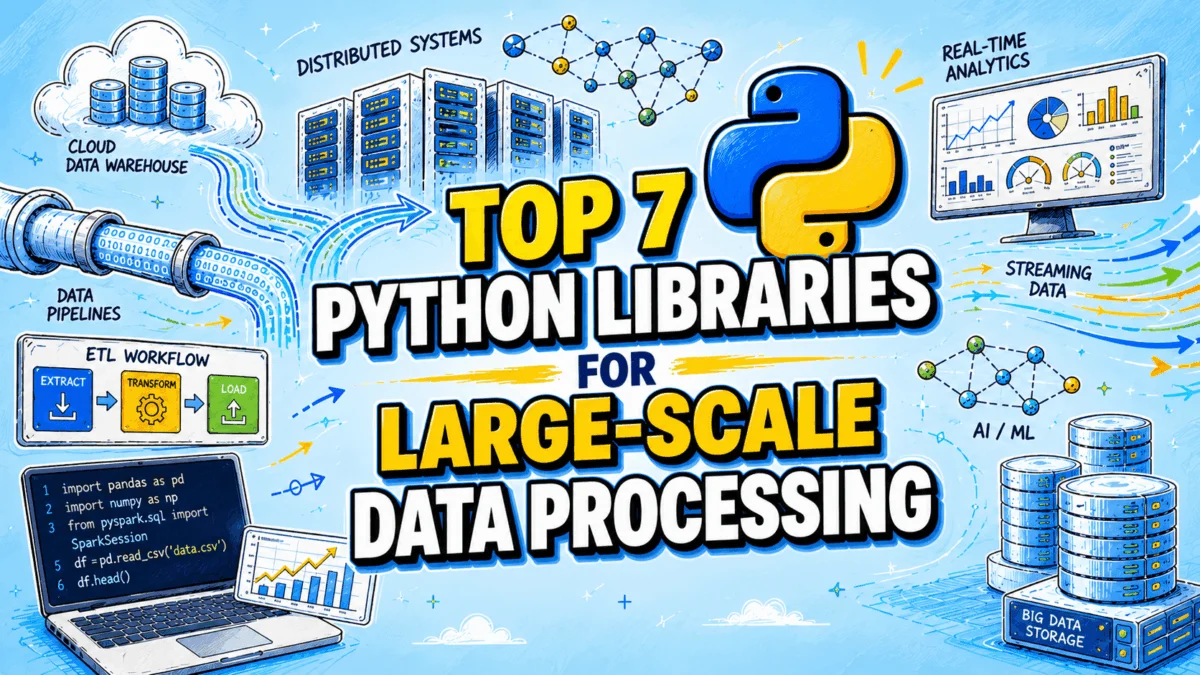
The Python ecosystem has cemented its position as an indispensable tool for data scientists and engineers, offering a comprehensive suite of libraries for every stage of the data lifecycle. However, as data volumes surge into gigabytes, terabytes, and even petabytes, traditional in-memory processing tools like pandas and NumPy quickly reach their operational limits. This escalating challenge has driven the development of specialized Python libraries engineered to handle large-scale data processing efficiently, whether through distributed computing, out-of-core techniques, or highly optimized underlying architectures. These innovations empower professionals to tackle complex tasks ranging from massive Extract, Transform, Load (ETL) pipelines and distributed machine learning model training to real-time event streaming and high-performance analytical queries.
The proliferation of data in the digital age, driven by everything from IoT devices and social media interactions to scientific research and enterprise systems, has created an urgent demand for scalable data solutions. Companies now routinely collect and process billions of data points daily, necessitating robust frameworks capable of operating across clusters of machines or employing sophisticated memory management techniques on powerful single nodes. Python, with its readability, vast community, and extensive scientific computing heritage, was a natural candidate to extend its capabilities into the big data realm. The evolution from single-threaded, memory-bound operations to parallel and distributed paradigms represents a critical shift, enabling the analysis of datasets previously considered intractable within a Python environment. This article delves into seven pivotal Python libraries that are at the forefront of this transformation, each offering distinct advantages for various large-scale data processing challenges.
PySpark: The Enterprise Standard for Distributed ETL and Machine Learning
PySpark serves as the Python API for Apache Spark, which has become the de facto industry standard for large-scale distributed data processing. Born out of UC Berkeley’s AMPLab in 2009 and open-sourced in 2010, Spark rapidly gained traction due to its in-memory processing capabilities, which significantly outperformed its MapReduce predecessors, particularly for iterative algorithms common in machine learning. PySpark extends Spark’s powerful distributed computing engine to Python developers, allowing them to leverage familiar Python syntax to orchestrate complex batch and streaming computations across vast clusters.
At its core, PySpark operates on resilient distributed datasets (RDDs) and, more commonly, DataFrames, which provide a higher-level, more optimized API for structured data. It supports lazy evaluation, meaning transformations are not executed until an action is called, allowing for query optimization across the entire computation graph. PySpark integrates seamlessly with diverse data sources, including Hadoop Distributed File System (HDFS), Amazon S3, Delta Lake, and various other cloud data platforms, making it a versatile tool for enterprise-level ETL pipelines. Its robust ecosystem includes MLlib for distributed machine learning, GraphX for graph processing, and Spark Streaming for real-time analytics, catering to a wide array of big data applications. Organizations globally, from financial institutions to tech giants, rely on PySpark for mission-critical operations, underscoring its reliability and scalability. For newcomers, comprehensive tutorials such as "Build Your First ETL Pipeline with PySpark" and the official PySpark documentation offer excellent starting points to master its capabilities.
Dask: Scaling Pandas and NumPy Beyond Memory Limits
Dask emerges as a powerful parallel computing library designed to scale existing pandas, NumPy, and scikit-learn workflows to datasets that exceed available memory or require distributed processing. Developed as a flexible and lightweight alternative to full-fledged distributed systems like Spark for certain use cases, Dask was first released in 2014. It addresses the "medium-data" problem, where datasets are too large for a single machine’s RAM but might not necessarily warrant the overhead of a full Spark cluster setup.
Dask achieves scalability by breaking down large datasets or complex computations into smaller, manageable chunks and constructing a task graph that dictates the order of execution. This graph can then be executed lazily, either on a single multi-core machine or distributed across a cluster of machines. Dask’s DataFrames mimic the pandas API, allowing users to transition easily without learning entirely new syntax, while Dask Arrays mirror NumPy for large numerical computations. Dask also offers "Dask Delayed" for parallelizing arbitrary Python functions. The library’s strength lies in its ability to integrate seamlessly with the existing Python data science stack, providing a pathway to scale without a complete re-architecture of codebases. Its modular design and explicit control over parallelism make it a favorite for researchers and data scientists needing to push the boundaries of single-machine performance or distribute workloads efficiently across smaller clusters. The Dask Tutorial on GitHub and the extensive Dask documentation are invaluable resources for practitioners looking to leverage its power.
Polars: High-Performance DataFrame Transformations with Rust and Arrow
Polars represents a significant leap forward in high-performance DataFrame processing, distinguishing itself through its Rust-based core and native integration with the Apache Arrow columnar memory format. First appearing on the scene around 2020, Polars quickly gained notoriety for consistently outperforming pandas in numerous benchmarks, often by orders of magnitude, particularly on multi-core systems. Its design philosophy prioritizes speed, memory efficiency, and a robust API for data manipulation.
The Rust backend provides C-level performance, while Apache Arrow ensures efficient in-memory data representation and zero-copy data sharing between compatible libraries, eliminating costly serialization/deserialization steps. Polars supports both eager and lazy execution. Lazy evaluation, in particular, is a game-changer for datasets that don’t fit entirely into memory, as it allows Polars to optimize query plans before execution, similar to how a database query optimizer works. This means complex chains of operations can be analyzed and reordered for optimal performance and memory usage. Its expressiveness and speed make it an attractive alternative for data scientists accustomed to pandas but needing significantly more performance without the overhead of distributed systems. The rising adoption of Polars highlights a growing trend towards high-performance, single-node solutions for complex data tasks, offering a compelling balance between speed and ease of use. Resources like "Polars vs. pandas: What’s the Difference?" and "How to Work With Polars LazyFrames" provide practical comparisons and deep dives into its functionalities.
Ray: The Distributed Framework for Machine Learning and Parallel Python
Ray is an open-source distributed computing framework originally developed at UC Berkeley’s RISELab, with its initial public release in 2017. It was specifically engineered to scale Python workloads across clusters, addressing the burgeoning need for distributed machine learning training, hyperparameter tuning, and serving. Ray provides a simple, universal API for building and running distributed applications, abstracting away the complexities of distributed systems programming.
At its core, Ray employs an actor model for stateful computations and remote functions for stateless tasks, allowing developers to easily parallelize existing Python code. Its comprehensive ecosystem includes specialized libraries that extend its utility: Ray Data for scalable data ingestion and processing, Ray Train for distributed model training (integrating with popular ML frameworks like PyTorch and TensorFlow), Ray Tune for hyperparameter optimization, and Ray Serve for scalable model deployment. Ray’s flexibility allows it to run on a single machine for development and seamlessly scale to large cloud clusters, offering a consistent experience across environments. This makes it a crucial tool for organizations developing and deploying sophisticated AI applications, enabling faster iteration cycles and more efficient resource utilization for computationally intensive tasks. The "Ray Getting Started guide" and the "Ray Tutorial on GitHub" offer excellent pathways to explore its capabilities.
Vaex: Out-of-Core DataFrame Analysis on a Single Machine
Vaex is a Python library tailored for the exploration and processing of large tabular datasets, often containing billions of rows, without requiring a distributed cluster. Introduced around 2017, Vaex specializes in "out-of-core" processing, meaning it handles data that is larger than the available RAM by memory-mapping data files and performing computations on chunks as needed. This allows data scientists to work with truly massive datasets on a single machine, often a powerful workstation, without encountering memory errors.
Vaex achieves its impressive performance through several key techniques: memory mapping (especially for HDF5 files), lazy evaluation of expressions, and efficient, compiled C++ code for core operations. It excels at tasks like filtering, creating "virtual columns" (which are computed on the fly without consuming extra memory), and performing aggregations on huge datasets with minimal memory footprint. For exploratory data analysis (EDA) on multi-gigabyte or terabyte datasets, Vaex provides an interactive experience that would be impossible with traditional in-memory tools. It bridges the gap between pandas (for smaller datasets) and full-blown distributed systems like Spark, offering a cost-effective and simpler solution for single-node big data analytics. The official Vaex documentation and example notebooks are excellent resources for understanding its unique approach to large-scale data handling.
Apache Kafka: The Backbone for High-Throughput Real-Time Streaming
While not a Python library itself, Apache Kafka is a foundational distributed event streaming platform that plays a critical role in large-scale real-time data processing, and its integration with Python is paramount. Originally developed at LinkedIn and open-sourced in 2011, Kafka is designed for building high-throughput, fault-tolerant, and scalable real-time data pipelines and streaming applications. It acts as a publish-subscribe messaging system, enabling applications to produce and consume streams of records (events) efficiently.
In the context of Python, client libraries like kafka-python and confluent-kafka provide the necessary interfaces to interact with Kafka clusters. These libraries allow Python applications to act as producers, sending high volumes of data into Kafka topics, or as consumers, reading and processing event streams in real-time. This capability is crucial for scenarios requiring immediate data ingestion, processing, and reaction, such as fraud detection, IoT data processing, log aggregation, and real-time analytics dashboards. Kafka’s distributed log architecture ensures durability and scalability, making it a cornerstone for modern data architectures that demand low-latency data flow. Its widespread adoption across industries for mission-critical real-time applications underscores its importance. The Confluent Python client documentation is a comprehensive guide for developing robust Kafka-enabled Python applications.
DuckDB: In-Process SQL Analytics on Any File Format
DuckDB is an analytical database that stands out by running entirely in-process within your Python environment, eliminating the need for a separate server or complex infrastructure setup. First released in 2019, DuckDB has rapidly gained popularity for its ability to execute fast online analytical processing (OLAP) queries directly on local files, including Parquet, CSV, and JSON, without prior ingestion into a database.
Built for analytical workloads, DuckDB is a columnar-oriented database designed for high-performance aggregation and complex join operations. Its tight integration with the Python data ecosystem, particularly with pandas, Polars, and Apache Arrow, allows for seamless data exchange and analysis. Data engineers and analysts can leverage SQL for powerful transformations and queries on their local data, enjoying database-level performance without the operational overhead. This "serverless" OLAP approach is particularly beneficial for ad-hoc analysis, data quality checks, and building embedded analytical components within Python applications. DuckDB’s commitment to performance, SQL compliance, and ease of use makes it a compelling choice for anyone seeking robust analytical capabilities directly within their Python workflow. The "Getting Started with DuckDB" guide and the "DuckDB Engineering Blog" provide insightful details into its architecture and capabilities.
The Broader Impact and Future Outlook
The continuous innovation in Python’s data processing landscape reflects the ever-growing demand for efficient and scalable solutions in the age of big data and artificial intelligence. These seven libraries, each with its unique strengths and use cases, collectively empower data professionals to tackle virtually any data challenge, regardless of scale or complexity. PySpark remains the workhorse for enterprise-grade distributed ETL and machine learning, offering unparalleled breadth and integration. Dask provides a flexible bridge for scaling existing pandas and NumPy workflows, while Polars delivers unprecedented single-node DataFrame performance through its Rust-Arrow backend. Ray emerges as a versatile distributed framework for general-purpose parallel Python and advanced ML tasks. Vaex offers a unique out-of-core approach for exploring massive datasets on a single machine, providing an alternative to distributed systems for certain analytical needs. Kafka forms the critical infrastructure for real-time data streaming, enabling immediate insights and reactive systems. Finally, DuckDB revolutionizes local SQL analytics, bringing powerful OLAP capabilities directly into the Python environment without infrastructure complexity.
The trajectory of these libraries suggests a future where data processing in Python will continue to evolve towards higher performance, greater ease of use, and more seamless integration across different scales—from personal laptops to massive cloud clusters. The emphasis on columnar formats like Apache Arrow, lazy evaluation, and efficient C++/Rust backends points towards a future where Python can truly stand toe-to-toe with compiled languages for raw data processing speed, while retaining its renowned developer productivity. For data scientists, engineers, and machine learning practitioners, mastering these tools is no longer optional but a necessity for navigating the increasingly data-intensive demands of modern industry. The continued development and adoption of these libraries signify Python’s enduring and expanding role as the lingua franca of data science and a cornerstone of scalable data ecosystems worldwide.