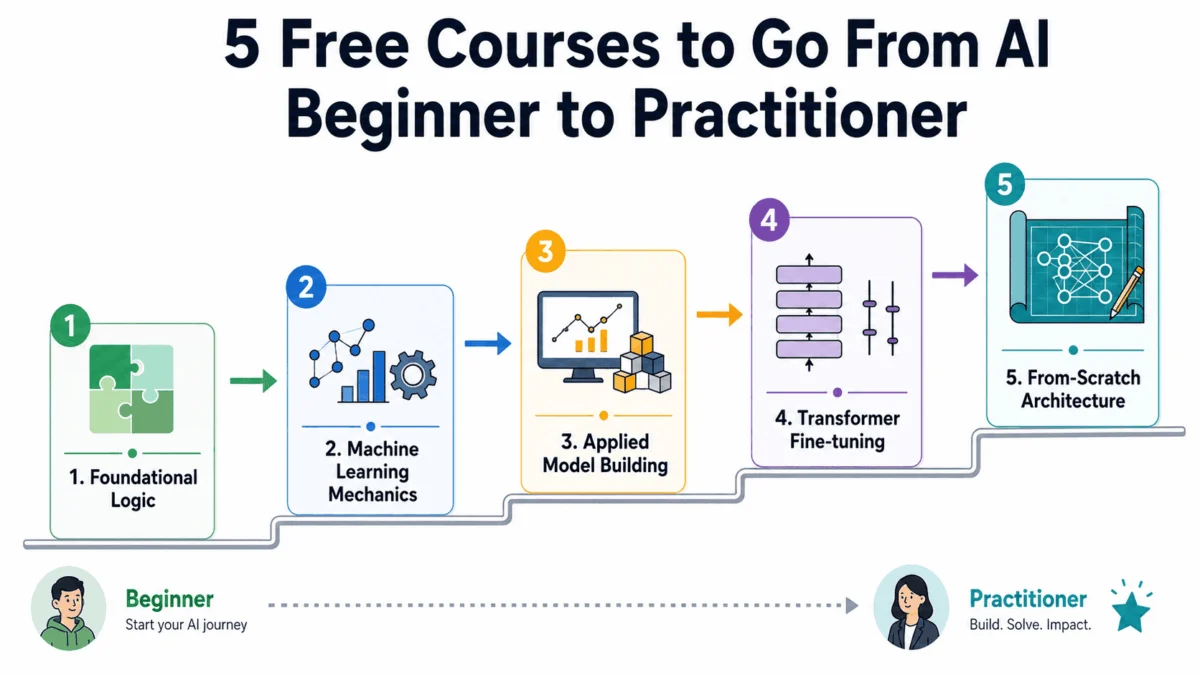
The landscape of artificial intelligence education is undergoing a profound transformation, moving away from exclusive, high-cost academic programs towards a highly accessible, industry-driven model. While the demand for AI skills has never been higher, leading to a proliferation of expensive bootcamps and certifications, a significant shift has occurred where the most impactful AI education in 2026 is, remarkably, entirely free. Major organizations and pioneering educators who are at the forefront of building frontier AI models and frameworks have increasingly open-sourced their educational materials, effectively democratizing access to cutting-edge knowledge.
This paradigm shift enables individuals with a foundational understanding of Python to transition into competent AI practitioners without incurring substantial debt or investing in lengthy degree programs. The key lies not in financial outlay, but in selecting the right curriculum and committing to a structured learning path. This article outlines a sequential, five-course roadmap designed to guide aspiring practitioners from fundamental AI algorithms to the sophisticated process of building modern large language models (LLMs) from scratch. These courses have been rigorously verified for their quality, practicality, and the esteem they command from hiring managers across the technology sector.
The Evolving Landscape of AI Education and Demand
The global artificial intelligence market, valued at approximately $200 billion in 2023, is projected to grow at a compound annual growth rate (CAGR) exceeding 37% through 2030, according to various market intelligence reports. This explosive growth fuels an insatiable demand for skilled AI professionals across virtually every industry, from finance and healthcare to automotive and entertainment. Roles such as AI Engineer, Machine Learning Scientist, Data Scientist, and AI Researcher consistently rank among the highest-paying and most sought-after positions in the technology sector. Data from LinkedIn and other job platforms frequently highlight a severe talent shortage, with demand for AI specialists often outstripping the supply of qualified candidates by a significant margin. For instance, a 2023 report by the World Economic Forum indicated that AI and Machine Learning Specialists are among the top five fastest-growing jobs globally.
This burgeoning demand has historically led to a bottleneck in traditional educational pathways, which often struggle to keep pace with the rapid advancements in AI research and application. Universities, while offering robust theoretical foundations, can be slow to integrate the latest industry practices. This gap created an opportunity for a burgeoning market of private bootcamps and online courses, many of which carry hefty price tags—often ranging from $10,000 to $30,000 or more for intensive programs. While some of these programs deliver value, the sheer volume has also contributed to a "signal-to-noise" problem, making it challenging for aspiring learners to discern high-quality, relevant content from less effective offerings.
A New Era of Open-Source Learning
Against this backdrop, a powerful counter-trend has emerged: the deliberate open-sourcing of high-quality, practical AI educational content by the very organizations and individuals driving the field forward. This movement is driven by several factors, including a desire to democratize AI knowledge, cultivate a broader talent pool, foster open-source communities, and in some cases, serve as a talent pipeline for the creators themselves. The year 2026 marks a point where these free resources have matured, offering curricula that are often more current and practical than many paid alternatives.
The initial step in any serious AI education transcends merely installing libraries or calling APIs; it involves constructing a robust mental model for how AI systems approach and resolve problems. The foundational two courses in this curated list are dedicated to establishing this critical understanding, transitioning from classical AI logic to the core mathematical underpinnings of machine learning. Overlooking this foundational layer is a common misstep among self-taught practitioners and frequently surfaces as a deficiency in technical interviews. Once theoretical comprehension is solidified, the focus shifts towards practical application. The subsequent two courses are pivotal for most learners, as they mandate the deployment of functional models rather than passive consumption of material. Upon completing this segment, learners should possess the capability to train, evaluate, and deploy a model on a dataset of their own selection. The final stage elevates practitioners to the level of engineers. While proficiency in utilizing frameworks is valuable, a deeper understanding of their internal mechanisms represents an entirely different echelon of expertise. The concluding course in this roadmap systematically deconstructs every abstraction, compelling learners to rebuild the architecture from fundamental principles. This material, while challenging, offers unparalleled clarity.
The Five-Course Roadmap to AI Proficiency
The following five courses represent a carefully curated, sequential roadmap designed to build a comprehensive understanding of AI, from foundational concepts to advanced model building.
1. Harvard’s CS50: Introduction to AI with Python
Before delving into the complexities of neural networks, a fundamental grasp of artificial intelligence’s core logic is indispensable. Harvard University’s CS50: Introduction to AI with Python serves as an expertly constructed bridge between standard software engineering principles and the specialized domain of machine learning. This course places significant emphasis on understanding the cognitive processes and decision-making mechanisms inherent in AI systems. Launched as part of Harvard’s renowned CS50 series, which has educated millions globally since its inception, the AI module extends this legacy by providing an accessible entry point to a complex field.
Key aspects that render the CS50 AI course essential include its focus on search algorithms (like breadth-first search and A*), knowledge representation, logical inference, constraint satisfaction problems, and machine learning concepts such as classification and reinforcement learning. By exploring classic AI problems like tic-tac-toe, traffic simulation, and language processing, students develop an intuitive understanding of how AI systems "think." The course also integrates practical programming exercises using Python, reinforcing theoretical concepts with hands-on application. Its structured approach and the reputation of Harvard’s Computer Science department provide a credible and robust starting point. The course is freely available for audit on edX and directly through Harvard’s OpenCourseWare platform, making this world-class education accessible to anyone with an internet connection. Enrollment figures for CS50 courses often reach hundreds of thousands, underscoring their widespread appeal and effectiveness.
2. Google’s Machine Learning Crash Course
Upon establishing a foundational understanding of AI logic, the subsequent crucial step is to comprehend how machines extract knowledge from data. Google’s Machine Learning Crash Course stands out as arguably the most efficient and direct pathway to mastering the core mathematics and mechanics underpinning modern machine learning. This is not merely an external offering; it is the identical curriculum Google employs to upskill its vast internal engineering teams, a testament to its practical relevance and high standards. Launched by Google’s AI team, the course reflects the company’s extensive experience in deploying machine learning at scale.
The course is structured around a series of interactive modules, accompanied by practical exercises and Colab notebooks, allowing learners to immediately apply concepts. Key takeaways include a deep dive into core machine learning concepts such as feature engineering, generalization, regularization, and loss functions. It covers fundamental algorithms like linear regression, logistic regression, and neural networks, explained with clear visual aids and practical examples. The emphasis is on building an intuitive understanding of how these models work and how to optimize them effectively. Given Google’s pioneering role in AI research and application, its internal training materials offer an unparalleled insight into industry-best practices. Access to this comprehensive crash course is direct via Google’s developer portal, requiring no sign-up, thereby eliminating any barrier to entry for aspiring practitioners. The course has been updated regularly since its initial release, ensuring its content remains current with industry advancements.
3. fast.ai’s Practical Deep Learning for Coders
Traditional educational methodologies often prioritize theoretical understanding, deferring practical application for weeks or even months. fast.ai’s Practical Deep Learning for Coders, spearheaded by Jeremy Howard, radically reverses this approach. This widely acclaimed course is renowned for its "top-down" methodology, which empowers learners to train a state-of-the-art deep learning model in the very first lesson. The remainder of the course is then dedicated to meticulously dissecting and explaining the underlying mechanisms of how that model operates. Launched in 2017, fast.ai quickly gained prominence for its pragmatic and highly effective teaching style, directly addressing the needs of practitioners.
Why fast.ai is considered the ultimate practitioner’s course lies in its unwavering focus on immediate practical application. It demystifies complex deep learning concepts by showing how they are used in real-world scenarios before diving into the intricate details. Topics covered include image classification, natural language processing (NLP), tabular data analysis, and recommendation systems, all taught using the fastai library, which is built on PyTorch. The course emphasizes transfer learning, enabling learners to leverage pre-trained models for rapid development and high performance. Jeremy Howard’s philosophy—that practical experience solidifies theoretical understanding—has proven immensely effective, producing highly capable deep learning practitioners. All lectures and Jupyter notebooks are freely available on the fast.ai website, ensuring complete accessibility to its innovative curriculum. The course has influenced countless individuals, with many alumni crediting it for their successful entry into the deep learning field.
4. The Hugging Face NLP Course
In the current era of generative AI, a comprehensive understanding of Transformer models is non-negotiable. Hugging Face has established itself as the central, indispensable hub for open-source AI, particularly in the domain of natural language processing (NLP). Their official NLP course serves as the definitive guide to navigating and leveraging their extensive ecosystem. This course expertly bridges the gap from a functional understanding of NLP to the practical application of fine-tuning the sophisticated models that power today’s most advanced AI applications. Hugging Face, founded in 2016, gained widespread recognition for its Transformers library, which revolutionized NLP development.
The Hugging Face course offers a deep dive into the architecture and application of Transformer models, including foundational concepts like attention mechanisms, tokenization, and transfer learning specific to NLP tasks. Learners gain hands-on experience with the Hugging Face ecosystem, including the Transformers library, Datasets library, and Tokenizers library. The curriculum guides users through tasks such as text classification, question answering, summarization, and translation, culminating in the ability to fine-tune pre-trained models for specific applications. Given Hugging Face’s central role in facilitating the development and deployment of LLMs, mastery of their tools is critical for anyone aiming to work with modern generative AI. The course is entirely free, interactive, and directly accessible on their platform, reflecting Hugging Face’s commitment to fostering a vibrant open-source AI community. The platform currently hosts over 500,000 models and 90,000 datasets, demonstrating its unparalleled influence in the AI world.
5. Andrej Karpathy’s Neural Networks: Zero to Hero
To truly transcend the label of a beginner and emerge as a high-level AI engineer, it is essential to peel back the layers of abstraction provided by frameworks and reconstruct the architecture from its fundamental components. Andrej Karpathy, a towering figure in the AI community—former Director of AI at Tesla and a founding member of OpenAI—developed the "Neural Networks: Zero to Hero" video series with this profound objective. This series methodically teaches learners how to build a neural network and, ultimately, a Generative Pre-trained Transformer (GPT)-level LLM entirely from scratch. Karpathy’s reputation stems from his deep technical expertise and his ability to communicate complex ideas with exceptional clarity.
This series stands apart due to its rigorous, first-principles approach. Instead of merely using pre-built functions, Karpathy guides viewers through the mathematical and computational steps required to implement forward and backward propagation, loss functions, optimizers, and the complete architecture of a Transformer. This granular understanding is invaluable for debugging, optimizing, and innovating beyond existing frameworks. The content is delivered through a series of engaging YouTube videos, making highly advanced concepts accessible. For professionals aiming for roles that demand deep architectural insight, such as AI research engineers or those working on novel AI hardware, this series provides an unparalleled educational experience. It is arguably the most valuable free AI content available today, dedicating a few weekends to this playlist on YouTube can provide a level of clarity and understanding that few other resources can match.
Timeline and Evolution of Free AI Resources
The availability of high-quality free AI education has evolved significantly over the last decade. Early online learning platforms offered introductory computer science courses, but specific, advanced AI curricula were scarce. The mid-2010s saw the rise of MOOCs (Massive Open Online Courses) from institutions like Stanford and deep learning pioneers like Andrew Ng, which began to offer more specialized content. However, these often focused on theoretical aspects. The late 2010s marked a turning point with the release of practical courses like fast.ai, demonstrating that hands-on, top-down learning could accelerate proficiency.
The 2020s, particularly with the explosion of generative AI and LLMs, have seen an unprecedented commitment from industry leaders—Google, Hugging Face, and individual luminaries like Karpathy—to open-source their cutting-edge training materials. This chronological progression highlights a maturation of free AI education, moving from broad introductions to highly specialized, industry-relevant training that rivals or surpasses many paid alternatives in its depth and practicality.
Implications and Broader Impact
The proliferation of these high-quality, free AI courses carries profound implications for individuals, the education sector, and the global economy:
- Democratization of AI: By removing financial barriers, these resources empower individuals from diverse socio-economic backgrounds and geographical locations to acquire valuable AI skills. This fosters a more inclusive and globally representative AI talent pool, potentially accelerating innovation by incorporating broader perspectives.
- Impact on Traditional Education: The existence of such robust free alternatives places pressure on traditional universities and expensive bootcamps to re-evaluate their curricula, pricing, and pedagogical approaches. Educational institutions that fail to adapt to the rapid pace of AI development or justify their costs against free, industry-validated content risk becoming less relevant. Some universities are now integrating these very open-source courses into their official curricula.
- Mitigation of the Skills Gap: These courses directly address the critical shortage of AI talent. By providing a clear, structured pathway for self-learners, they contribute significantly to upskilling the global workforce and meeting industry demand. This has a direct positive impact on economic growth and technological advancement.
- Empowerment of Self-Learners: While requiring significant discipline and self-motivation, these resources empower individuals to take ownership of their career development. The structured nature of this roadmap mitigates some of the common challenges of self-learning, such as knowing where to start or what content to trust.
- Fostering Open-Source Collaboration: The very act of open-sourcing these materials reinforces the ethos of collaborative development that is central to the AI community. Learners become familiar with open-source tools and contribute to the ecosystem, creating a virtuous cycle of innovation.
Conclusion
The aspiration to become a proficient AI engineer no longer necessitates an investment of thousands of dollars. The five-course sequence detailed above is meticulously designed for sequential completion, with each subsequent layer directly building upon the knowledge acquired in the preceding one. Harvard’s CS50 establishes the foundational logical reasoning; Google’s Machine Learning Crash Course imparts the essential mathematical and mechanical principles; fast.ai accelerates practical model building and deployment; Hugging Face integrates learners into the vital open-source ecosystem of generative AI; and Andrej Karpathy’s series illuminates the intricate underlying architectures.
This comprehensive sequence, while demanding, typically requires an estimated three to five months of part-time study. The depth of understanding cultivated through this curriculum is robust and directly applicable to industry challenges. It is noteworthy that most commercial programs offering a comparable outcome command substantial fees, yet few manage to surpass the thoroughness and practical relevance of the free resources outlined here. Commencing with CS50 and progressing at a measured pace, prioritizing a solid grasp of the foundational concepts, will ensure that the subsequent stages of the roadmap are approached with clarity and enhanced comprehension.
Happy learning!
Vinod Chugani is an AI and data science educator who bridges the gap between emerging AI technologies and practical application for working professionals. His focus areas include agentic AI, machine learning applications, and automation workflows. Through his work as a technical mentor and instructor, Vinod has supported data professionals through skill development and career transitions. He brings analytical expertise from quantitative finance to his hands-on teaching approach. His content emphasizes actionable strategies and frameworks that professionals can apply immediately.