

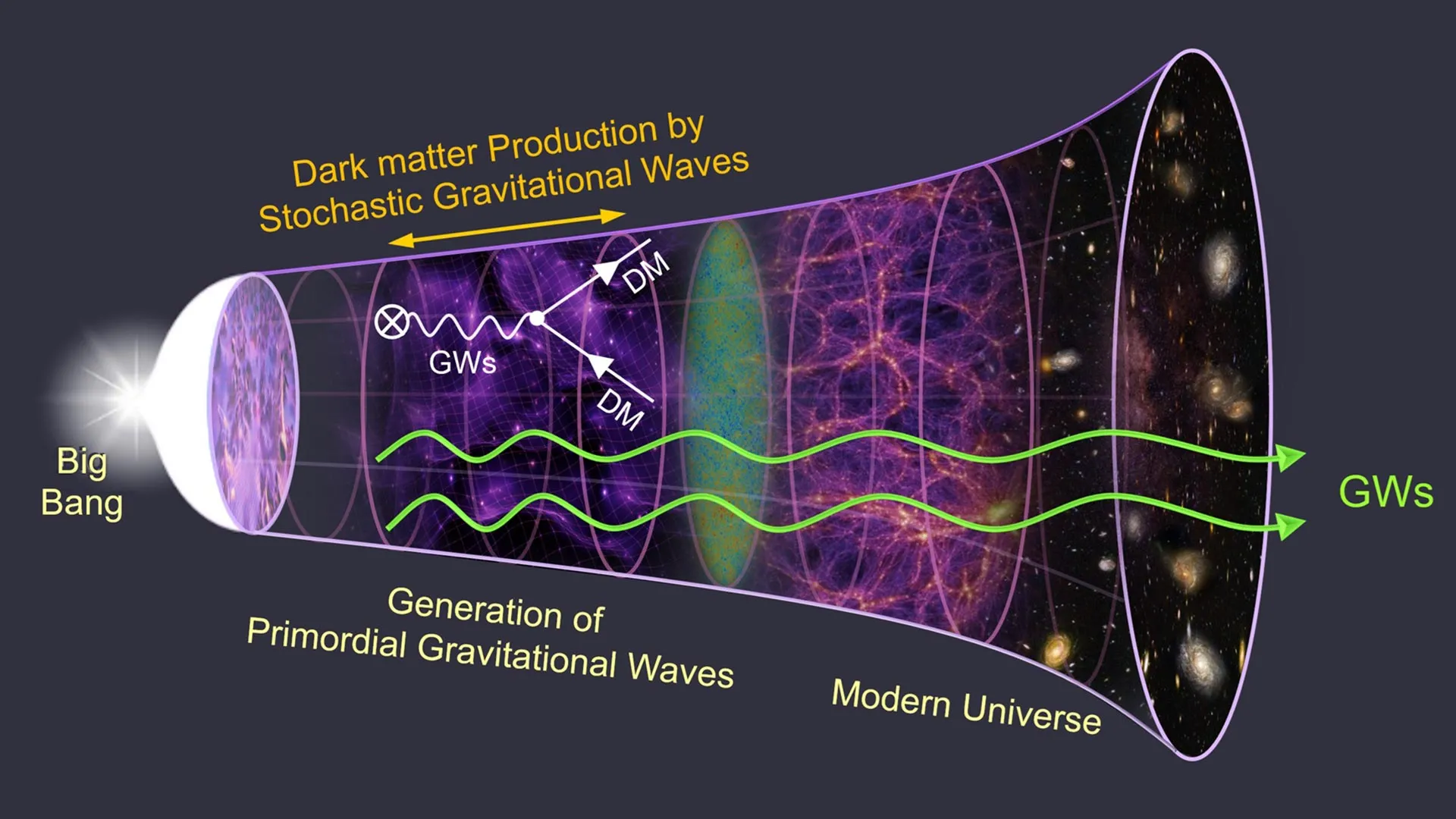
A groundbreaking theoretical study led by researchers at Johannes Gutenberg University Mainz and Swansea University has proposed a transformative mechanism for the origin of dark matter, suggesting that the elusive substance may have been forged by gravitational waves in the immediate aftermath of the Big Bang. The research, spearheaded by Professor Joachim Kopp of the PRISMA++ Cluster of Excellence and Dr. Azadeh Maleknejad, introduces a departure from traditional dark matter models by focusing on stochastic gravitational waves—ripples in the fabric of spacetime that permeated the nascent universe long before the formation of the first stars or galaxies. Published in the prestigious journal Physical Review Letters, the study provides a mathematical framework for how these gravitational fluctuations could have catalyzed the production of fermions, which subsequently evolved into the dark matter that today constitutes the vast majority of the universe’s mass.
The Search for the Invisible Universe
For decades, the composition of the universe has remained one of the most profound mysteries in modern science. Empirical observations of galactic rotation curves, gravitational lensing, and the cosmic microwave background radiation consistently indicate that visible matter—the protons, neutrons, and electrons that form planets, stars, and biological life—accounts for a mere four to five percent of the total energy density of the cosmos. The remainder is divided between dark energy, which drives the accelerated expansion of the universe, and dark matter, which acts as the gravitational "glue" holding galaxies together.
Dark matter represents approximately 23 to 27 percent of the total universe, yet it remains invisible to conventional telescopes because it does not emit, absorb, or reflect electromagnetic radiation. Current leading theories have long favored "Weakly Interacting Massive Particles" (WIMPs) as the primary candidate for dark matter. However, despite decades of sensitive underground experiments and high-energy collisions at the Large Hadron Collider (LHC), no direct evidence of WIMPs has been found. This "silence" from the dark sector has prompted physicists like Kopp and Maleknejad to explore radical new production mechanisms that do not rely on standard particle interactions.
The Role of Stochastic Gravitational Waves
To understand the proposed mechanism, it is necessary to distinguish between two types of gravitational waves. The waves famously detected by the LIGO and Virgo observatories are "event-based" waves, generated by cataclysmic localized events such as the merger of two black holes or neutron stars. In contrast, the research by Kopp and Maleknejad focuses on "stochastic" gravitational waves. These are not tied to specific massive objects but are instead a background hum of spacetime ripples produced by large-scale processes in the very early universe.
These stochastic waves are believed to have originated during the "inflationary" epoch or shortly thereafter, as the universe underwent rapid phase transitions while cooling. Other potential sources include primordial magnetic fields or cosmic strings. Unlike the sharp "chirps" of black hole mergers, stochastic waves form a continuous, random background signal that fills the entirety of space. The study suggests that the energy density contained within these primordial ripples was sufficient to interact with quantum fields, leading to the creation of new particles.
A New Mechanism: From Spacetime Ripples to Fermions
The core of the Mainz-Swansea study lies in the interaction between gravity and quantum mechanics. According to the researchers’ calculations, the intense gravitational environment of the early universe allowed for a process where gravitational wave energy was converted into fermions. Fermions are a fundamental category of particles characterized by half-integer spin; this category includes quarks and leptons (such as electrons and neutrinos).
In the scenario described by Kopp and Maleknejad, these fermions were initially produced as "massless" or nearly massless entities. In the high-energy environment of the early universe, mass behaves differently than it does in the modern, cooler cosmos. As the universe expanded and underwent further phase transitions—processes similar to steam condensing into water—these fermions are theorized to have acquired mass. This transition would have effectively "frozen" them into the stable, non-reactive state we identify as dark matter today.
"In this article, we investigate the possibility of gravitational waves—which are believed to have been ubiquitous in the early universe—being partially converted into dark matter particles," Professor Joachim Kopp explained. This conversion represents a "gravitational production" model, which is distinct from "thermal production" models where dark matter is created through collisions of hot plasma in the early universe.
Chronology of the Dark Matter Formation
The timeline proposed by this theory places the birth of dark matter within the first fraction of a second after the Big Bang. The chronological sequence can be broken down into four distinct phases:
- The Stochastic Era: Immediately following the Big Bang, the universe is a high-energy environment where spacetime itself is subject to violent, stochastic fluctuations. These gravitational waves carry immense energy.
- Particle Excitation: Through a process of quantum field excitation, the energy of the gravitational waves interacts with the vacuum, "popping" massless fermions into existence.
- The Cooling Phase: As the universe expands, it cools. This cooling triggers various symmetry-breaking events (phase transitions) in the fundamental forces of nature.
- Mass Acquisition: During these transitions, the massless fermions interact with fields (potentially similar to the Higgs field) to gain mass. Once they possess mass and lose their initial kinetic energy, they begin to cluster under the influence of gravity, eventually forming the "halos" that allow galaxies to form.
Supporting Data and Theoretical Implications
The research published in Physical Review Letters utilizes complex analytical estimates to prove that this conversion is not only possible but mathematically probable under certain early-universe conditions. One of the most significant aspects of this data is the "coupling strength" between gravity and the fermion fields. Traditionally, gravity is considered the weakest of the four fundamental forces, making its ability to create matter seem unlikely. However, at the extreme energy scales of the early universe, the relative strength of these interactions changes, allowing gravity to play a more dominant role in particle physics.
Furthermore, this model addresses the "abundance problem." Any viable theory of dark matter must account for the specific amount of dark matter observed in the universe today. The calculations by Kopp and Maleknejad demonstrate that the energy density of primordial gravitational waves is consistent with the observed 23 percent dark matter density, provided the waves were generated at specific energy scales during the cosmic timeline.
Expert Analysis and Future Research Directions
The implications of this study extend beyond dark matter. If gravitational waves can produce fermions, they may also hold the key to the "Baryon Asymmetry"—the mystery of why the universe contains so much more matter than antimatter. In a perfectly symmetrical universe, matter and antimatter should have annihilated each other, leaving behind only light.
"Another avenue for future research is the investigation of further possible effects of gravitational waves in the early universe," said Kopp. "One example for this would be a mechanism that could account for the well-known difference in particles and antiparticles produced."
The scientific community has reacted to the study with cautious optimism. While the theory is currently based on analytical models, it provides a new target for next-generation gravitational wave detectors, such as the Laser Interferometer Space Antenna (LISA) and the Einstein Telescope. These instruments will be sensitive enough to detect the stochastic background of gravitational waves, potentially providing the empirical data needed to validate the Mainz-Swansea model.
Towards Numerical Validation
The next phase of the research involves moving from "pencil-and-paper" analytical estimates to high-performance computing. "The next step in developing this line of research is to go beyond our analytical estimates and conduct numerical calculations to improve the accuracy of our predictions," Kopp noted. Numerical simulations will allow the team to model the expansion of the universe in much finer detail, accounting for the complex "back-reaction" where the newly created matter begins to influence the gravitational waves that created it.
By refining these calculations, the researchers hope to predict a specific "signature" for this type of dark matter. If the dark matter was created by gravitational waves, it might have a unique distribution or velocity profile that differs from WIMPs or axions. Detecting such a signature would be a "smoking gun" for the theory, finally pulling back the veil on the 85 percent of the universe’s matter that has remained hidden for 13.8 billion years.
As cosmology enters an era of "multi-messenger" astronomy—using light, neutrinos, and gravitational waves to study the heavens—the theory that dark matter is a relic of spacetime’s earliest ripples offers a compelling bridge between the physics of the very large and the very small. If proven correct, the work of Kopp and Maleknejad will represent a fundamental shift in our understanding of the cosmic origin story, proving that the very fabric of space and time is responsible for the matter that makes our existence possible.










Leave a Reply