Large Language Models (LLMs) have demonstrated remarkable capabilities in generating human-like text, but a persistent and significant challenge remains: hallucinations. These instances occur when an LLM produces information that is factually incorrect, nonsensical, or entirely fabricated, often stemming from the model’s inherent probabilistic nature rather than a lack of internal knowledge, or from misinterpreting context. While the industry has seen a proliferation of solutions aimed at mitigating these inaccuracies, the development of robust, methodological evaluation frameworks specifically designed for internally diagnosing hallucinations has lagged. A recent study by Amazon researchers introduces a groundbreaking solution named GraphEval, a framework that leverages knowledge graphs to analyze and precisely detect hallucinations within LLM-generated outputs, marking a pivotal advancement in ensuring the reliability and trustworthiness of artificial intelligence.
The Pervasive Challenge of LLM Hallucinations: A Background
The rise of LLMs like GPT-3, Llama, and Mistral has ushered in a new era of AI applications, from sophisticated chatbots and content creation tools to complex data analysis and code generation. However, the phenomenon of "hallucinations" has cast a shadow over their widespread adoption, particularly in high-stakes environments. An LLM hallucination is more than just an error; it’s a confident presentation of false information, often indistinguishable from factual content to an untrained eye. These can range from minor factual inaccuracies to entirely fabricated events, individuals, or statistics.
The root causes of hallucinations are multi-faceted. They can arise from biases in training data, limitations in the model’s ability to reason or synthesize information from disparate sources, or simply the inherent statistical nature of token prediction, where the model prioritizes plausible sequences over factual accuracy. For instance, an LLM might generate a convincing biography of a non-existent person or cite a fabricated scientific study. The implications of such errors are profound, potentially leading to the spread of misinformation, flawed decision-making in business and healthcare, legal liabilities, and a significant erosion of public trust in AI technologies.
In response, the AI community has developed various strategies to combat hallucinations. Retrieval-Augmented Generation (RAG) systems, for example, aim to ground LLM responses by retrieving relevant, factual documents from external knowledge bases before generating text. Prompt engineering focuses on crafting precise instructions to guide LLMs towards accurate outputs. Fine-tuning models on domain-specific, verified datasets also helps reduce factual errors. Despite these advancements, a critical gap persisted: how to systematically evaluate and explain where and why hallucinations occur at a granular level, rather than just measuring their overall frequency. Traditional evaluation metrics, while useful for assessing general performance, typically provide aggregate scores for aspects like accuracy or coherence, offering little insight into the specific factual inconsistencies within a generated text. GraphEval steps in to fill this void, providing a diagnostic lens that goes beyond surface-level assessment.
GraphEval’s Innovative Approach: A Two-Stage Evaluation for Explainability
GraphEval distinguishes itself by moving beyond classical performance metrics, which often yield single, opaque scores. Instead, it employs a two-stage evaluation process that prioritizes explainability, offering granular insights into the exact location and nature of a hallucination. This methodology not only flags an issue but also pinpoints the problematic statement, a crucial feature for debugging and improving LLMs.
The framework operates on two distinct, yet complementary, stages:
-
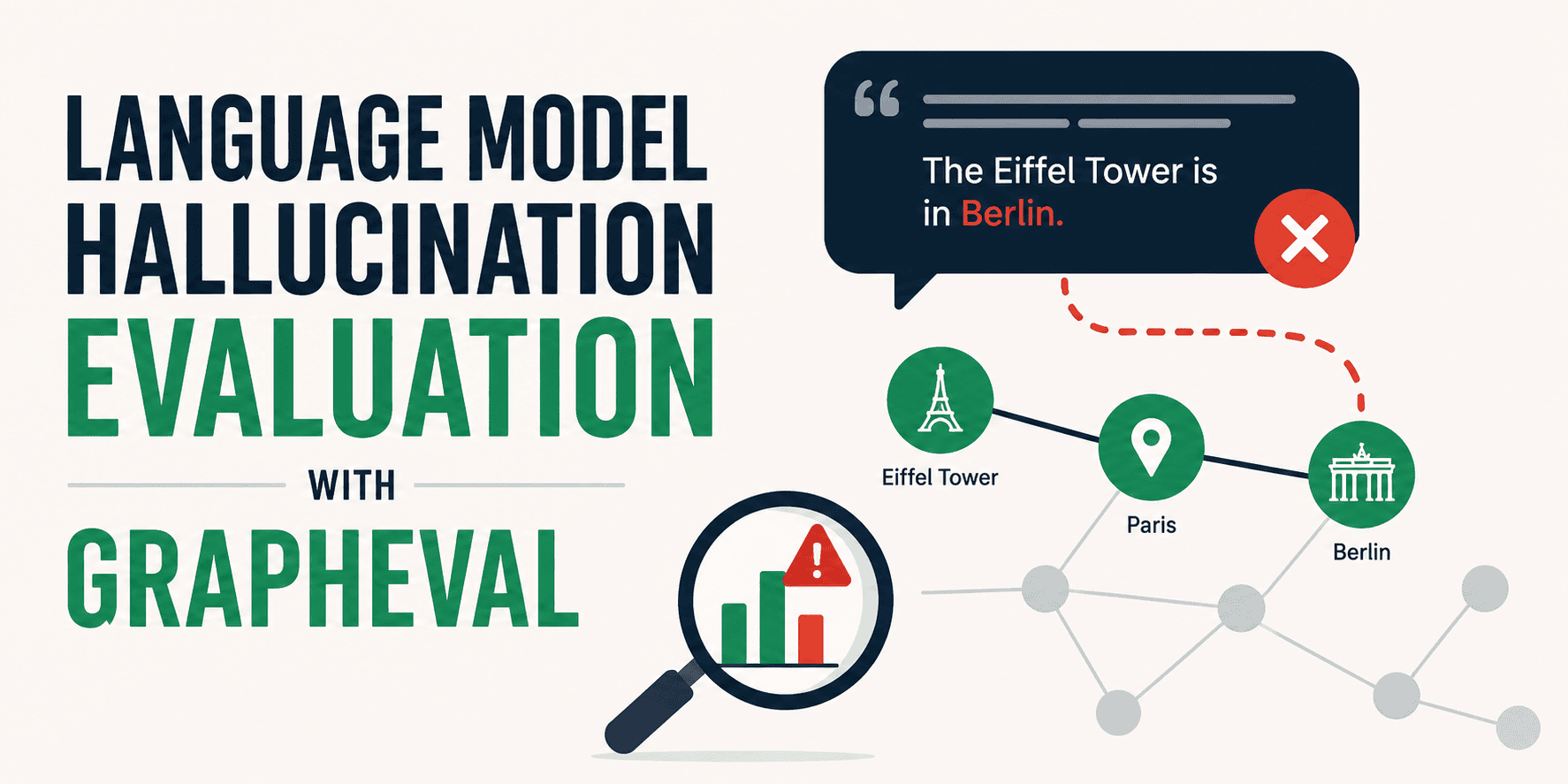
Knowledge Graph Extraction from LLM Output: The first stage involves transforming the unstructured text generated by an LLM into a structured representation known as a knowledge graph (KG). A knowledge graph represents information as a network of entities (nodes) and their relationships (edges), typically in the form of subject-predicate-object triples (e.g., "GraphEval – is – evaluation framework"). This conversion is typically performed by an auxiliary LLM specifically trained or prompted for information extraction, or a dedicated natural language processing (NLP) pipeline. The rationale behind this step is to break down complex, free-form text into atomic, verifiable facts. By structuring the information, GraphEval creates a canonical representation that is easier to compare against a ground truth.
-
Natural Language Inference (NLI) Based Hallucination Detection: Once the LLM’s output is distilled into a set of knowledge graph triples, the second stage commences. Each extracted triple is treated as a "hypothesis" and is rigorously compared against a "ground-truth context." This ground-truth context represents the factual basis against which the LLM’s response should be evaluated. In a real-world RAG system, this context would typically be derived from the retrieved documents that were provided to the LLM. The comparison is facilitated by a Natural Language Inference (NLI) model. NLI models are trained to determine the logical relationship between two text segments, typically classifying the relationship as ‘entailment’ (the hypothesis is true given the premise), ‘contradiction’ (the hypothesis is false given the premise), or ‘neutral’ (the premise neither supports nor contradicts the hypothesis). In the context of GraphEval, if the NLI model determines that the ground-truth context does not entail a particular triple (i.e., it predicts ‘neutral’ or ‘contradiction’), that specific triple is flagged as a hallucination. This granular evaluation at the triple level allows GraphEval to precisely localize where the LLM deviated from the facts.
Supporting Data and Industry Context: The Synergy of KGs and NLI
The integration of knowledge graphs and Natural Language Inference models is a powerful combination that underscores the innovation of GraphEval. Knowledge graphs have long been recognized for their ability to store and represent factual information in a structured, machine-readable format. Their use has surged in recent years as enterprises seek to build robust internal knowledge bases and enhance the explainability of AI systems. KGs provide a "single source of truth" that can be queried and reasoned upon, making them ideal candidates for grounding LLM outputs.
The NLI component, on the other hand, represents a significant advancement in natural language understanding. Models like Google’s BERT, Facebook AI’s RoBERTa, and particularly Microsoft’s DeBERTa, have pushed the boundaries of NLI performance. DeBERTa-v3-small, as utilized in the GraphEval demonstration, is an open-source model available through platforms like Hugging Face. These models are trained on massive datasets of text pairs labeled with their logical relationships, enabling them to discern subtle semantic nuances. The ability of NLI models to robustly determine entailment or contradiction between a piece of text (the ground truth) and a factual statement (the extracted triple) is what makes GraphEval’s diagnostic capabilities so effective.
This approach is particularly relevant in the context of Retrieval-Augmented Generation (RAG) systems. RAG models aim to mitigate hallucinations by retrieving relevant documents from a vast corpus and using them as context for the LLM’s generation. GraphEval acts as a crucial post-processing or evaluation layer for RAG systems. While RAG ensures the LLM has access to factual information, GraphEval verifies that the LLM actually uses that information correctly and doesn’t introduce new, ungrounded facts into its output. This synergy creates a more reliable and auditable AI pipeline, essential for applications where factual accuracy is paramount.
A Practical Demonstration: Unpacking the Code Simulation
To demystify GraphEval’s methodology, the authors provided a lightweight, simulation-based code example. This practical approach illustrates the conceptual building blocks without the heavy computational burden associated with real-world LLM deployments.
The simulation begins by defining a source_context, which serves as the ground-truth knowledge base. In a production environment, this source_context would dynamically stem from a vector database within a RAG system, providing the factual backdrop against which an LLM’s output is evaluated. For simplicity, the example directly hardcodes a brief factual description of GraphEval.
Next, a hypothetical llm_output is introduced, representing the response generated by an LLM to a user prompt. Crucially, this llm_output is intentionally crafted to contain a hallucination: "It requires a highly expensive, enterprise-level server farm to operate." This fabricated detail is key to demonstrating GraphEval’s detection capabilities.
To initiate the first stage of evaluation, a KG_EXTRACTION_PROMPT is defined. In a full-scale implementation, this prompt would be fed to an auxiliary LLM (e.g., a smaller, specialized model like Mistral-7B) to extract knowledge graph triples from the llm_output. For the simulation, this step is bypassed, and extracted_triples are manually provided. These triples include the truthful statements about GraphEval and, critically, the hallucinated one: ("GraphEval", "requires", "expensive enterprise server farm"). This simulation allows the demonstration to focus on the core evaluation logic without the overhead of running multiple large models.
The "real action" begins with the NLI process. The code leverages the transformers library to load cross-encoder/nli-deberta-v3-small, an open-source NLI model from Hugging Face. This model is responsible for comparing each extracted triple (hypothesis) against the source_context (premise).
The evaluate_triple function encapsulates the NLI logic. It constructs a hypothesis string from the subject-relation-object triple and then feeds the source_context and the hypothesis to the nli_evaluator. The model outputs a label (entailment, neutral, or contradiction) and a score. GraphEval’s core principle dictates that any label other than ‘entailment’ signals a hallucination.
The execution of the evaluation pipeline clearly demonstrates GraphEval’s effectiveness. For the triples ('GraphEval', 'is', 'evaluation framework') and ('GraphEval', 'uses', 'Knowledge Graphs'), the NLI model correctly identifies ‘entailment’, labeling them as "GROUNDED." However, for the intentionally inserted hallucination ('GraphEval', 'requires', 'expensive enterprise server farm'), the NLI model outputs ‘neutral’, correctly flagging it as a "HALLUCINATION." This precise identification illustrates the power of GraphEval’s diagnostic capabilities.
Finally, the demonstration includes a compelling visualization using networkx and matplotlib. This visual representation of the knowledge graph clearly differentiates between grounded facts (green edges) and hallucinations (red edges), making the evaluation results intuitive and immediately actionable. This visual touch further enhances the explainability aspect, allowing users and developers to quickly identify and understand the problematic parts of an LLM’s response.
Implications and Broader Impact: Towards More Trustworthy AI
GraphEval represents a significant methodological leap forward in the quest for more reliable and trustworthy AI. Its implications extend across several critical domains:
- Enhanced Trust and Reliability: By providing a clear, explainable mechanism for detecting hallucinations, GraphEval can significantly bolster confidence in LLMs. For industries such as finance, healthcare, and legal services, where factual accuracy is non-negotiable, such diagnostic tools are indispensable. The ability to audit an LLM’s output for factual integrity will accelerate the adoption of these powerful models in sensitive applications.
- Improved LLM Development and Fine-tuning: Developers and researchers can leverage GraphEval’s granular feedback to iteratively improve LLMs. Knowing precisely which statements are hallucinated allows for targeted fine-tuning, better data curation, and the development of more robust guardrails. This shifts the paradigm from merely identifying that an LLM has hallucinated to understanding how and where the hallucination occurred, paving the way for more effective mitigation strategies.
- Enterprise Adoption and Governance: For enterprises deploying LLMs, compliance and governance are paramount. GraphEval’s explainable output provides a crucial layer of accountability, enabling organizations to demonstrate that their AI systems are operating within defined factual boundaries. This transparency is vital for regulatory adherence and risk management.
- Advancing AI Safety and Explainability: GraphEval contributes directly to the broader field of AI safety and explainability. It moves beyond "black box" evaluation, offering a structured, interpretable method for assessing a critical aspect of AI performance. This aligns with the growing demand for AI systems that are not only powerful but also understandable, controllable, and transparent.
- Future of AI Evaluation: GraphEval sets a precedent for diagnostic evaluation frameworks that move beyond aggregate scores. It suggests a future where AI evaluation is not just about performance metrics but also about precise, actionable insights into model behavior, allowing for continuous improvement and greater control over complex generative models.
While GraphEval presents a promising solution, its real-world implementation may face challenges, such as the computational cost of extracting knowledge graphs from very long or complex LLM outputs, and the need for high-quality, comprehensive ground-truth contexts. However, the foundational principles laid out by GraphEval offer a robust pathway for addressing these issues through ongoing research and engineering efforts, including optimizing KG extraction models and developing more efficient NLI pipelines.
In closing, GraphEval stands as a testament to the continuous innovation in AI research. By integrating the structural power of knowledge graphs with the semantic capabilities of Natural Language Inference models, Amazon researchers have provided a powerful, explainable methodology to confront one of the most persistent challenges in large language models: hallucinations. This framework not only helps detect and localize factual inconsistencies but also provides critical diagnostic feedback, promising a future where LLMs are not only intelligent but also reliably truthful.