In a landmark study published in the journal Nature, a multidisciplinary team of engineers at Stanford University has unveiled a novel soft material capable of mimicking the sophisticated camouflage abilities of cephalopods, such as octopuses and cuttlefish. The breakthrough centers on a flexible, water-responsive polymer film that can dynamically alter its surface topography and visual properties at the micron scale—dimensions smaller than the width of a human hair. By manipulating the material’s physical structure and light-reflective qualities in real-time, the researchers have bridged a long-standing gap between biological adaptability and synthetic material science, offering a glimpse into the future of "smart" surfaces.
The ability of cephalopods to blend into their environment is one of nature’s most complex biological feats. These creatures utilize a combination of pigment-filled sacs called chromatophores and muscular structures known as papillae to change both their skin color and texture in milliseconds. While human-made materials have previously achieved either color or texture shifts, the Stanford team is the first to demonstrate a system that integrates both capabilities into a single, soft, and scalable platform. This innovation holds profound implications for camouflage technology, soft robotics, wearable electronics, and the burgeoning field of nanophotonics.
The Science of Dynamic Topography and Color Control
At the heart of the Stanford discovery is a specialized polymer film that responds to environmental stimuli—specifically water and alcohol. The researchers utilized electron-beam lithography, a high-precision manufacturing technique typically reserved for creating the intricate circuits on semiconductor chips. By exposing a water-responsive polymer to a focused beam of electrons, the team was able to "program" specific regions of the film.
The electron beam modifies the chemical structure of the polymer, altering its cross-linking density. In areas where the beam is most intense, the material becomes more or less absorbent compared to the surrounding regions. When the film is exposed to water, these programmed areas swell at different rates and to different heights. This differential swelling transforms a perfectly flat, two-dimensional surface into a complex, three-dimensional landscape.
"Textures are crucial to the way we experience objects, both in how they look and how they feel," explained Siddharth Doshi, a doctoral student in materials science and engineering at Stanford and the study’s lead author. "These animals can physically change their bodies at close to the micron scale, and now we can dynamically control the topography of a material—and the visual properties linked to it—at this same scale."
The precision afforded by this method allows for the creation of incredibly detailed structures. To demonstrate this, the team engineered a microscopic replica of Yosemite National Park’s El Capitan. When dry, the material is a flat, featureless film. However, upon the introduction of moisture, the iconic granite monolith rises from the surface in high relief. The process is entirely reversible; by applying an alcohol-based solvent, the water is drawn out, and the material returns to its original flat state.
A Serendipitous Discovery in the Lab
The path to this breakthrough was not entirely linear. Like many significant scientific advances, the key insight arrived through a stroke of luck during routine laboratory work. While conducting an earlier experiment involving nanostructures, Doshi was using a scanning electron microscope (SEM) to examine a polymer film. Rather than discarding the samples after they had been bombarded with electrons, he decided to reuse them for a different set of tests.
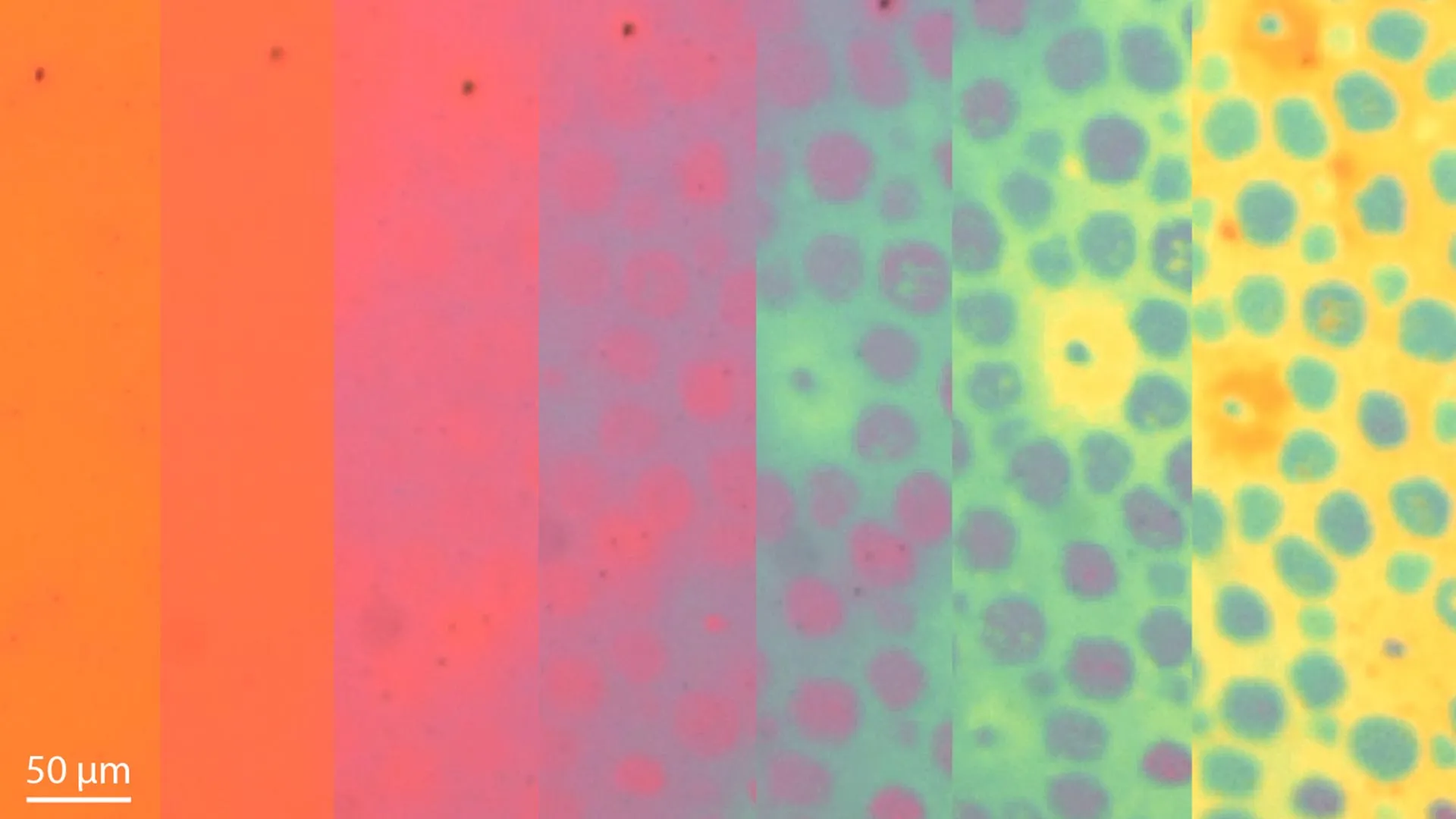
During subsequent observations, Doshi noticed that the areas previously exposed to the SEM’s electron beam behaved strangely. When the film was hydrated, the "pre-exposed" sections displayed distinct topographical shifts and unexpected color changes. This accidental observation revealed that the electron beam was not merely a tool for observation but a powerful instrument for modifying the material’s internal "memory" of how it should swell.
"We realized that we could use these electron beams to control topography at very fine scales," Doshi said. "It was definitely serendipitous." This realization allowed the team to move beyond static patterns toward a truly dynamic, programmable material.
Manipulating Light: The Role of Nanophotonics
The material’s ability to change color is rooted in the physics of light interference rather than chemical dyes. To achieve this, the researchers incorporated thin metal layers on both sides of the polymer film, creating what is known in physics as a Fabry-Pérot resonator. These resonators are optical cavities that selectively reflect specific wavelengths of light based on the distance between the two metallic layers.
As the polymer film swells with water or contracts with solvent, the thickness of the cavity changes. This shift in thickness causes the material to reflect different colors of the visible spectrum. A thin film might appear blue, while a more swollen, thicker film might shift toward red. By controlling the degree of swelling across different zones of the film, the researchers can generate vibrant, multi-colored patterns that are far more dynamic than traditional liquid crystal displays (LCDs).
Furthermore, the team can manipulate the material’s surface finish. By creating microscopic "bumps" or "pits" through e-beam programming, they can switch the material’s appearance from a glossy, reflective surface to a matte, diffused finish. This dual control over color and texture allows the material to replicate the visual complexity of natural environments with unprecedented accuracy.
Implications for Camouflage, Robotics, and Beyond
The potential applications for this "chameleon" material are vast. In the realm of defense and security, the material could be used to create next-generation camouflage systems. Unlike current passive camouflage, which is optimized for a single environment, a suit or vehicle coating made from this polymer could adapt its appearance in real-time to match forests, deserts, or urban settings.
The integration of artificial intelligence is the next step in this evolution. The Stanford team envisions a system where computer vision and neural networks analyze the background environment and automatically adjust the material’s hydration levels to match the surroundings. "We want to be able to control this with an AI-based system that could compare the skin and its background, then automatically modulate it to match in real-time, without human intervention," Doshi noted.
In soft robotics, the material offers a way to regulate friction and grip. By changing its surface texture on command, a small robot could transition from a smooth state—allowing it to slide through tight spaces—to a rough, textured state that provides the traction needed to climb vertical surfaces.
Beyond mechanical and visual uses, the material shows promise in bioengineering. Because the topography can be controlled at the micron scale, researchers can use it to influence the behavior of biological cells, which are sensitive to the physical "feel" of the surfaces they grow on. This could lead to new methods for tissue engineering or the development of medical implants that interact more naturally with human tissue.
Technical Data and Collaborative Support
The study, titled "Dynamic Control of Soft Material Topography and Color," represents a significant collaborative effort across Stanford’s engineering and physics departments. Senior authors Nicholas Melosh and Mark Brongersma emphasized the unique nature of the material’s softness and scalability.
"There’s just no other system that can be this soft and swellable, and that you can pattern at the nanoscale," said Melosh, a professor of materials science and engineering. Brongersma added that the introduction of soft materials into the world of optics "opens up an entirely new toolbox to manipulate how things look."
The research involved a diverse team of experts, including Alberto Salleo, a specialist in photon science; Associate Professor Polly Fordyce; and several postdoctoral researchers and graduate students. The project was supported by a wide array of prestigious institutions and funding bodies, reflecting its interdisciplinary importance. Contributors included the Stanford Graduate Fellowship, the Meta PhD Fellowship, the Wu Tsai Human Performance Alliance, the German National Academy of Sciences Leopoldina, and the U.S. Department of Energy.
Conclusion: A New Frontier in Material Science
The development of this water-responsive, programmable polymer marks a transition from static materials to "living" surfaces that can interact with their environment in sophisticated ways. While currently a laboratory-scale proof of concept, the principles established by the Stanford team provide a roadmap for commercial-scale applications.
As the team continues to refine the automation process and explore more durable polymer compositions, the era of truly adaptive materials draws closer. Whether it is a wearable device that changes color to match an outfit, a robot that can change its grip on the fly, or a medical device that guides cell growth, the ability to control matter at the micron scale is set to redefine the boundaries of human engineering.
"Small changes in the properties of soft materials over micron distances are finally possible," Melosh concluded. "I think there are a lot of exciting things coming up."